

Omnilingual ASR
AIOpen SourceFreeOpen-source multilingual speech recognition system that natively transcribes 1,600+ languages with low-resource adaptability.
Omnilingual ASR
Open-source multilingual speech recognition system that natively transcribes 1,600+ languages with low-resource adaptability.
About Omnilingual ASR
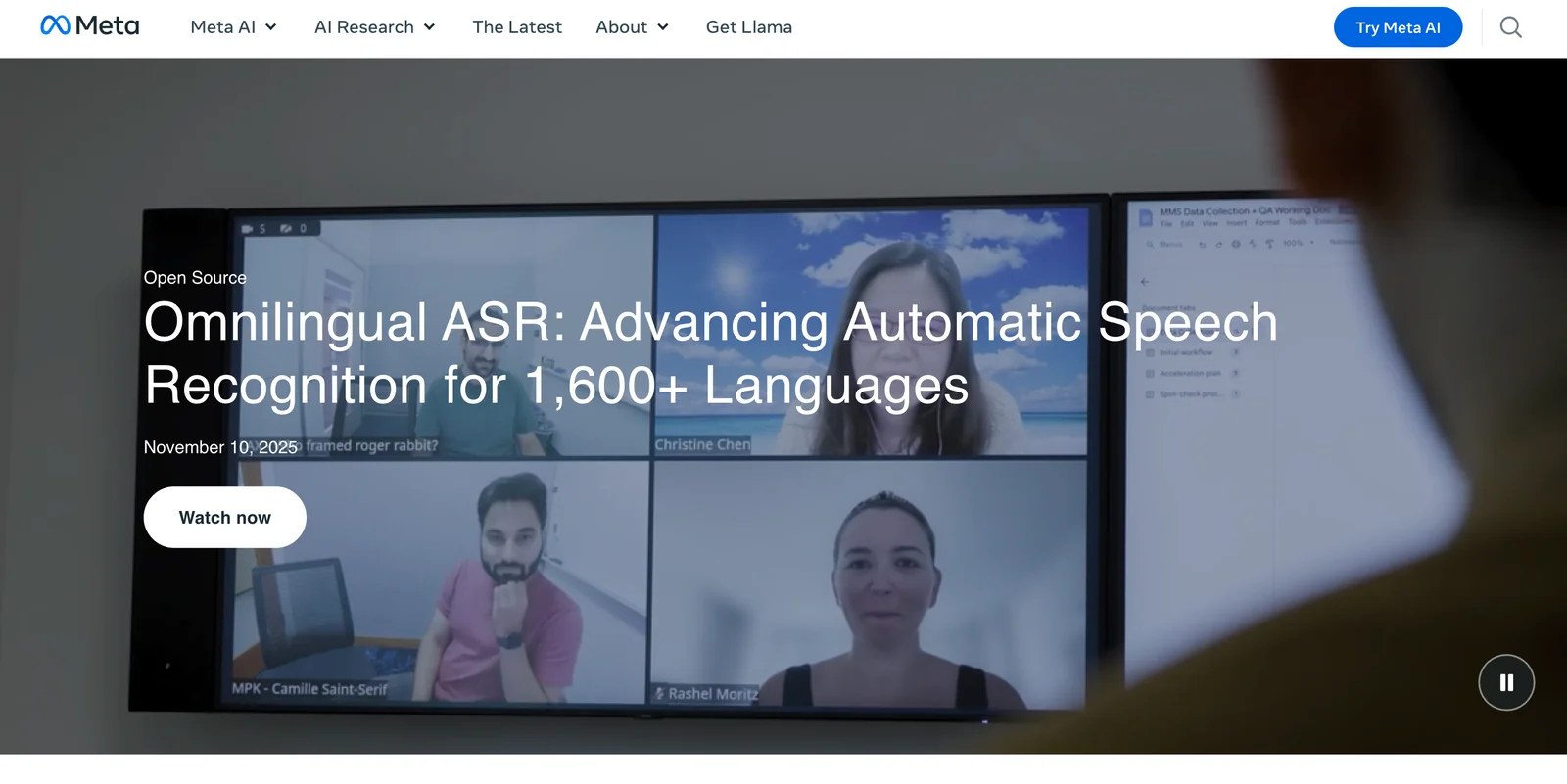
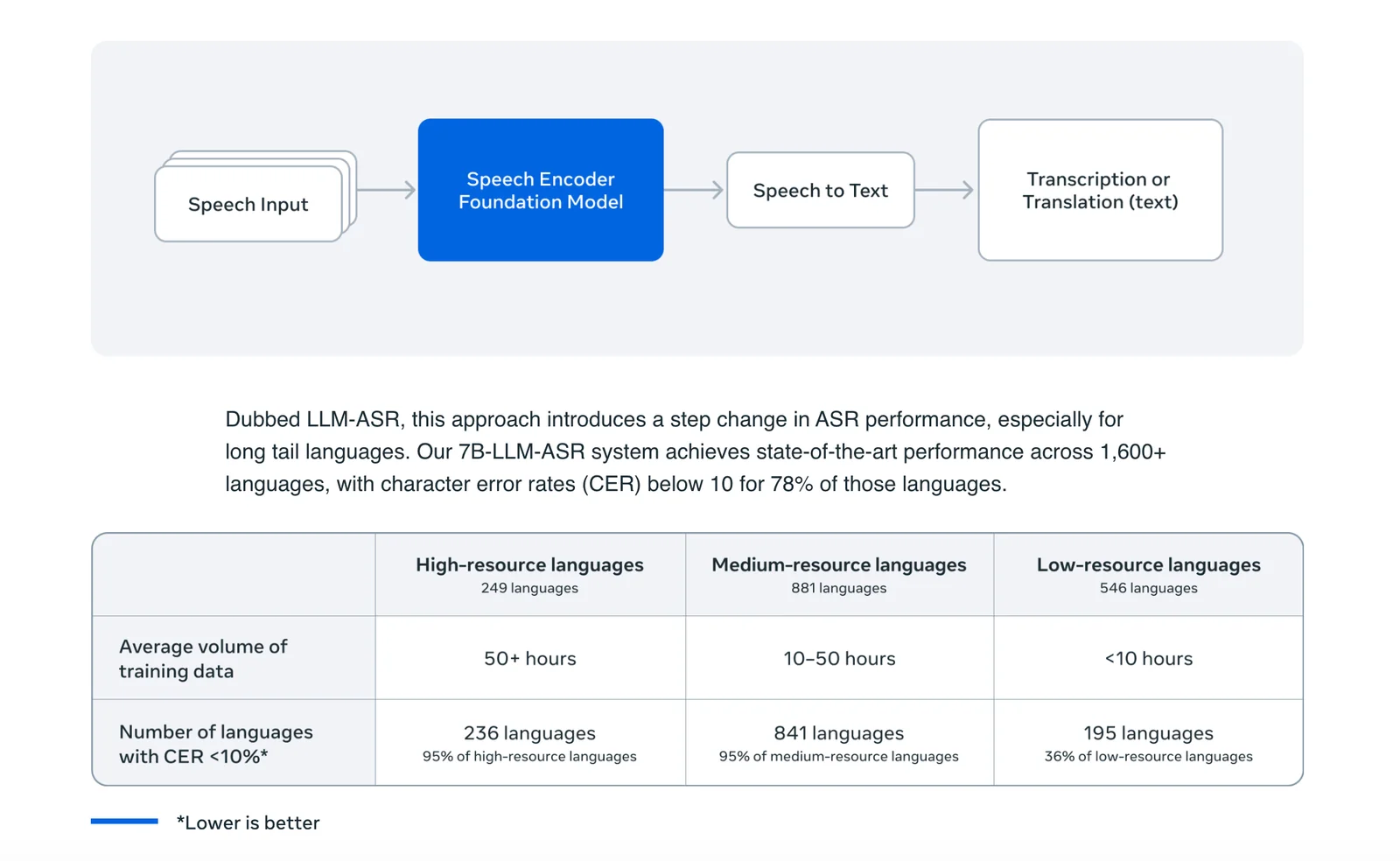
Omnilingual ASR is an open-source automatic speech recognition suite from Meta that provides native transcription for over 1,600 languages, including hundreds previously unsupported by ASR technology. It combines a family of flexible speech models (including a 7B multilingual audio representation model) with a massive speech corpus to enable scalable zero-shot learning and rapid extension to new languages using only a few paired examples. The project includes model weights, training and evaluation code, and dataset releases (via GitHub and Hugging Face), plus demo spaces for evaluation and community use. Its primary value is making high-quality speech technology accessible and extensible for low-resource and underserved language communities.
Screenshots
Key Features
Use Cases



Frequently asked questions about Omnilingual ASR
What are the pricing options for Omnilingual ASR?
Omnilingual ASR is entirely free to use, as it is an open-source project. Users can access model weights, training code, and datasets at no cost, following the project's licensing terms. This makes it an attractive option for developers and researchers interested in automatic speech recognition technology.
Key Points
- Omnilingual ASR is open-source and free.
- Users can access essential resources like model weights and training code.
- Licensing terms dictate the usage and distribution of the software.
Detailed Explanation
Omnilingual ASR stands out in the field of automatic speech recognition (ASR) due to its open-source nature. This means that not only is the software free to use, but users also have the opportunity to modify and improve the code according to their needs.
Key Resources Available
- Model Weights: These are pre-trained models that can be used directly for speech recognition tasks, making it easier for developers to implement ASR without starting from scratch.
- Training Code: The project provides the necessary code to train models on custom datasets, allowing for personalized speech recognition solutions tailored to specific languages or dialects.
- Datasets: Users can access various datasets that are essential for training and testing ASR models. These datasets include multilingual audio samples, contributing to the comprehensive capabilities of the Omnilingual ASR project.
Use Cases
Developers can leverage Omnilingual ASR in various applications, such as:
- Voice Assistants: Integrating ASR technology into smart home devices.
- Transcription Services: Creating tools for automatic transcription of meetings and lectures.
- Language Learning Apps: Enhancing language education platforms with accurate speech recognition.
Best Practices / Tips
- Stay Updated: Regularly check for updates in the project’s repository to benefit from new features and improvements.
- Engage with the Community: Participate in forums and user groups to share experiences and gain insights from other users.
- Test Extensively: Conduct thorough testing with diverse datasets to ensure the model performs well across different accents and languages.
Additional Resources
By utilizing the resources provided by Omnilingual ASR, users can create powerful speech recognition applications without incurring any costs, making it an ideal choice for both hobbyists and professionals in the AI field.
How does Omnilingual ASR support low-resource languages?
Omnilingual ASR utilizes scalable zero-shot learning to effectively support low-resource languages. This innovative technology enables the system to recognize and process new languages with minimal examples, making it particularly beneficial for languages that lack extensive labeled datasets, thereby expanding accessibility and usability in diverse linguistic contexts.
Key Points
- Scalable Zero-Shot Learning: Enables language recognition with few samples.
- Support for Low-Resource Languages: Ideal for languages lacking large datasets.
- Increased Accessibility: Broadens the reach of speech recognition technology.
Detailed Explanation
Omnilingual ASR (Automatic Speech Recognition) is designed to tackle the challenges faced by low-resource languages, which often do not have enough audio data or labeled examples for traditional machine learning models to learn effectively. The core of this technology lies in its scalable zero-shot learning capabilities.
How It Works
-
Zero-Shot Learning: This approach allows the ASR system to generalize knowledge from languages it has been trained on to recognize and understand new languages. For instance, if the system is trained on English and Spanish, it can apply this knowledge to recognize similar phonetic structures in a completely different language, such as Swahili, even with just a few audio samples.
-
Minimal Data Requirement: Unlike conventional ASR systems that often require thousands of hours of transcribed audio, Omnilingual ASR can learn from just a handful of recordings. This is particularly advantageous for languages that may only have limited digital resources available.
-
Real-World Applications: This technology can be applied in various scenarios, such as:
- Education: Facilitating language learning apps for underrepresented languages.
- Healthcare: Improving patient-provider communication in multilingual settings.
- Customer Service: Enabling businesses to assist non-native speakers more effectively.
Best Practices / Tips
- Utilize Diverse Data: When implementing Omnilingual ASR, use a variety of accents and dialects within the low-resource language to enhance understanding.
- Continuous Learning: Implement feedback loops where users can correct misrecognized speech, further improving the model.
- Combine with Other Technologies: Integrate with translation services to provide comprehensive language support.
Additional Resources
How can I get started with using Omnilingual ASR?
To get started with Omnilingual ASR, access the source code and models on GitHub. Follow the installation instructions in the documentation to set up the models on your local machine or a cloud platform for fine-tuning and running the speech recognition system effectively.
Key Points
- Access the source code and models on GitHub.
- Follow the setup instructions in the official documentation.
- Choose between local and cloud-based installation for flexibility.
Detailed Explanation
Omnilingual ASR (Automatic Speech Recognition) is an advanced tool designed to transcribe speech in multiple languages. To begin using it, follow these steps:
-
Download the Source Code: Visit the Omnilingual ASR GitHub repository to download the latest version of the source code and pre-trained models.
-
Install Dependencies: Ensure you have the necessary software dependencies installed. This may include Python, NumPy, TensorFlow, and any other libraries specified in the documentation.
-
Follow Setup Instructions: The official documentation guides you through configuring your environment. Pay attention to details regarding environment variables and configuration files.
-
Run the Model: Once you have set everything up, you can run the model locally. You can also choose to deploy it in a cloud environment for better scalability and resource management.
-
Fine-Tune the Model: After running the base model, you can fine-tune it with your own datasets by following the training instructions in the documentation. This step is crucial for improving accuracy based on your specific use case.
Best Practices / Tips
- Use a Virtual Environment: To avoid dependency conflicts, create a virtual environment for your project using tools like
venvorconda. - Test with Sample Data: Before diving into fine-tuning, test the ASR with sample audio files to understand its capabilities and limitations.
- Monitor Performance: After fine-tuning, continuously monitor the system's performance and make adjustments as necessary.
- Engage with the Community: Participate in forums or GitHub discussions to share experiences and learn from others using Omnilingual ASR.
Additional Resources
What technical requirements are needed to run Omnilingual ASR?
Omnilingual ASR requires a machine with a minimum of 16 GB RAM, a multi-core CPU, and a compatible GPU for efficient model training and inference. Users can operate it locally or leverage cloud platforms, depending on the model size and specific application needs.
Key Points
- Minimum system requirements include 16 GB RAM and a multi-core CPU.
- A compatible GPU is recommended for optimal performance.
- Local and cloud deployment options are available based on user needs.
Detailed Explanation
Omnilingual ASR (Automatic Speech Recognition) is designed to cater to various languages and dialects, making it a versatile tool for developers and organizations. To successfully run Omnilingual ASR, consider the following technical requirements:
-
Hardware Specifications:
- RAM: At least 16 GB of RAM is necessary to handle large models and datasets efficiently. More RAM may be required for complex applications or larger datasets.
- CPU: A multi-core processor (e.g., Intel i7 or AMD Ryzen 7) is recommended for faster processing speeds during model training and inference.
- GPU: For optimal performance, especially during training of deep learning models, a dedicated GPU such as NVIDIA GTX 1060 or higher is essential. This significantly speeds up computation times.
-
Software Requirements:
- Operating Systems: Omnilingual ASR is compatible with various operating systems, including Windows, macOS, and Linux. Ensure that your OS supports the necessary libraries and frameworks.
- Dependencies: Install required libraries such as TensorFlow or PyTorch, which are essential for running the models. Make sure these libraries are compatible with your operating system and hardware.
-
Deployment Options:
- Local Deployment: For organizations with adequate hardware, running Omnilingual ASR locally allows for greater control over data privacy and security.
- Cloud Services: For scalability, consider cloud platforms like AWS, Google Cloud, or Azure. These platforms offer flexible computing resources that can be adjusted based on your application’s needs.
Best Practices / Tips
- Benchmarking: Before fully deploying Omnilingual ASR, conduct benchmarking tests to ensure that your hardware meets the model’s demands.
- Cloud Scalability: If using cloud services, opt for instances with powerful GPUs, and monitor usage to manage costs effectively.
- Regular Updates: Keep your software and dependencies updated to benefit from performance improvements and security patches.
Additional Resources
By understanding these technical requirements and best practices, users can effectively implement Omnilingual ASR for their speech recognition needs.
How does Omnilingual ASR compare to other speech recognition tools?
Omnilingual ASR excels in speech recognition by supporting over 1,600 languages and offering an open-source framework. This allows users to customize and optimize models for specific needs, unlike proprietary systems which often limit language accessibility and adaptability.
Key Points
- Extensive Language Support: Over 1,600 languages available.
- Open-Source Flexibility: Users can modify and enhance models easily.
- Adaptability: Tailor the system to specific applications or industries.
Detailed Explanation
Omnilingual ASR is a cutting-edge automatic speech recognition system that surpasses many competitors by supporting an extensive array of languages. This is particularly beneficial in multilingual environments, where effective communication is essential. For instance, businesses operating in diverse regions can use Omnilingual ASR to transcribe meetings or customer interactions in real time, catering to a global audience.
One of the standout features of Omnilingual ASR is its open-source nature. Unlike proprietary speech recognition tools, which typically come with rigid frameworks and limited language options, Omnilingual ASR allows developers to adapt the models to their specific requirements. For example, a tech startup might modify the algorithms to recognize industry-specific jargon, ensuring higher accuracy in transcriptions.
Moreover, the versatility of Omnilingual ASR makes it suitable for various applications, including:
- Customer Service: Enhance customer interactions by accurately transcribing calls in multiple languages.
- Education: Support language learning and accessibility by providing transcriptions in classrooms.
- Healthcare: Facilitate patient communication by allowing practitioners to transcribe notes in the patient's preferred language.
Best Practices / Tips
- Model Training: Regularly retrain the ASR models with new data to improve accuracy over time.
- User Feedback: Incorporate user feedback to identify common errors and areas for improvement.
- Integration: Ensure seamless integration with existing software systems for streamlined workflows.
Additional Resources
- Omnilingual ASR GitHub Repository - Explore the source code and documentation.
- Speech Recognition Technologies Overview - Learn more about various speech recognition tools and their features.
- Best Practices for Speech Recognition - Discover tips for optimizing speech recognition systems.
Explore more AI Ai Models tools
Browse all Ai Models tools →Browse by use case: Voice & Audio
Compare Omnilingual ASR: vs Mouse-1 · vs Milliseconds.ai · vs SWE-2 · vs Desert Ant Labs