

ReWeaver AI DriftDetector
AIFree scanner that gives any GitHub repo a Production Drift Ratio across nine production-readiness dimensions, scored commit by commit.
ReWeaver AI DriftDetector
Free scanner that gives any GitHub repo a Production Drift Ratio across nine production-readiness dimensions, scored commit by commit.
About ReWeaver AI DriftDetector
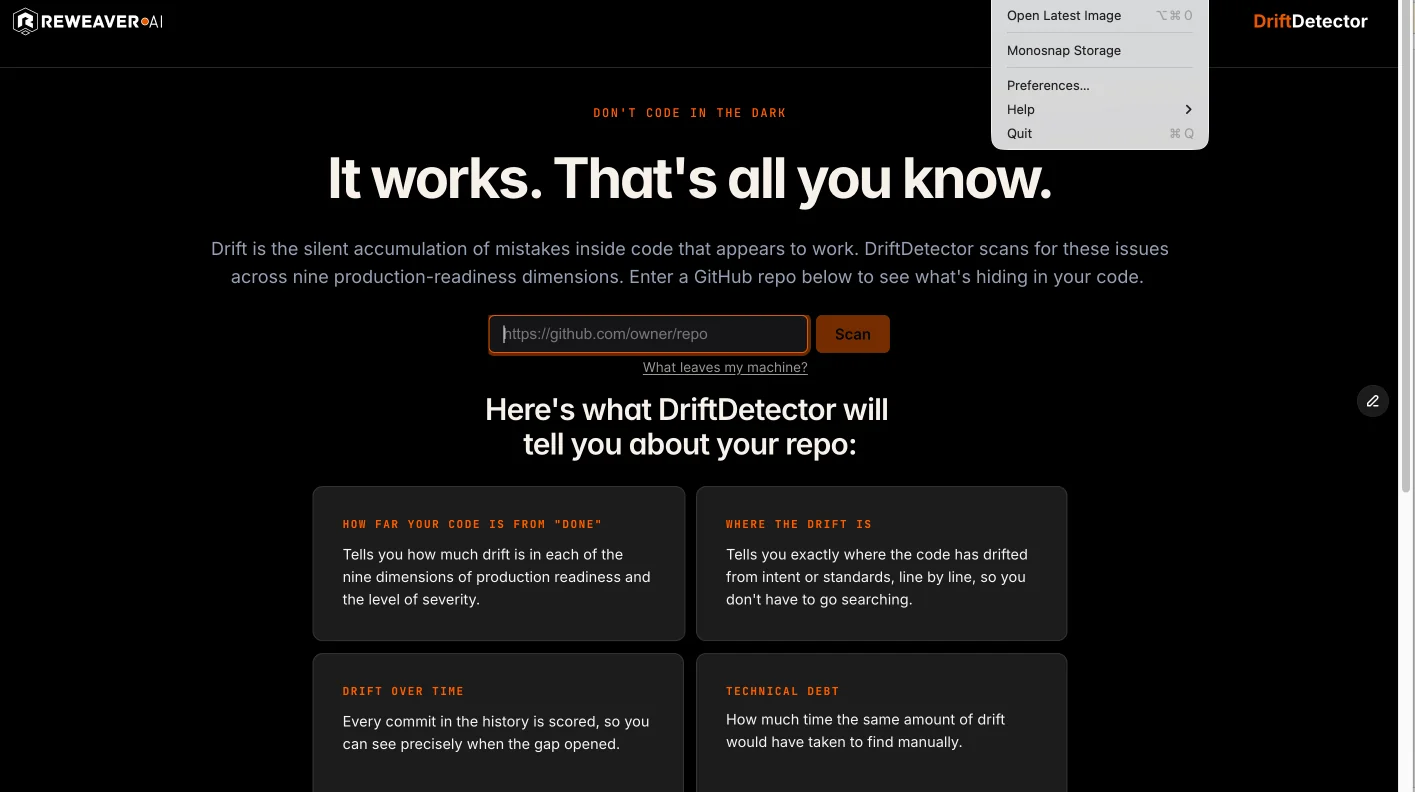
ReWeaver AI DriftDetector measures how far a codebase has drifted from being production-ready and expresses it as a single number, the Production Drift Ratio (PDR). Drift is the silent accumulation of mistakes inside code that compiles, renders and passes review — the missing empty state, the absent focus return, the test that protects nothing — which a diff cannot show you because you cannot see what is not there. Rather than pointing a second LLM at a diff to guess what was missed, DriftDetector runs a deterministic rule engine over the repository across nine dimensions: design consistency, accessibility, user experience, reliability, maintainability, architecture, testability, security and privacy, and AI code governance. It reports how many issues exist and at what severity in each dimension, points to the exact lines where code diverged from intent or standards, scores every commit in the history so you can see when the gap opened, and estimates the technical debt as the time the same findings would have taken to locate manually. Scanning is privacy-preserving: repository code streams from GitHub straight into scanner memory without passing through the browser or touching disk, the charting clone fetches commit metadata only, and the scan aborts rather than continue if a file blob ever reaches disk. Nothing from a private scan is retained — no cached clone, score, name or report — and the only stored item is an encrypted GitHub token you can revoke at any time. DriftDetector is the free entry point to ReWeaver, a design-to-code reconciliation layer that runs the same versioned rule catalog inside VS Code, Figma and GitHub pull requests.
Screenshots
Key Features
Use Cases



Frequently asked questions about ReWeaver AI DriftDetector
What is ReWeaver AI DriftDetector?
Free scanner that gives any GitHub repo a Production Drift Ratio across nine production-readiness dimensions, scored commit by commit.
How does ReWeaver AI DriftDetector work?
ReWeaver AI DriftDetector works by combining Production Drift Ratio: A single score for how far a repository sits from production-ready, computed as drift frequency weighted by severity and estimated fix time, normalized per component., Nine-Dimension Rule Catalog: Findings are grouped across design consistency, accessibility, user experience, reliability, maintainability, architecture, testability, security and privacy, and AI code governance, each with its own severity band., Line-Level Findings: Reports exactly where code drifted from intent or standards rather than handing back a summary you have to go searching through., Commit-by-Commit Drift History: Every commit in the repository history is scored so you can pinpoint the moment the gap opened instead of estimating it., Technical Debt Estimate: Converts the findings into the time the same amount of drift would have taken a human to locate manually, giving the score a cost. to help users with Auditing AI-Generated Code: Score a repository that has absorbed heavy Copilot, Cursor or Claude Code output to find the omissions that compile cleanly but are not production-ready., Evaluating an Unfamiliar Repo: Paste a public GitHub URL to get a readiness score and severity breakdown before adopting a dependency or joining a project., Pinpointing Regression Onset: Use the per-commit history chart to identify the release or sprint where quality started diverging., Quantifying Technical Debt: Turn a backlog argument into a number by showing how much manual review time the accumulated drift represents., Accessibility and Security Sweeps: Surface missing ARIA roles, keyboard patterns and reproduced frontend vulnerabilities that pass functional review..
What are the main features of ReWeaver AI DriftDetector?
Key features include Production Drift Ratio: A single score for how far a repository sits from production-ready, computed as drift frequency weighted by severity and estimated fix time, normalized per component., Nine-Dimension Rule Catalog: Findings are grouped across design consistency, accessibility, user experience, reliability, maintainability, architecture, testability, security and privacy, and AI code governance, each with its own severity band., Line-Level Findings: Reports exactly where code drifted from intent or standards rather than handing back a summary you have to go searching through., Commit-by-Commit Drift History: Every commit in the repository history is scored so you can pinpoint the moment the gap opened instead of estimating it., Technical Debt Estimate: Converts the findings into the time the same amount of drift would have taken a human to locate manually, giving the score a cost..
Who is ReWeaver AI DriftDetector for?
ReWeaver AI DriftDetector is useful for anyone interested in Auditing AI-Generated Code: Score a repository that has absorbed heavy Copilot, Cursor or Claude Code output to find the omissions that compile cleanly but are not production-ready., Evaluating an Unfamiliar Repo: Paste a public GitHub URL to get a readiness score and severity breakdown before adopting a dependency or joining a project., Pinpointing Regression Onset: Use the per-commit history chart to identify the release or sprint where quality started diverging., Quantifying Technical Debt: Turn a backlog argument into a number by showing how much manual review time the accumulated drift represents., Accessibility and Security Sweeps: Surface missing ARIA roles, keyboard patterns and reproduced frontend vulnerabilities that pass functional review..
How much does ReWeaver AI DriftDetector cost?
ReWeaver AI DriftDetector is free to use.
How do I get started with ReWeaver AI DriftDetector?
Visit https://drift.reweaver.ai/ to sign up and explore ReWeaver AI DriftDetector.
Explore more AI Ai Tools tools
Browse all Ai Tools tools →Compare ReWeaver AI DriftDetector: vs Screenify Studio · vs Agnost AI · vs Assistly · vs Memoria