

LlamaIndex
AIOpen SourceFreeOpen-source framework for building LLM-powered knowledge assistants and retrieval-augmented systems over your data.
LlamaIndex
Open-source framework for building LLM-powered knowledge assistants and retrieval-augmented systems over your data.
About LlamaIndex
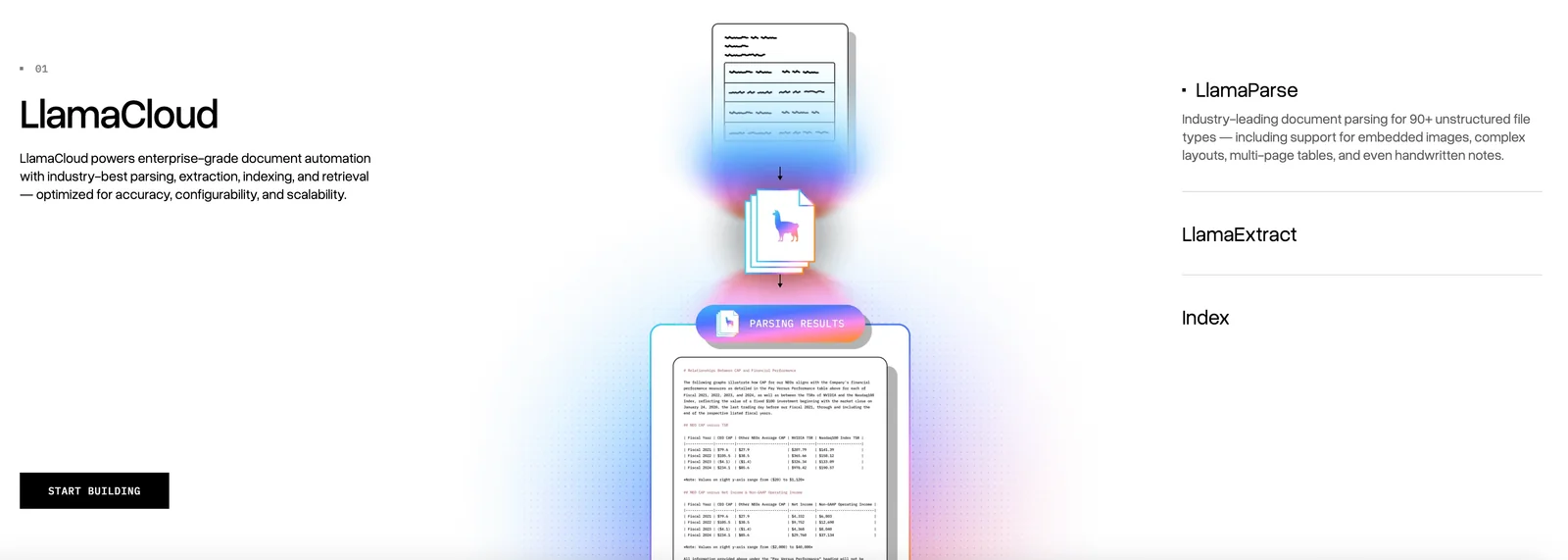
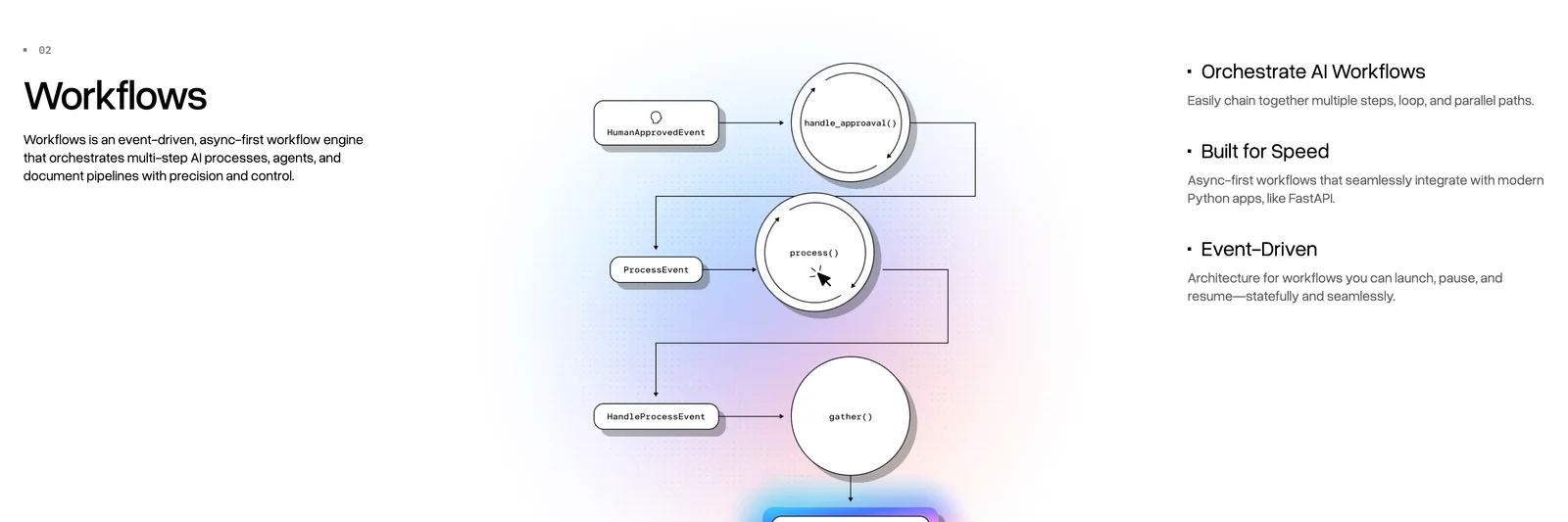
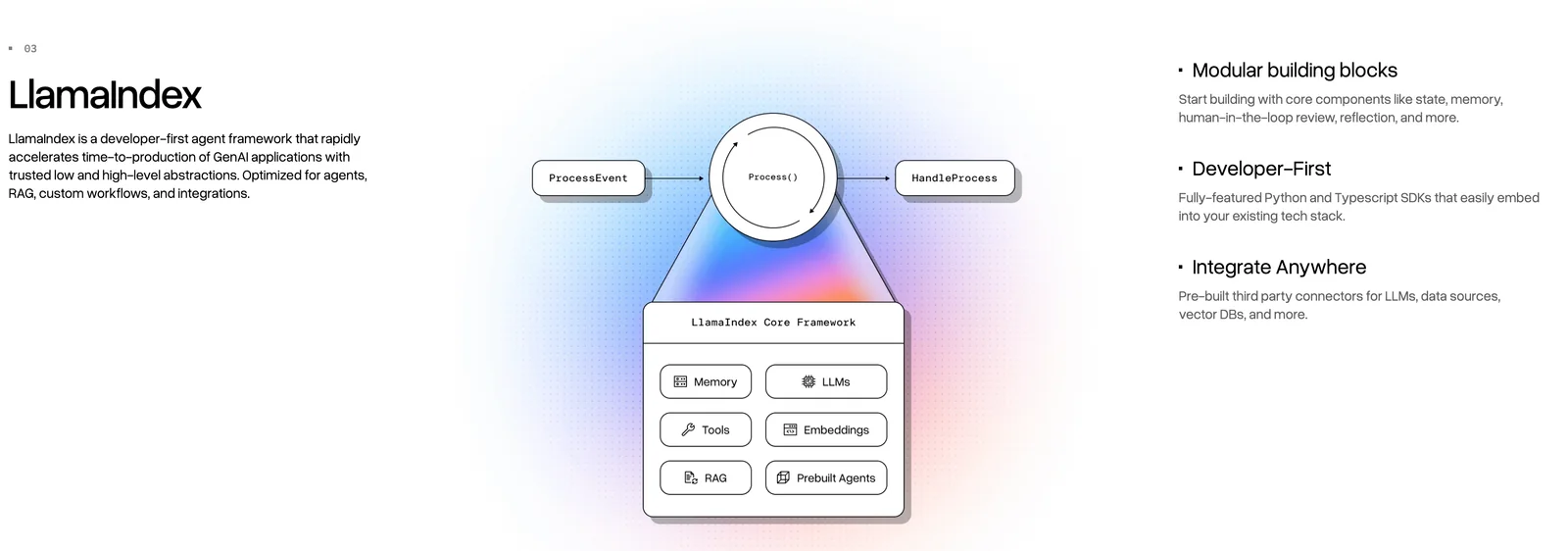
LlamaIndex is an open-source data framework that connects large language models to external data sources to build knowledge assistants, retrieval-augmented generation (RAG) systems, and LLM-powered agents. It provides high-level APIs for quick ingestion and querying of documents in just a few lines of code and lower-level modular components (connectors, indices, retrievers, query engines, and rerankers) for advanced customization. LlamaIndex supports multiple runtimes (Python and TypeScript), integrates with many LLM providers and vector stores, and includes a component registry (LlamaHub) and cloud products for production deployment. Its modular design enables composable, production-ready pipelines for enterprise knowledge and agent applications.
Screenshots

Key Features
Use Cases



Frequently asked questions about LlamaIndex
Is LlamaIndex free to use?
Yes, LlamaIndex offers a free tier that includes 10,000 credits for personal use. This tier is perfect for individual developers and small projects, allowing users to experiment with the platform without incurring costs.
Key Points
- Free tier includes 10,000 credits.
- Ideal for individual developers and small experiments.
- No hidden fees or costs for initial usage.
Detailed Explanation
LlamaIndex is a powerful tool designed for developers and researchers interested in leveraging AI technologies. The free tier, which provides 10,000 credits, enables users to explore various features and functionalities of the platform. This is particularly advantageous for those just starting their journey in AI development or for small-scale projects that do not require extensive resources.
Use Cases
- Personal Projects: Developers can utilize the free credits to build personal applications, test new ideas, or prototype solutions without financial commitment.
- Learning and Experimentation: New users can familiarize themselves with the LlamaIndex features, such as data integration and model training, helping them to develop skills in AI and machine learning.
- Small Business Applications: Entrepreneurs can use the free tier to develop minimum viable products (MVPs) before investing in a paid plan.
Best Practices / Tips
- Monitor Usage: Regularly check your credit balance to avoid running out unexpectedly. LlamaIndex provides tools to track usage easily.
- Utilize Documentation: Take advantage of the official LlamaIndex documentation to understand the best ways to use your credits effectively.
- Experiment with Features: Use the free credits to explore different functionalities, such as data ingestion and model evaluation, to determine what best fits your needs.
Additional Resources
What are the main features of LlamaIndex?
LlamaIndex offers a suite of powerful features including high-level ingestion APIs, a composable indexing framework, customizable retrieval options, and multi-language SDKs, all designed to simplify data integration and enhance data retrieval processes for developers and businesses.
Key Points
- High-Level Ingestion APIs: Streamlined data import.
- Composable Indexing Suite: Flexible and modular indexing.
- Customizable Retrieval Options: Tailored data access methods.
- Multi-Language SDKs: Support for various programming languages.
Detailed Explanation
LlamaIndex is a robust tool for managing and retrieving data efficiently. Here’s a breakdown of its main features:
-
High-Level Ingestion APIs: These APIs enable users to easily ingest data from various sources such as databases, CSV files, or APIs. This simplicity accelerates the onboarding process for new data types, allowing developers to focus on building applications rather than managing data logistics.
-
Composable Indexing Suite: The indexing suite is designed to be modular, meaning users can create complex indexing strategies by combining different components. This modularity allows for greater flexibility in how data is indexed, which can lead to improved search and retrieval performance tailored to specific applications.
-
Customizable Retrieval Options: LlamaIndex supports various retrieval strategies, enabling users to customize how data is accessed. This includes options for relevance ranking, filtering, and sorting, which can significantly enhance the user experience by delivering more accurate search results.
-
Multi-Language SDKs: Supporting a range of programming languages (like Python, Java, and JavaScript), LlamaIndex ensures that developers can integrate its features into their existing tech stacks without needing to switch languages or platforms. This broad compatibility facilitates quicker adoption and less friction in development.
Best Practices / Tips
- Optimize Data Ingestion: Use batch processing for large datasets to improve efficiency. Regularly monitor and update ingestion pipelines to ensure data accuracy.
- Experiment with Indexing Strategies: Take advantage of the composable indexing features. Test different combinations to find the most effective setup for your specific use case.
- Leverage Custom Retrieval: Tailor retrieval configurations based on user feedback to enhance search relevance. A/B testing can be useful to determine the most effective retrieval options.
Additional Resources
How do I get started with LlamaIndex?
To get started with LlamaIndex, visit the official website, download the SDKs, and refer to the documentation for setup and usage guides. Additionally, familiarize yourself with the community forums for troubleshooting and best practices to enhance your experience.
Key Points
- Visit the Official Website: Access resources and downloads.
- Download SDKs: Get the software development kits tailored for your environment.
- Refer to Documentation: Understand setup and usage through detailed guides.
Detailed Explanation
LlamaIndex is a powerful tool designed for building and managing AI applications efficiently. Follow these steps to get started:
-
Visit the Official Website: Head over to the LlamaIndex website to explore features and capabilities.
-
Download SDKs: Choose the appropriate SDK based on your programming language or environment. SDKs are available for popular languages such as Python, Java, and JavaScript, providing flexibility for developers.
-
Refer to Documentation: The comprehensive documentation includes installation instructions, API references, and code examples to help you set up your environment. Look for sections related to:
- Installation: Step-by-step guidance on installing the SDK.
- Quick Start Guide: A brief overview to help you create your first project quickly.
- Advanced Features: Learn about more complex functionalities as you grow familiar with basic operations.
-
Community Forums: Engage with the LlamaIndex community through forums and discussion boards. This is an excellent way to ask questions, share experiences, and discover best practices.
Best Practices / Tips
- Start with Simple Projects: Begin with basic applications to understand core functionalities before tackling complex use cases.
- Utilize Community Resources: Leverage tutorials and user experiences shared in forums to avoid common pitfalls.
- Keep SDKs Updated: Regularly check for updates to the SDKs to ensure you have the latest features and security patches.
- Experiment with Examples: Use provided code samples as a foundation to build your projects, adapting them as necessary.
Additional Resources
By following these steps and utilizing the available resources, you'll be well on your way to mastering LlamaIndex for your AI projects.
What are the technical requirements for using LlamaIndex?
LlamaIndex requires Python or TypeScript for development and integrates seamlessly with various data sources and LLM (Large Language Model) providers. Ensure your tech stack is compatible with these languages and APIs to leverage its full capabilities effectively.
Key Points
- Programming Languages: LlamaIndex supports Python and TypeScript.
- Integration: Works with multiple data sources and LLM providers.
- Compatibility: Check your existing tech stack for alignment.
Detailed Explanation
LlamaIndex is a versatile tool designed for developers who want to create applications that utilize large language models and process diverse datasets. To effectively utilize LlamaIndex, it is essential to meet the following technical requirements:
-
Programming Languages: LlamaIndex is built to work with Python and TypeScript. Python is favored for its extensive libraries and community support, making it ideal for data manipulation and machine learning tasks. TypeScript, on the other hand, provides strong typing and better error handling, making it a great choice for building scalable applications.
-
Data Source Integration: LlamaIndex can integrate with multiple data sources such as SQL databases, NoSQL databases, and even external APIs. This flexibility allows developers to pull in data from various formats to feed into their models.
-
LLM Providers: The tool supports integration with prominent LLM providers like OpenAI and Hugging Face. This enables users to leverage cutting-edge AI models to enhance their applications without starting from scratch.
For instance, if you are building a chatbot that responds to user queries, you can use LlamaIndex to fetch data from a SQL database where user information is stored, while also using OpenAI's GPT model for generating responses.
Best Practices / Tips
- Choose the Right Language: Depending on your team's expertise, select either Python or TypeScript. If your project heavily involves data analysis, Python may be more suitable.
- Test for Compatibility: Before starting development, ensure that all components of your tech stack are compatible with LlamaIndex. This includes verifying that your databases can communicate effectively with the APIs.
- Leverage Documentation: Refer to the official LlamaIndex documentation for detailed guides on integration and best practices. This will save you time and help avoid common pitfalls.
Additional Resources
How does LlamaIndex compare to other AI models?
LlamaIndex distinguishes itself from other AI models through its open-source framework, allowing for extensive customization and adaptability. Additionally, it benefits from strong community support and cost-effectiveness, making it a flexible alternative to proprietary AI tools that may lack transparency and limit user control.
Key Points
- Open-Source Framework: LlamaIndex provides users with the ability to modify and enhance functionalities.
- Customizable Indexing: Users can tailor indexing processes to suit specific application needs.
- Community Support: A strong community around LlamaIndex offers resources, plugins, and collaborative improvements.
Detailed Explanation
LlamaIndex is an open-source AI model that enables developers and businesses to leverage its capabilities without the constraints of proprietary software. The open-source nature allows for:
-
Flexibility: Developers can adapt the framework to meet diverse needs across various industries. For instance, a financial institution can customize LlamaIndex to index and analyze large datasets of transactions, while a healthcare provider might use it to manage patient records efficiently.
-
Cost-Effectiveness: Unlike many proprietary models that require hefty licensing fees, LlamaIndex is free to use, significantly lowering the barrier to entry for startups and small businesses. This accessibility allows even those with limited budgets to implement advanced AI solutions.
-
Community Contributions: The active community surrounding LlamaIndex contributes to its growth. Users can share their modifications and improvements, leading to rapid iterations and enhancements. For example, a user may develop a new indexing plugin that optimizes search capabilities, which can then be shared with the community.
Best Practices / Tips
-
Explore Community Resources: Take advantage of forums, GitHub repositories, and documentation provided by the LlamaIndex community. Engage with other users to learn best practices and innovative applications.
-
Regular Updates: Keep your version of LlamaIndex updated to benefit from the latest features and security enhancements. Regular updates ensure you’re leveraging the most efficient tools available.
-
Experiment with Customization: Utilize the open-source nature to experiment with custom indexing techniques that suit your specific requirements. This experimentation can lead to unique solutions tailored to your business needs.
Additional Resources
- LlamaIndex Official Documentation
- GitHub Repository for LlamaIndex
- Community Forum for LlamaIndex Users
By understanding the unique advantages of LlamaIndex, users can effectively harness its features to optimize their AI projects and gain a competitive edge in their respective fields.
Explore more AI Ai Tools tools
Browse all Ai Tools tools →Compare LlamaIndex: vs CleanSlop · vs Kalender Sync · vs UseIt Studio · vs Woven Video