linkgo
Contextberg

Contextberg

AI

Surfaces your active work as persistent agent memory and serves it to agents via the Model Context Protocol (MCP).

-(0 Reviews)
Free Available
Starting from Free
Premium plans available

About Contextberg

Contextberg captures and exposes the contextual signals from a user's work (the "context beneath your screen") and turns that history into structured, accessible memory for AI agents. It exposes those memory artifacts over the Model Context Protocol (MCP), enabling agents and developer tools to request, consume, and reuse long-term context across sessions. By standardizing how work-derived context is served, Contextberg reduces context-switching, helps agents make decisions with richer historical information, and enables interoperable memory across agent ecosystems.

Screenshots
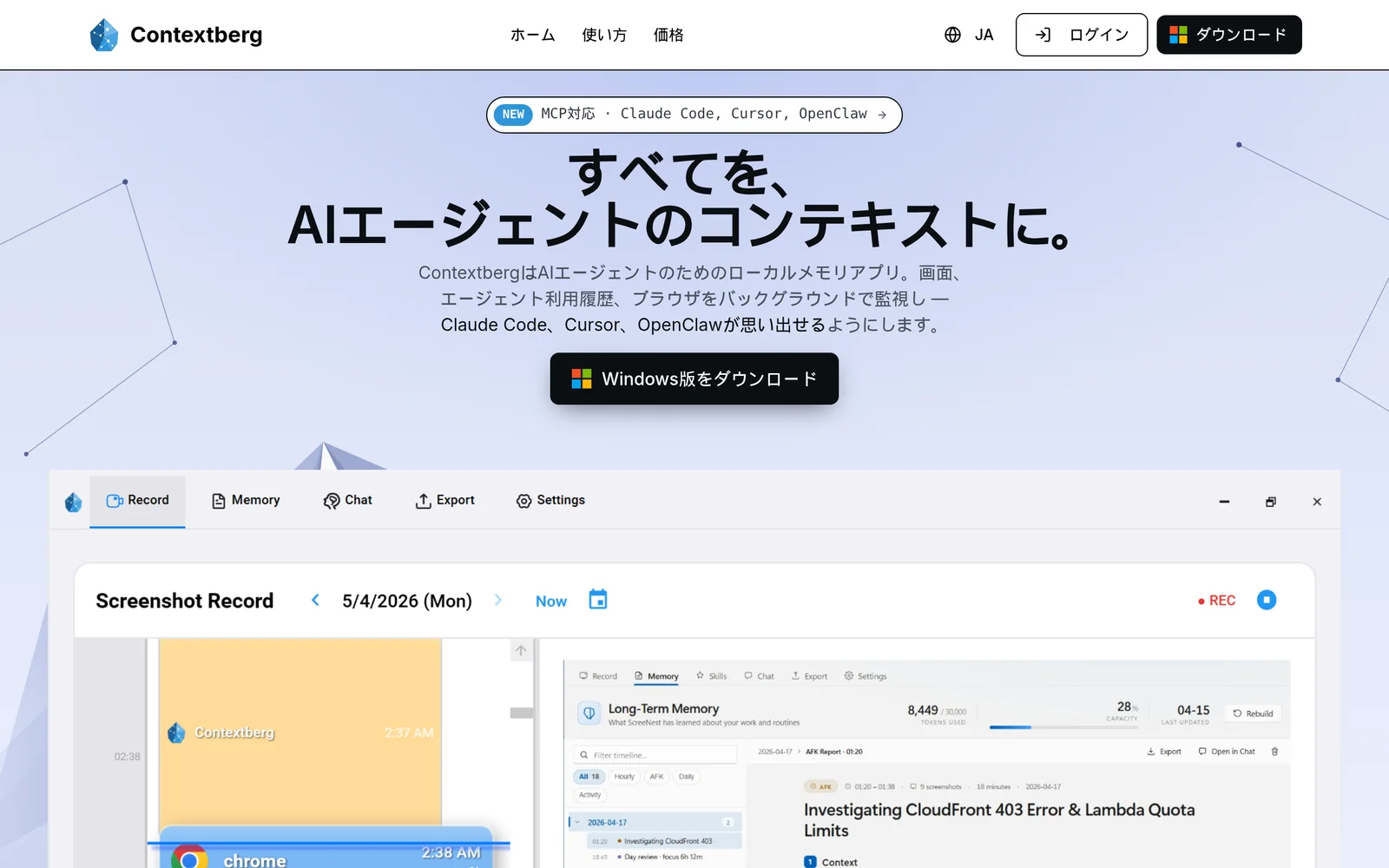
Contextberg screenshot 1
+

Key Features

Work-to-Memory Conversion: Extracts contextual signals from a user's workspace (files, tabs, app state and activity) and converts them into structured memory artifacts usable by agents.
MCP Serving: Exposes collected memory via the Model Context Protocol (MCP) so any MCP-compatible agent or tool can query and consume context in a standard way.
Long-Term Persistence: Stores and indexes historical context across sessions to provide agents with continuity and long-term state for multi-step or recurring tasks.
Interoperability with Agent Tooling: Designed to plug into developer workflows and agent infrastructures, enabling multiple agents and platforms to reuse the same context artifacts.
Context Enrichment: Organizes and surfaces relevant snippets of work history so agents receive concise, actionable context rather than raw logs or bulk files.
Serve work history and artifacts as agent-readable memory via the Model Context Protocol (MCP).
Index and persist long-term context so agents can access historical state across sessions.
Provide a standardized memory endpoint for agent frameworks and tooling to query context.
Integrate with developer workflows and tooling to capture relevant context from work artifacts.
Reduce context-switching by making workspace context available to multiple agents and tools.

Use Cases

Persistent Coding Assistants: Provide code-focused agents with project history, design decisions, and prior edits so suggestions and refactorings consider long-term context.
Customer Support Augmentation: Supply support agents with the user’s prior interactions, documents, and troubleshooting steps to enable faster, context-aware responses.
Personal Productivity Agents: Let personal assistants recall past tasks, notes, and project context to manage follow-ups, scheduling, and multi-session workflows.
Team Knowledge Access: Serve a shared, queryable memory layer to team agents so newcomers and tools can access project context and rationale without manual handoffs.
Agent Handoffs and Orchestration: Allow multiple specialized agents to request the same memory artifacts via MCP when coordinating complex, multi-step automations.
Enable agents to complete multi-step tasks using a user's historical project context.
Provide persistent memory for coding assistants so they retain project-specific state between sessions.
Bridge work artifacts (files, commits, notes) into a standardized memory layer for orchestration.
Improve agent decision-making by serving relevant long-term context during automated workflows.

Explore more AI Ai Tools tools

Browse all Ai Tools tools →

Browse by use case: Code Generation

Compare Contextberg: vs Halo by Scam AI · vs Cleanlist AI · vs Screencap · vs OpenCodeReview