

ARBR
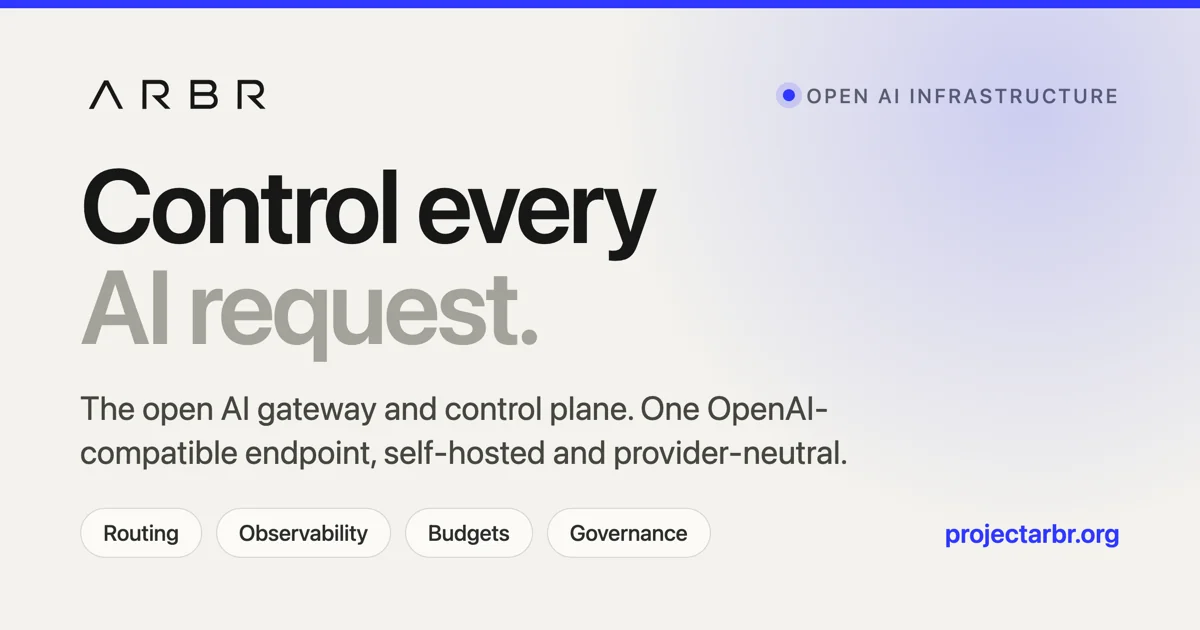
AIOpen-source, MIT-licensed AI gateway and control plane that routes, governs and observes every LLM request behind one OpenAI-compatible endpoint.
ARBR
Open-source, MIT-licensed AI gateway and control plane that routes, governs and observes every LLM request behind one OpenAI-compatible endpoint.
About ARBR
ARBR is a self-hosted, provider-neutral AI gateway and control plane that sits between your applications and every model provider. Applications point at a single OpenAI-compatible endpoint, and ARBR classifies each request by task type and difficulty, routes it to the right model using rules, cost guardrails and fallbacks, then meters and governs it before delivery. Budgets, rate limits, output guardrails, prompt-injection checks and kill switches act inside the request path rather than after the fact, and every call becomes a structured event attributed by app, team, model and user for local dashboards or OpenTelemetry export. An LLM-judge evaluation loop scores a sample of live traffic so traffic can be routed to the cheapest model proven to clear a quality bar, while canary and shadow deployment with regression gates lets new models ship safely. Pricing and benchmark data spans over 3,000 models across frontier labs, cloud platforms and fast open providers, plus anything reachable through LiteLLM or a self-hosted OpenAI-compatible endpoint.
Screenshots
Key Features
Use Cases



Frequently asked questions about ARBR
What is ARBR?
Open-source, MIT-licensed AI gateway and control plane that routes, governs and observes every LLM request behind one OpenAI-compatible endpoint.
How does ARBR work?
ARBR works by combining OpenAI-Compatible Routing: A single drop-in endpoint over every major provider, with rules, difficulty-aware selection, cost guardrails and automatic fallback choosing the model per request., In-Path Governance: Budgets, rate limits, output guardrails, prompt-injection checks and kill switches enforce policy before inference rather than auditing it afterwards., Structured Observability: Cost, latency, tokens and routing decisions are emitted as structured events attributed by application, team, model and user, viewable in local dashboards or exported to OpenTelemetry backends such as Datadog, Grafana and Prometheus., LLM-Judge Evaluation: A sample of live traffic is scored for quality so requests can be routed to the cheapest model that provably clears the bar, rather than optimising on price alone., Safe Model Deployment: Canary and shadow new models against real traffic with regression gates that block promotion until evaluations pass, plus instant rollback. to help users with LLM Cost Reduction: Route summarisation and extraction traffic to cheap small models while reserving frontier models for analysis, cutting spend without hand-editing every call site., AI Spend Attribution: Give finance and engineering a per-application, per-team and per-user breakdown of token spend so AI budgets can be owned by the groups that generate them., Enterprise AI Governance: Enforce departmental budgets, rate limits and kill switches in the request path so a runaway agent cannot exhaust a quarter's inference budget., Provider Risk Mitigation: Keep applications provider-neutral behind one endpoint with automatic fallback, so a single vendor outage or price change does not require a code change., Model Migration Testing: Shadow or canary a newly released model against production traffic and let regression gates decide whether it is promoted..
What are the main features of ARBR?
Key features include OpenAI-Compatible Routing: A single drop-in endpoint over every major provider, with rules, difficulty-aware selection, cost guardrails and automatic fallback choosing the model per request., In-Path Governance: Budgets, rate limits, output guardrails, prompt-injection checks and kill switches enforce policy before inference rather than auditing it afterwards., Structured Observability: Cost, latency, tokens and routing decisions are emitted as structured events attributed by application, team, model and user, viewable in local dashboards or exported to OpenTelemetry backends such as Datadog, Grafana and Prometheus., LLM-Judge Evaluation: A sample of live traffic is scored for quality so requests can be routed to the cheapest model that provably clears the bar, rather than optimising on price alone., Safe Model Deployment: Canary and shadow new models against real traffic with regression gates that block promotion until evaluations pass, plus instant rollback..
Who is ARBR for?
ARBR is useful for anyone interested in LLM Cost Reduction: Route summarisation and extraction traffic to cheap small models while reserving frontier models for analysis, cutting spend without hand-editing every call site., AI Spend Attribution: Give finance and engineering a per-application, per-team and per-user breakdown of token spend so AI budgets can be owned by the groups that generate them., Enterprise AI Governance: Enforce departmental budgets, rate limits and kill switches in the request path so a runaway agent cannot exhaust a quarter's inference budget., Provider Risk Mitigation: Keep applications provider-neutral behind one endpoint with automatic fallback, so a single vendor outage or price change does not require a code change., Model Migration Testing: Shadow or canary a newly released model against production traffic and let regression gates decide whether it is promoted..
How much does ARBR cost?
ARBR is free to use.
How do I get started with ARBR?
Visit https://projectarbr.org/ to sign up and explore ARBR.
Explore more AI Ai Tools tools
Browse all Ai Tools tools →Compare ARBR: vs CleanSlop · vs Kalender Sync · vs UseIt Studio · vs Woven Video