

TradingAgents
AIAn open-source multi-agent LLM framework that mirrors a trading firm, with analyst, researcher, trader and risk agents debating each decision.
TradingAgents
An open-source multi-agent LLM framework that mirrors a trading firm, with analyst, researcher, trader and risk agents debating each decision.
About TradingAgents
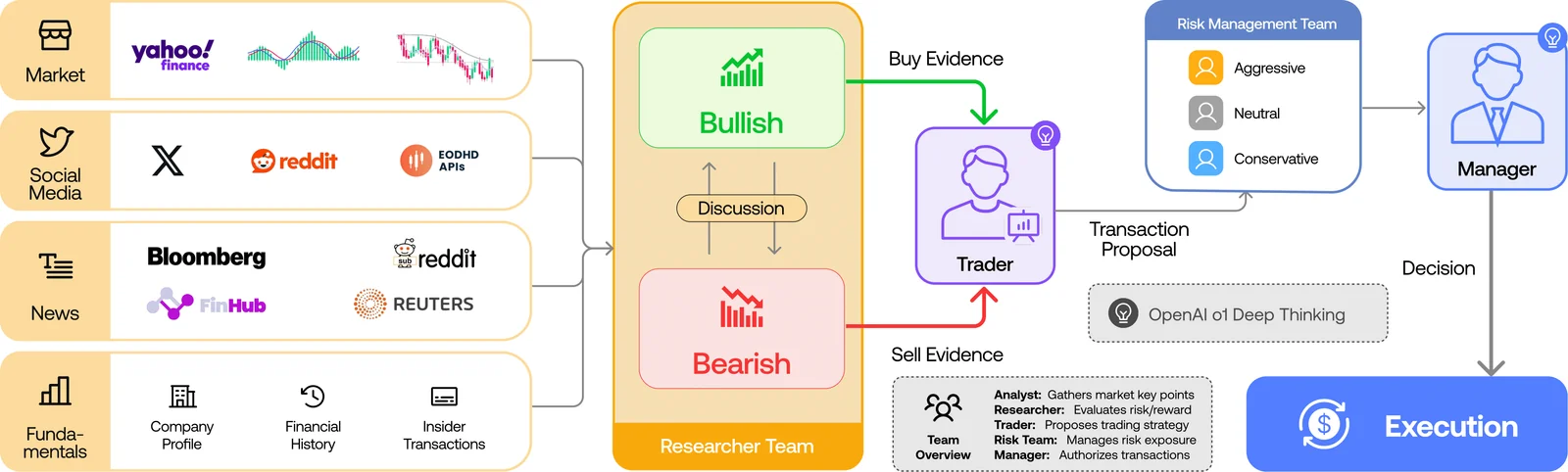
TradingAgents is an open-source research framework that models the internal dynamics of a real trading firm using specialized LLM-powered agents. An analyst team covering fundamentals, sentiment, news and technicals produces reports; bullish and bearish researchers then debate those findings in structured argument; a trader agent composes the debate into a proposed position; and a risk management team plus a portfolio manager approve or reject the order before it reaches a simulated exchange. The framework is built on LangGraph with checkpoint resume, a persistent decision log and a verified data-access contract that filters look-ahead bias across FRED macro data, price history and social sentiment. It supports a wide provider registry — OpenAI, Anthropic, Google, xAI, DeepSeek, Qwen, GLM, Mistral, Groq, NVIDIA, Kimi, AWS Bedrock, Azure and local Ollama models — and ships both a CLI and a Python package, with Docker images available. The maintainers state explicitly that it is built for research and is not financial, investment or trading advice.
Screenshots

Key Features
Use Cases



Frequently asked questions about TradingAgents
What is TradingAgents?
An open-source multi-agent LLM framework that mirrors a trading firm, with analyst, researcher, trader and risk agents debating each decision.
How does TradingAgents work?
TradingAgents works by combining Analyst Team: Four specialized agents — fundamentals, sentiment, news and technical — each producing an independent report on a ticker before any decision is made., Bull vs Bear Debate: Opposing researcher agents critically assess the analyst reports through structured debate, balancing potential gains against inherent risks., Risk Management Chain: A risk team evaluates volatility and liquidity and reports to a portfolio manager agent who approves or rejects each proposed transaction., Look-Ahead Protection: A verified data-access contract with point-in-time filtering across FRED macro data, Alpha Vantage and social sentiment so backtests do not leak future information., Multi-Provider LLM Registry: Configurable backbones across OpenAI, Anthropic, Google, xAI, DeepSeek, Qwen, GLM, MiniMax, Mistral, Groq, NVIDIA, Kimi, Bedrock, Azure and local Ollama endpoints. to help users with Agent Architecture Research: Studying how debate and role separation between LLM agents changes the quality of a complex decision., Strategy Backtesting: Replaying historical periods with point-in-time data to evaluate how an agent-driven approach would have behaved., Model Comparison: Swapping backbone LLMs across providers to measure how model choice affects reasoning quality on the same task., Financial NLP Pipelines: Reusing the fundamentals, news and sentiment analyst components as building blocks in other market-research tooling., Multi-Agent Teaching Material: Demonstrating analyst, debate, execution and risk-review roles as a worked example of an agentic workflow..
What are the main features of TradingAgents?
Key features include Analyst Team: Four specialized agents — fundamentals, sentiment, news and technical — each producing an independent report on a ticker before any decision is made., Bull vs Bear Debate: Opposing researcher agents critically assess the analyst reports through structured debate, balancing potential gains against inherent risks., Risk Management Chain: A risk team evaluates volatility and liquidity and reports to a portfolio manager agent who approves or rejects each proposed transaction., Look-Ahead Protection: A verified data-access contract with point-in-time filtering across FRED macro data, Alpha Vantage and social sentiment so backtests do not leak future information., Multi-Provider LLM Registry: Configurable backbones across OpenAI, Anthropic, Google, xAI, DeepSeek, Qwen, GLM, MiniMax, Mistral, Groq, NVIDIA, Kimi, Bedrock, Azure and local Ollama endpoints..
Who is TradingAgents for?
TradingAgents is useful for anyone interested in Agent Architecture Research: Studying how debate and role separation between LLM agents changes the quality of a complex decision., Strategy Backtesting: Replaying historical periods with point-in-time data to evaluate how an agent-driven approach would have behaved., Model Comparison: Swapping backbone LLMs across providers to measure how model choice affects reasoning quality on the same task., Financial NLP Pipelines: Reusing the fundamentals, news and sentiment analyst components as building blocks in other market-research tooling., Multi-Agent Teaching Material: Demonstrating analyst, debate, execution and risk-review roles as a worked example of an agentic workflow..
How much does TradingAgents cost?
TradingAgents is free to use.
How do I get started with TradingAgents?
Visit https://github.com/TauricResearch/TradingAgents to sign up and explore TradingAgents.
Explore more AI Ai Agents tools
Browse all Ai Agents tools →Compare TradingAgents: vs Proto-Mind · vs Ami · vs Duvi · vs AskDeck