

CrowdSynthetic
AIOpen-source crowd safety simulator that predicts and visualizes congestion to help prevent dangerous crowding.
CrowdSynthetic
Open-source crowd safety simulator that predicts and visualizes congestion to help prevent dangerous crowding.
About CrowdSynthetic
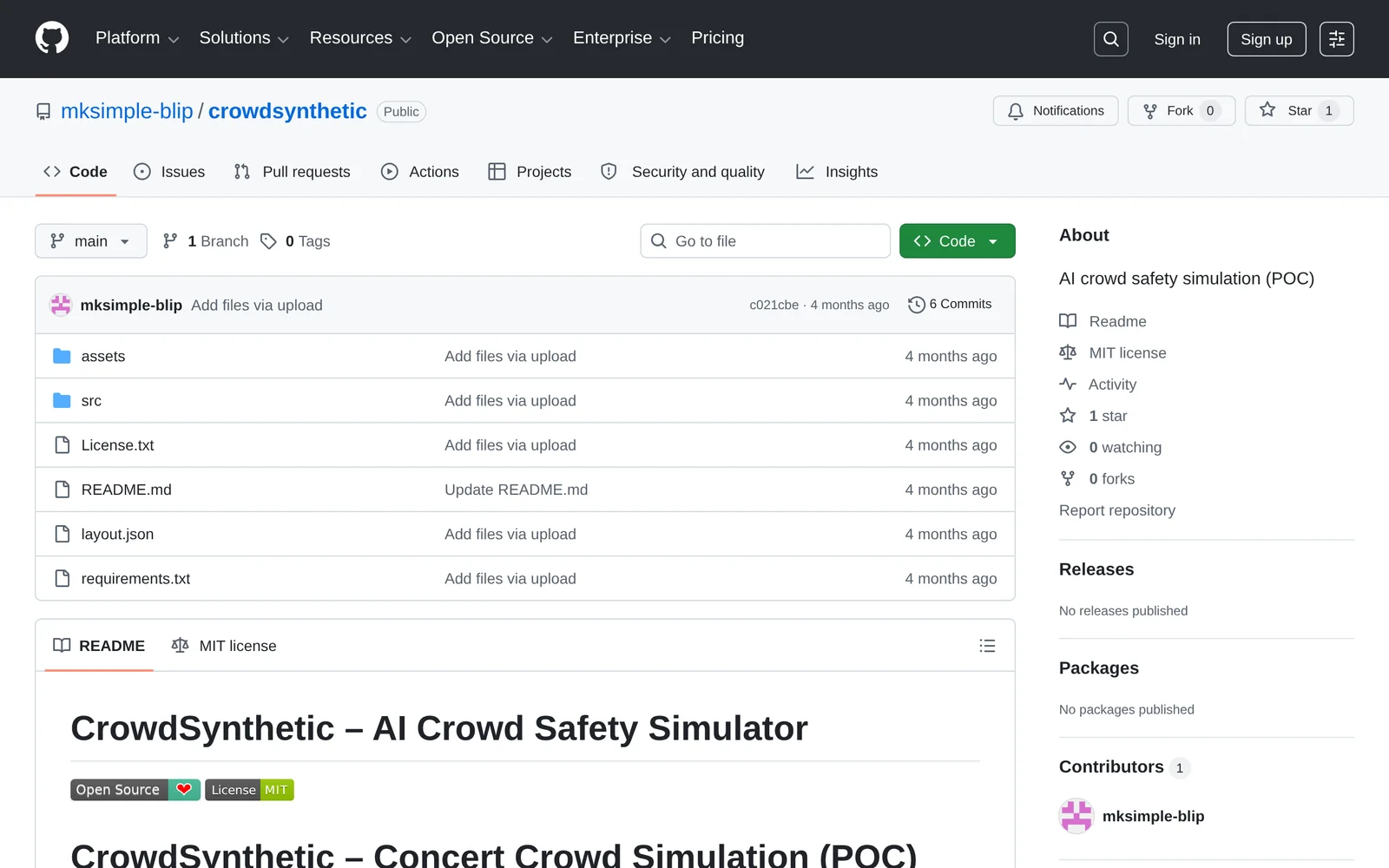
CrowdSynthetic is an open-source proof-of-concept crowd safety simulator that uses AI-driven simulation to predict crowd congestion before it becomes hazardous. It visualizes pedestrian movement and density over time to highlight potential bottlenecks and high-risk areas. Designed as a research and operations tool, it enables scenario testing and situational awareness for event planners, transit operators, and safety teams. As a GitHub-hosted project, it is extensible and intended for experimentation, integration with live inputs, and further development by the community.
Screenshots
Key Features
Use Cases


Frequently asked questions about CrowdSynthetic
What is CrowdSynthetic?
CrowdSynthetic is an open-source crowd safety simulator designed to predict and visualize crowd congestion. This innovative tool aids in preventing dangerous crowding scenarios, making it invaluable for event planners, safety officials, and urban developers who need to manage large gatherings effectively.
Key Points
- Open-source Tool: Free to use and modify, fostering community collaboration.
- Predictive Analytics: Uses algorithms to forecast crowd behavior and congestion.
- Visualization Features: Offers graphical representations for better understanding and planning.
Detailed Explanation
CrowdSynthetic leverages advanced algorithms to simulate crowd dynamics in various environments. It can analyze factors such as crowd density, movement patterns, and potential bottlenecks. By inputting specific variables like crowd size, venue layout, and flow rates, users can generate predictive models that reflect real-world scenarios.
For example, during a music festival, CrowdSynthetic can help organizers visualize and predict congested areas, allowing them to implement strategies such as additional signage, barriers, or staff deployment to manage crowd flow effectively. The software can be particularly useful in emergency planning, helping to devise evacuation routes and identify high-risk areas.
The open-source nature of CrowdSynthetic encourages contributions from developers and researchers, enhancing its capabilities over time. Users can customize the simulator according to specific needs, which is beneficial for various applications like sporting events, public demonstrations, or urban planning.
Best Practices / Tips
- Regular Updates: Keep your CrowdSynthetic software updated to benefit from the latest features and improvements.
- Realistic Simulations: Input accurate data regarding venue dimensions and expected crowd behaviors to ensure reliable predictions.
- Test Scenarios: Run multiple simulations under different conditions to prepare for unexpected situations, such as sudden weather changes or emergency evacuations.
- Engage Stakeholders: Involve local authorities and emergency services in the planning process to align on safety protocols.
Additional Resources
- CrowdSynthetic GitHub Repository - Access the source code and documentation.
- User Manual and Documentation - Comprehensive guide on how to use the simulator effectively.
- Case Studies - Real-world applications and outcomes of using CrowdSynthetic in event planning.
How does CrowdSynthetic work?
CrowdSynthetic operates by integrating advanced AI technologies to streamline and enhance users' everyday AI workflows. This platform enables users to efficiently manage tasks such as data labeling, model training, and deployment, effectively automating time-consuming processes while maintaining high-quality results.
Key Points
- AI Integration: Combines machine learning and natural language processing.
- Workflow Automation: Streamlines repetitive tasks for increased efficiency.
- User-Friendly Interface: Designed for accessibility across various skill levels.
Detailed Explanation
CrowdSynthetic leverages core AI capabilities to facilitate seamless interaction with complex AI tasks. By using machine learning algorithms, it provides users with tools for automating data labeling, which is essential for training accurate models. For example, a business might use CrowdSynthetic to label thousands of images for a computer vision project, significantly reducing manual effort.
Additionally, CrowdSynthetic supports natural language processing (NLP) tasks, allowing users to analyze text data more efficiently. This is particularly useful for sentiment analysis, chatbots, and content generation.
The platform's user-friendly interface is designed to cater to both technical and non-technical users. This means that even those without extensive programming knowledge can effectively utilize the platform to enhance their AI capabilities.
Best Practices / Tips
- Start Small: Begin with simple projects to familiarize yourself with the platform's functionalities.
- Utilize Templates: Leverage pre-built templates for common tasks to save time and ensure consistency.
- Regular Updates: Keep your AI models updated with the latest data to maintain accuracy and relevance.
- Engage with Community: Join forums or support groups to exchange tips and best practices.
Additional Resources
- CrowdSynthetic Official Documentation
- AI Workflow Automation Guide
- Understanding Machine Learning Basics
By utilizing CrowdSynthetic, users can harness the power of AI to simplify their workflows, allowing them to focus on more strategic initiatives.
What are the main features of CrowdSynthetic?
CrowdSynthetic offers a range of advanced features designed to enhance AI model training and data generation. Key capabilities include high-quality synthetic data generation, customizable data labeling, and seamless integration with existing machine learning pipelines, making it an essential tool for businesses looking to optimize their AI projects.
Key Points
- High-Quality Synthetic Data Generation: Create diverse datasets tailored to specific needs.
- Customizable Data Labeling: Streamline the labeling process to fit unique project requirements.
- Seamless Integration: Easily integrate with existing AI frameworks and workflows.
Detailed Explanation
CrowdSynthetic is a powerful platform that leverages artificial intelligence to help businesses generate and manage synthetic data.
1. High-Quality Synthetic Data Generation
CrowdSynthetic excels in producing high-quality synthetic datasets that mimic real-world data without privacy concerns. For instance, if you require training data for a facial recognition system, CrowdSynthetic can generate diverse images that maintain the statistical properties of actual datasets. This is critical for training robust AI models.
2. Customizable Data Labeling
The platform allows users to customize the data labeling process according to specific project needs. Whether you're working on image classification or natural language processing tasks, CrowdSynthetic provides tools to annotate data accurately and efficiently. This feature significantly reduces the time and cost associated with manual labeling.
3. Seamless Integration
CrowdSynthetic is designed to integrate smoothly with popular machine learning frameworks, such as TensorFlow and PyTorch. This means that teams can easily incorporate synthetic data into their existing pipelines, enhancing productivity and accelerating the model training process. For example, users can utilize APIs to automate data flow between CrowdSynthetic and their AI tools.
Best Practices / Tips
- Define Clear Objectives: Before using CrowdSynthetic, outline your data requirements and objectives. This clarity will help in generating relevant synthetic data.
- Experiment with Parameters: Take advantage of CrowdSynthetic’s customizable features by experimenting with different data generation parameters. This can lead to better model performance.
- Monitor Data Quality: Regularly assess the quality of the synthetic data generated. Using validation datasets can help ensure that your AI models remain accurate and effective.
Additional Resources
Who is CrowdSynthetic for?
CrowdSynthetic is designed for developers, businesses, and researchers who seek to enhance their AI workflows. Whether you’re creating machine learning models, conducting data analysis, or automating repetitive tasks, CrowdSynthetic provides the tools necessary for efficient AI integration and process optimization.
Key Points
- Target Audience: Developers, businesses, researchers, and AI enthusiasts.
- Use Cases: Enhancing machine learning models, data analysis, and task automation.
- Benefits: Streamlines operations and improves workflow efficiency in AI projects.
Detailed Explanation
CrowdSynthetic is particularly beneficial for a diverse range of users:
-
Developers: For software developers, CrowdSynthetic offers a platform to create, test, and deploy AI models rapidly. The integration of APIs allows for seamless incorporation into existing applications, reducing development time significantly.
-
Businesses: Small to large enterprises can leverage CrowdSynthetic for automating customer service through AI chatbots or optimizing supply chain processes with predictive analytics. This automation leads to cost savings and improved customer satisfaction.
-
Researchers: Academic and industry researchers can utilize CrowdSynthetic for data annotation and model training, making their research more efficient. The platform supports collaborative projects, enabling teams to work simultaneously on AI initiatives.
Examples of Use Cases:
- E-commerce: Automating product recommendations using AI algorithms to analyze customer behavior.
- Healthcare: Using AI for predictive analytics to improve patient outcomes based on historical data.
- Finance: Implementing AI for fraud detection by analyzing transaction patterns in real-time.
Best Practices / Tips
- Define Clear Goals: Before using CrowdSynthetic, outline your project objectives to tailor the platform's features to your needs.
- Utilize Documentation: Make full use of CrowdSynthetic’s official documentation for the best practices in model training and API usage.
- Regularly Update Models: Maintain and update your models frequently based on new data to ensure accuracy and relevance.
Additional Resources
By harnessing the capabilities of CrowdSynthetic, users can significantly enhance their AI workflows, leading to more innovative solutions and improved operational efficiency.
How much does CrowdSynthetic cost?
CrowdSynthetic is completely free to use, providing users access to AI-driven synthetic data generation without any associated costs. This makes it an attractive option for developers, researchers, and businesses looking to enhance their machine learning models efficiently.
Key Points
- Cost-Free Access: CrowdSynthetic offers services at no charge.
- User-Friendly: Designed for easy navigation and usability.
- Versatile Applications: Suitable for various industries, including healthcare, finance, and autonomous vehicles.
Detailed Explanation
CrowdSynthetic allows users to generate synthetic datasets that can be utilized for training machine learning models. The platform is designed for a variety of applications, such as enhancing AI systems in sectors like healthcare, finance, and autonomous vehicles. By offering a free service, CrowdSynthetic democratizes access to essential data resources, enabling both small startups and large enterprises to develop robust AI solutions without the burden of financial constraints.
Use Cases
- Healthcare: Generate synthetic patient records to train models for disease prediction without compromising patient privacy.
- Finance: Create datasets to detect fraudulent transactions, allowing financial institutions to improve security measures.
- Autonomous Vehicles: Simulate driving scenarios to help improve the algorithms that enable self-driving cars to navigate safely.
Best Practices / Tips
- Experiment with Settings: Take advantage of the customizable features within CrowdSynthetic to tailor the synthetic data according to your project needs.
- Combine Real and Synthetic Data: For optimal results, use a mix of real and synthetic data to train your models, enhancing accuracy and reliability.
- Regular Updates: Keep your synthetic data generation settings updated based on feedback and the evolving requirements of your machine learning models.
Additional Resources
How do I get started with CrowdSynthetic?
To get started with CrowdSynthetic, visit CrowdSynthetic GitHub to sign up and explore the platform. Follow the installation instructions and documentation to seamlessly integrate this tool into your projects.
Key Points
- Easy sign-up process via GitHub
- Comprehensive documentation for setup
- Community support and contributions
Detailed Explanation
CrowdSynthetic is a powerful tool designed for synthetic data generation, particularly useful in machine learning and AI projects. To get started:
-
Visit the GitHub Repository: Go to CrowdSynthetic GitHub and click on the “Sign Up” button. This will allow you to access the full features of the tool.
-
Download and Install: Follow the installation instructions provided in the repository. You may need to clone the repository to your local machine using Git. Use the command:
git clone https://github.com/mksimple-blip/crowdsynthetic.git -
Explore the Documentation: Navigate to the documentation section to understand the functionalities and features of CrowdSynthetic. This will help you learn how to generate synthetic datasets tailored to your specific needs.
-
Join the Community: Engage with the CrowdSynthetic community through forums or GitHub discussions. This is beneficial for troubleshooting and learning from experienced users.
Best Practices / Tips
- Follow the Setup Guide: Always adhere to the installation and configuration instructions in the documentation to avoid common pitfalls.
- Experiment with Examples: Utilize the example datasets provided in the repository to understand how to generate synthetic data effectively.
- Stay Updated: Keep an eye on the GitHub repository for updates and new features that can enhance your projects.
Additional Resources
- CrowdSynthetic Documentation
- GitHub Issues Page for troubleshooting
- Community Discussions for user support and ideas
Explore more AI Ai Tools tools
Browse all Ai Tools tools →Compare CrowdSynthetic: vs Decode · vs LibreChat · vs AppGrowthKit · vs Humanizer