

ReLLM
AIPython library that enforces exact structured outputs from LLM completions by masking logits to match regex patterns.
ReLLM
Python library that enforces exact structured outputs from LLM completions by masking logits to match regex patterns.
About ReLLM
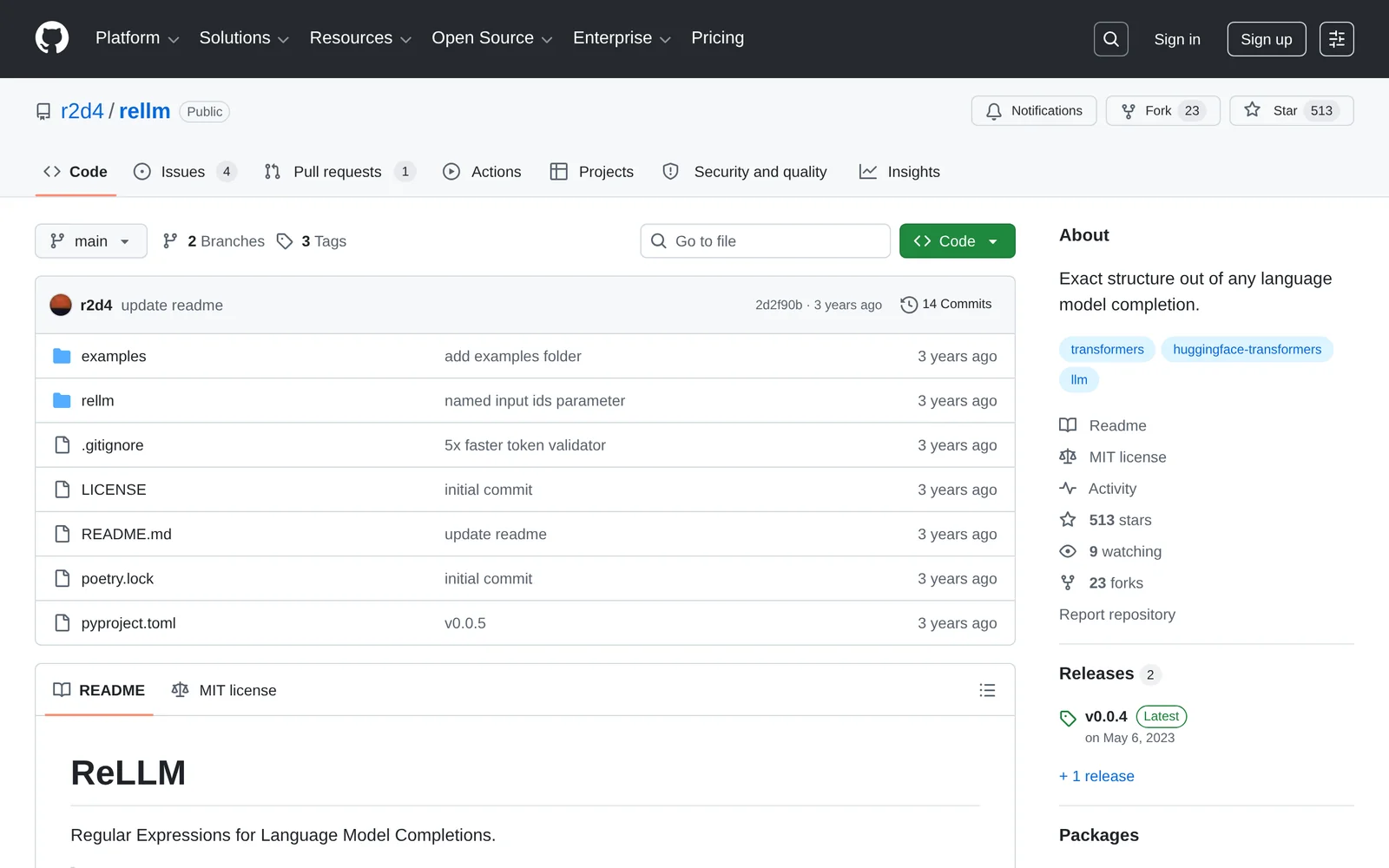
ReLLM is an open-source Python library that produces exact, pattern-constrained outputs from language models by filtering non-matching tokens before generation. For each candidate token at generation time, ReLLM tests potential continuations against a partial regular expression and masks logits for completions that would violate the pattern, steering the model to only produce conforming tokens. This enables reliable extraction of structured data (e.g., JSON arrays, fixed formats) from LLMs and can integrate with inference pipelines or be used via third-party hosted Regex Completion APIs referenced in the project.
Screenshots
Key Features
Use Cases



Frequently asked questions about ReLLM
What is ReLLM?
ReLLM is a Python library designed to ensure that large language model (LLM) outputs conform to specific structured formats by using regex patterns to mask logits. This enables developers to generate precise and reliable outputs tailored to their applications, enhancing the functionality of LLMs in various use cases.
Key Points
- Enforces structured outputs from LLMs using regex patterns.
- Utilizes masking of logits for precise control over model responses.
- Enhances reliability and accuracy in applications requiring specific output formats.
Detailed Explanation
ReLLM, short for Regex Language Model, is particularly useful for developers working with large language models (LLMs) like OpenAI's GPT or Google's BERT. By applying regular expressions (regex) to control the output of these models, ReLLM ensures that the generated text adheres to predefined structures.
How ReLLM Works
- Logit Masking: ReLLM operates by modifying the logits—numerical outputs that represent the likelihood of each possible token being the next in the generated sequence. By masking certain logits, ReLLM can effectively steer the model's output to match the desired regex pattern.
- Pattern Matching: Developers specify regex patterns that define the acceptable output structure. For example, if an output needs to be a date in the format "YYYY-MM-DD," ReLLM can enforce this format by masking outputs that don't match it.
- Applications: This technology is beneficial in various applications, such as:
- Data Validation: Ensuring that user inputs or generated data adhere to required formats.
- Chatbots: Crafting responses that maintain specific structures, such as lists or bullet points.
- Content Generation: Producing structured outputs for reports or logs that require strict formatting.
Best Practices / Tips
- Define Clear Patterns: When using ReLLM, ensure that your regex patterns are precise and well-tested to avoid unexpected outputs.
- Test Extensively: Before deploying models using ReLLM, conduct thorough testing to confirm that the output consistently meets your requirements.
- Monitor Performance: Keep track of how the model performs with the regex constraints in place, as excessive masking may lead to reduced flexibility in responses.
Additional Resources
- ReLLM GitHub Repository - Access the source code and documentation.
- Understanding Regex Patterns - A comprehensive guide to mastering regex.
- OpenAI API Documentation - Learn more about integrating LLMs with ReLLM.
How does ReLLM work?
ReLLM operates by integrating advanced artificial intelligence technologies to streamline and enhance everyday workflows. It leverages machine learning, natural language processing, and automation to optimize tasks, making it easier for users to manage complex projects efficiently.
Key Points
- Integration of AI Technologies: Combines machine learning and NLP.
- Workflow Automation: Enhances efficiency in daily tasks.
- User-Friendly Interface: Designed for ease of use across various applications.
Detailed Explanation
ReLLM stands for "Reinforced Language Learning Model," which harnesses the power of AI to assist users in a variety of tasks. It operates on three primary pillars:
-
Machine Learning: ReLLM continuously learns from user interactions, improving its ability to predict user needs and adapt to specific environments. For example, if a user frequently requests summaries of lengthy documents, ReLLM will optimize its responses based on previous interactions.
-
Natural Language Processing (NLP): This core feature allows ReLLM to understand and respond to user queries in conversational language. It can interpret complex commands, making it suitable for diverse applications such as customer support, content creation, and data analysis.
-
Automation: ReLLM automates repetitive tasks, such as data entry and report generation, freeing up valuable time for users. This can be particularly beneficial in businesses where efficiency is critical, reducing operational costs and improving productivity.
Use Cases
- Customer Support: Automating responses to frequently asked questions, allowing human agents to focus on more complex inquiries.
- Content Creation: Assisting writers in generating ideas, outlines, or even full drafts based on brief prompts.
- Data Analysis: Quickly analyzing large datasets and providing actionable insights without requiring extensive technical knowledge.
Best Practices / Tips
- Define Clear Objectives: Before using ReLLM, identify the specific areas in your workflow that require improvement. This will help tailor the AI tool to your needs.
- Regularly Update Training Data: Ensure that the model is trained with the latest information relevant to your industry to maintain accuracy and relevance in responses.
- Monitor Performance: Continuously assess how well ReLLM is meeting your workflow needs and make adjustments as necessary to enhance efficiency.
Additional Resources
What are the main features of ReLLM?
ReLLM offers a range of advanced features, including natural language understanding, customizable responses, and multi-modal capabilities. These features empower users to create more engaging and context-aware interactions, making ReLLM an effective tool for applications in customer support, content generation, and conversational agents.
Key Points
- Natural Language Understanding: Enhances communication by processing and interpreting user inputs.
- Customizable Responses: Allows users to tailor interactions based on specific needs or branding.
- Multi-Modal Capabilities: Supports text, images, and audio for a richer user experience.
Detailed Explanation
ReLLM leverages state-of-the-art AI technologies to revolutionize how users interact with systems.
-
Natural Language Understanding: ReLLM's natural language processing (NLP) capabilities enable it to understand and respond to user queries effectively. This feature is essential for applications such as chatbots, where accurate comprehension of user intent is vital. For example, in a customer support scenario, ReLLM can interpret a customer's question about a product and provide relevant information or troubleshoot issues seamlessly.
-
Customizable Responses: Users can modify ReLLM's responses to align with their brand voice or specific use cases. This flexibility is particularly beneficial for businesses that want to maintain a consistent tone across customer interactions. For instance, a retail company can configure ReLLM to use a friendly, casual tone, while a financial institution might prefer a more formal approach.
-
Multi-Modal Capabilities: ReLLM supports various input types, including text, images, and audio, which allows for a more immersive user experience. This feature is particularly useful in educational applications, where users can engage with content through different media. Imagine a learning platform where students can ask questions via voice, receive text-based answers, and view related images or diagrams in real time.
Best Practices / Tips
- Train Your Model: Regularly update and fine-tune ReLLM with specific datasets to improve accuracy and relevance in responses.
- Monitor Interactions: Analyze user interactions to identify areas for improvement. Adjust response styles and content based on feedback.
- Utilize Multi-Modal Features: Leverage all input types to enhance user engagement. For example, combine text responses with images to clarify complex concepts.
Additional Resources
Who is ReLLM for?
ReLLM is designed for a diverse range of users, including developers, data scientists, business analysts, educators, and anyone seeking to optimize their daily AI workflows. Its versatility makes it suitable for both technical and non-technical users interested in leveraging AI for efficiency and productivity.
Key Points
- Target Audience: Developers, data scientists, business analysts, educators.
- Use Cases: Automating tasks, enhancing decision-making, building AI applications.
- User-Friendly: Accessible for both technical and non-technical individuals.
Detailed Explanation
ReLLM (Robust Language Model) serves various groups interested in integrating AI into their daily routines.
-
Developers: ReLLM simplifies the process of creating AI-driven applications. Developers can use its APIs to integrate language models into their software, enhancing functionalities such as chatbot development, content generation, and automated customer support.
-
Data Scientists: For data professionals, ReLLM provides tools to analyze large datasets and generate insights. By utilizing natural language processing (NLP), they can extract meaningful information, automate reports, and enhance data visualization tasks.
-
Business Analysts: ReLLM aids business analysts in making data-driven decisions. They can use it to automate data collection and reporting processes, allowing them to focus on interpreting results rather than spending time on manual data manipulation.
-
Educators and Students: ReLLM is also beneficial for educators looking to incorporate AI into their curriculum. It can facilitate personalized learning experiences and assist students in research by generating content summaries and answering questions.
Best Practices / Tips
- Start Small: If you're new to ReLLM, begin with simple tasks to familiarize yourself with its features.
- Utilize Documentation: Refer to official ReLLM documentation for guidance on implementation and best practices.
- Experiment and Iterate: Regularly test different functionalities to discover new ways to enhance your workflows.
- Stay Updated: Follow ReLLM's updates for new features that can further optimize your processes.
Additional Resources
How much does ReLLM cost?
ReLLM is completely free to use, making it an accessible tool for anyone interested in leveraging large language models. Users can take advantage of its advanced features without incurring any costs, making it an ideal choice for developers, researchers, and hobbyists alike.
Key Points
- ReLLM offers a no-cost solution for users.
- Ideal for developers and researchers seeking advanced AI capabilities.
- No hidden fees or premium plans.
Detailed Explanation
ReLLM, or Recursive Large Language Model, is a robust platform designed for natural language processing tasks. Users can access its features without paying, which includes capabilities such as text generation, summarization, and translation. The free access allows individuals and organizations to experiment with AI and integrate it into their projects without financial constraints.
ReLLM's user-friendly interface and comprehensive documentation make it easy for beginners to get started. You can simply sign up on their website, and you’ll have immediate access to the tools necessary for building intelligent applications. Additionally, the tool is constantly updated, ensuring users benefit from the latest advancements in AI technology.
For instance, a developer may utilize ReLLM to create a chatbot for customer service, enhancing user engagement at no cost. Similarly, researchers can leverage its capabilities to analyze large datasets or generate academic papers, all while keeping expenses at bay.
Best Practices / Tips
- Explore Documentation: Familiarize yourself with the official documentation to understand the full range of features and best usage scenarios.
- Community Engagement: Join forums or communities focused on ReLLM to share experiences and tips with other users.
- Trial and Error: Experiment with different use cases to discover how ReLLM can best serve your needs.
Additional Resources
How do I get started with ReLLM?
To get started with ReLLM, visit ReLLM's GitHub page to sign up and access resources. Familiarize yourself with the documentation, examples, and community support available, which will help you effectively utilize this advanced AI tool for your projects.
Key Points
- Visit the GitHub page: Sign up and access essential resources.
- Explore the documentation: Find detailed guides and examples.
- Engage with the community: Join forums and discussions for support.
Detailed Explanation
ReLLM, or Recurrent Language Model, is a powerful AI tool designed for natural language processing tasks. To begin using ReLLM, follow these steps:
-
Sign Up: Go to the ReLLM GitHub page and create an account. This will give you access to the repository and updates.
-
Read the Documentation: After signing up, thoroughly read the documentation. It includes installation instructions, configuration options, and example scripts. This knowledge is crucial for effectively implementing ReLLM in your applications.
-
Clone the Repository: Use Git to clone the ReLLM repository to your local machine. This allows you to access the source code and modify it as needed.
-
Install Dependencies: Follow the installation guidelines to set up all necessary dependencies. This typically involves installing Python packages and ensuring you have the correct version of libraries like TensorFlow or PyTorch.
-
Run Example Scripts: Familiarize yourself with the tool by running provided example scripts. These scripts demonstrate how to use ReLLM for various tasks, such as text generation and summarization.
-
Experiment and Build: Start experimenting with your projects. Use ReLLM for tasks like chatbots, content generation, or data analysis. Consider different configurations to optimize performance for your specific needs.
Best Practices / Tips
- Start Small: Begin with simple projects to understand ReLLM's capabilities before tackling more complex applications.
- Utilize Community Resources: Engage with the ReLLM community on forums and social media. Sharing experiences and solutions can accelerate your learning.
- Test and Iterate: Continuously test your implementations and iterate based on results. Fine-tuning your model parameters can lead to significant improvements in output quality.
Additional Resources
- ReLLM Documentation: Access detailed guides and tutorials.
- ReLLM Community Forum: Join discussions and ask questions.
- Related AI Tools and Libraries: Explore similar AI projects for inspiration.
Explore more AI Ai Tools tools
Browse all Ai Tools tools →Compare ReLLM: vs Humanizer · vs Worktrunk · vs Mise · vs BiBimba