

Nova Act by Amazon
AIA browser-focused agent model and AWS service that automates UI workflows from natural language and escalates to humans when needed.
Nova Act by Amazon
A browser-focused agent model and AWS service that automates UI workflows from natural language and escalates to humans when needed.
About Nova Act by Amazon
Amazon Nova Act is a specialized model and service for building, developing, deploying, and operating AI agents that perform reliable web browser automation and UI workflows. It translates natural-language instructions into precise browser actions (click, type, scroll, navigate) and lets developers combine conversational prompts with Python code via an SDK and IDE extensions. Nova Act supports human-in-the-loop escalation, fleet deployment on AWS, monitoring and logging for production workflows, and integrations with testing frameworks for QA automation. Its unique value is providing deterministic, debuggable browser control at scale with developer tooling (playground, IDE extensions, SDKs) and operational controls for safe escalation and observability.
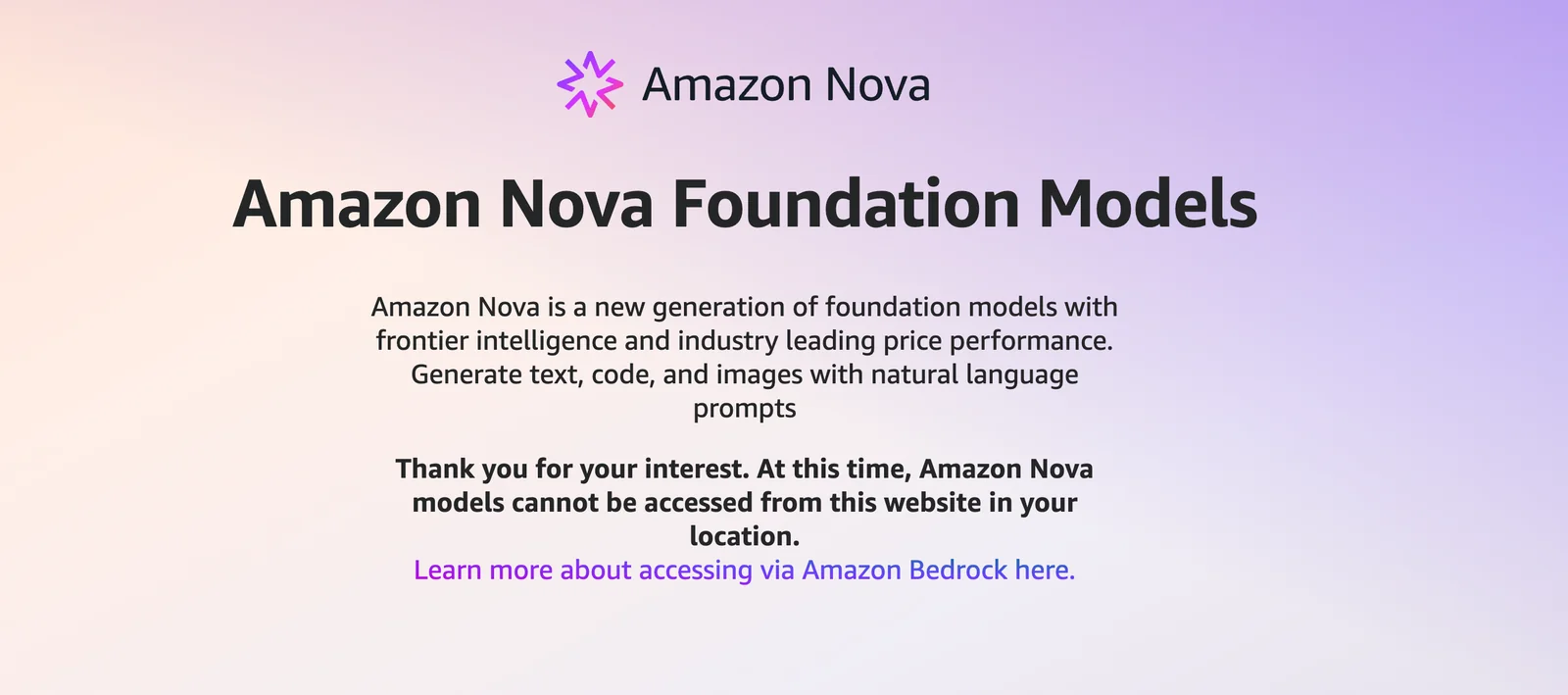
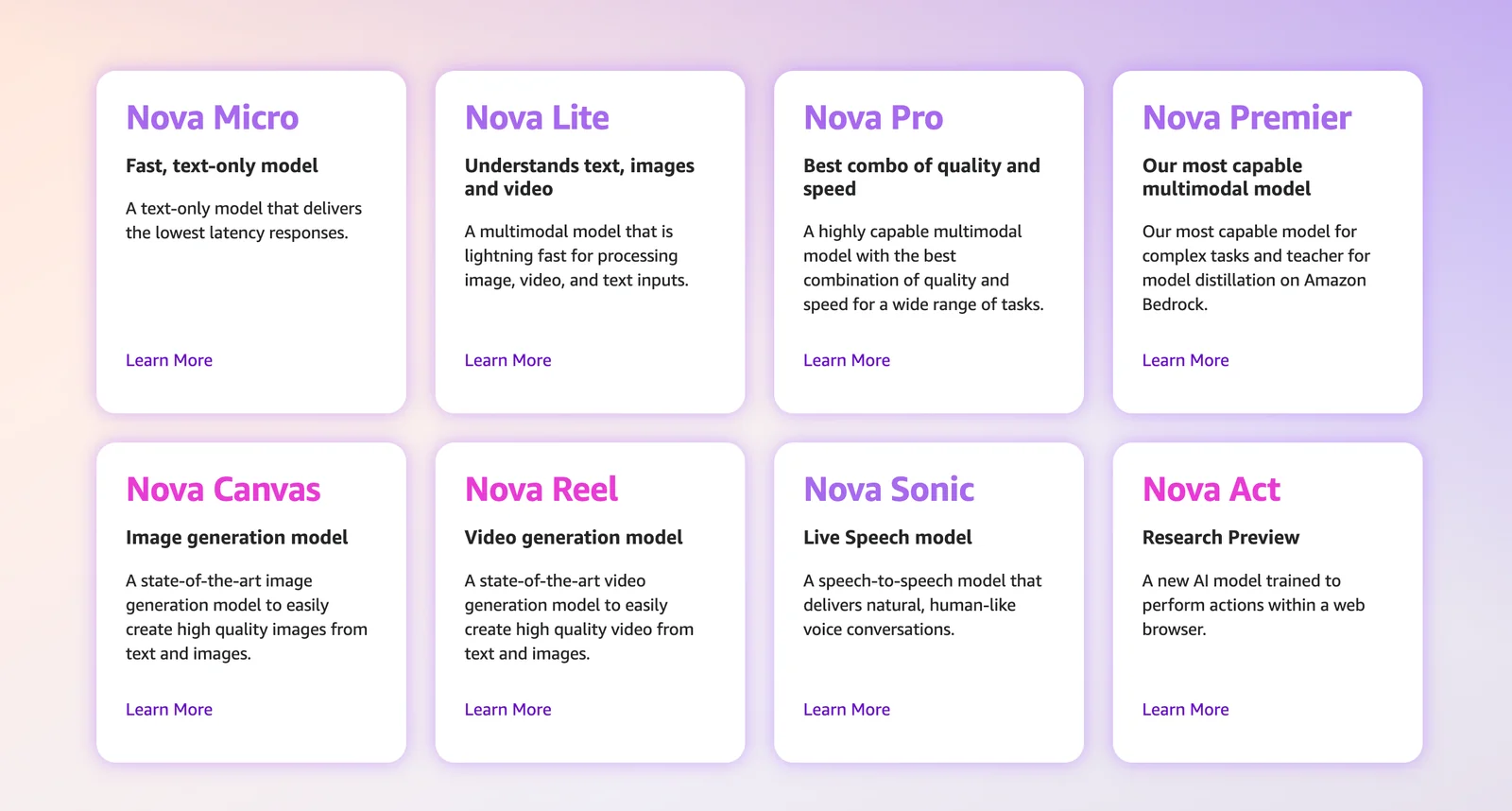
Screenshots
Key Features
Use Cases



Frequently asked questions about Nova Act by Amazon
What is the pricing structure for Nova Act by Amazon?
Nova Act by Amazon features a freemium pricing structure. Users can access a free trial offering a web playground and an API key. For production use, pricing is based on usage, with options for monthly subscriptions and per-agent-hour billing for deployed workflows, making it flexible for various needs.
Key Points
- Freemium Model: Start with a free trial.
- Usage-Based Pricing: Charges are based on actual usage.
- Flexible Plans: Options for monthly subscriptions and per-agent-hour billing.
Detailed Explanation
Nova Act’s pricing model is designed to accommodate both new users and established businesses. The freemium model allows potential customers to explore the platform without initial investment. During the free trial, users can experiment with the web playground and utilize an API key for testing various features.
Once ready for production, users can transition to a usage-based pricing system. This means costs are incurred based on the actual resources consumed, making it economical for businesses that want to scale their operations without committing to a fixed cost upfront.
There are two primary payment models for production use:
- Monthly Subscription: Ideal for consistent usage, where users pay a flat rate for access.
- Per-Agent-Hour Billing: Suitable for workflows that require varying levels of engagement, where charges are incurred based on the hours agents are actively deployed.
Example Scenario
For instance, a small business experimenting with Nova Act might start with the free trial to test its capabilities. After evaluating its needs, they may choose a monthly subscription when they decide to deploy it across their team, ensuring predictable budgeting.
Best Practices / Tips
- Evaluate Your Needs: Before choosing a plan, assess your usage requirements to select the most cost-effective option.
- Monitor Usage: Keep track of how many hours agents are deployed to avoid unexpected charges with per-agent-hour billing.
- Utilize the Free Trial: Make the most of the free trial to fully understand the platform's capabilities and how they align with your business goals.
Additional Resources
How does Nova Act automate UI workflows from natural language?
Nova Act automates UI workflows from natural language by converting conversational commands into browser actions such as clicking, typing, and navigating. This capability empowers non-technical users to streamline repetitive tasks in web applications, significantly boosting productivity without the need for programming skills.
Key Points
- Natural Language Processing: Nova Act utilizes advanced NLP to interpret user commands.
- No Coding Required: Users can automate tasks without any programming knowledge.
- Enhanced Productivity: Speeds up workflows by eliminating manual task execution.
Detailed Explanation
Nova Act leverages cutting-edge Natural Language Processing (NLP) to interpret user instructions given in plain language. For instance, if a user says, "Click on the login button and enter my credentials," Nova Act recognizes these commands and performs the actions in a web browser.
Use Cases
- Customer Support: A support agent can automate common tasks like retrieving user information or updating ticket statuses, allowing them to focus on complex queries.
- Data Entry: Sales representatives can quickly input data into CRM systems by simply stating what needs to be done, rather than manually filling out forms.
- E-Commerce: Users can automate order processing by instructing the system to navigate product pages, add items to carts, and complete purchases.
Step-by-Step Guidance
- Initiate Nova Act: Begin by launching the Nova Act interface.
- Speak or Type Commands: Input your instructions either via voice or by typing.
- Review Actions: Nova Act displays the intended actions for your confirmation.
- Execute Workflow: Once confirmed, the automation takes place seamlessly in the browser.
Best Practices / Tips
- Be Specific: Use clear and specific commands to improve the accuracy of the automation.
- Test Commands: Start with simple tasks to familiarize yourself with the tool before tackling more complex workflows.
- Regular Updates: Keep your Nova Act application updated to leverage new features and improvements.
Additional Resources
Can I integrate Nova Act with AWS services?
Yes, Nova Act seamlessly integrates with AWS services, including AWS Bedrock for deploying and managing agent workflows. This integration enhances scalability for production usage and provides robust monitoring capabilities through AWS CloudWatch, ensuring optimal performance and reliability.
Key Points
- Seamless integration with AWS services
- Utilization of AWS Bedrock for workflow management
- Monitoring with AWS CloudWatch
Detailed Explanation
Integrating Nova Act with AWS services allows organizations to leverage the full power of cloud computing for their AI-driven applications. By using AWS Bedrock, users can deploy sophisticated AI models efficiently, streamlining the process of creating, managing, and scaling agent workflows.
Benefits of Integrating with AWS
- Scalability: AWS infrastructure is designed to scale with demand. Whether you're handling thousands or millions of requests, Nova Act ensures that your applications can grow without compromising performance.
- Monitoring and Analytics: With AWS CloudWatch, you can monitor your Nova Act applications in real-time. This integration provides insights into performance metrics, error rates, and user engagement, enabling proactive system management.
- Cost Efficiency: AWS offers a pay-as-you-go model, allowing businesses to optimize their spending based on actual usage. This financial flexibility is crucial for startups and enterprises alike.
Use Cases
- Customer Support Automation: Businesses can deploy Nova Act with AWS to create intelligent chatbots that manage customer inquiries, leveraging the scalability of AWS to handle peak traffic.
- Data Analysis: Organizations can use Nova Act to automate data processing tasks, integrating with AWS services like S3 for data storage and Lambda for serverless computing to analyze large datasets efficiently.
Best Practices / Tips
- Plan Your Architecture: Before integration, design a clear architecture that outlines how Nova Act will interact with various AWS services. This helps prevent bottlenecks and ensures smooth operation.
- Leverage CloudWatch: Regularly review metrics in AWS CloudWatch to identify potential issues early. Set up alerts for critical thresholds to maintain performance.
- Optimize Costs: Use AWS Cost Explorer to analyze your usage and identify areas where you can reduce expenses, such as using reserved instances or adjusting scaling settings.
Additional Resources
What are the key use cases for Nova Act in business operations?
Nova Act is highly effective for automating repetitive web UI tasks, performing end-to-end QA testing, extracting data in authenticated sessions, and enhancing customer support operations. Its human-in-the-loop feature guarantees quality control, making it suitable for complex and critical business processes.
Key Points
- Automation of Repetitive Tasks: Streamlines workflows by minimizing manual efforts.
- Quality Assurance Testing: Ensures software reliability through comprehensive testing.
- Data Extraction: Efficiently gathers information from secure environments.
Detailed Explanation
Automation of Repetitive Tasks
Nova Act excels in automating mundane web UI tasks, such as filling forms, clicking buttons, and navigating through websites. This capability drastically reduces human error and frees up valuable time for employees to focus on strategic initiatives. For instance, a marketing team can use Nova Act to automate the process of updating multiple product listings on an e-commerce site, which can save hours of manual work.
Quality Assurance Testing
In the realm of software development, quality assurance (QA) is crucial. Nova Act's ability to perform end-to-end QA testing ensures that applications function correctly across various platforms and devices. By simulating user interactions, it can uncover bugs or inconsistencies before software deployment. For example, a financial service provider might utilize Nova Act to test their web application’s login functionality, ensuring a smooth user experience.
Data Extraction
Nova Act simplifies the data extraction process, especially in authenticated sessions where secure login is required. Businesses can gather critical data from web applications without compromising security. For example, a research firm could leverage Nova Act to extract large datasets from a secure database, streamlining their data analysis efforts.
Customer Support Operations
Nova Act enhances customer support by automating responses to common inquiries and guiding customers through troubleshooting steps. This reduces response times and improves customer satisfaction. For example, an online retailer can implement Nova Act to automatically handle return requests, allowing customer service representatives to focus on more complex issues.
Best Practices / Tips
- Identify Repetitive Tasks: Start by mapping out workflows to identify tasks suitable for automation.
- Test in Staging Environments: Always run tests in a safe staging environment before deploying to minimize risks.
- Monitor Performance: Regularly analyze the performance of automated tasks to ensure they meet business objectives.
- Incorporate Human Oversight: Utilize the human-in-the-loop feature for critical tasks that require decision-making or nuanced judgment.
Additional Resources
How does Nova Act compare to other browser automation tools?
Nova Act outperforms other browser automation tools by leveraging advanced natural language processing, which simplifies script generation for non-technical users. Its unique human-in-the-loop escalation feature also enhances decision-making, setting it apart from conventional automation tools that often require extensive technical expertise.
Key Points
- Natural Language Processing: Simplifies script creation for all skill levels.
- Human-in-the-Loop Feature: Enhances automation with human oversight.
- User-Friendly Interface: Designed for non-experts, reducing the learning curve.
Detailed Explanation
Nova Act is revolutionizing the browser automation landscape by integrating natural language processing (NLP). This functionality enables users to create automation scripts by simply inputting commands in plain language, which is a significant advantage for businesses without a dedicated tech team. For instance, a marketing team can automate data entry tasks without needing to learn complex programming languages.
Moreover, the human-in-the-loop escalation feature allows the automation process to seamlessly involve human judgment when necessary. This is particularly beneficial in scenarios where decision-making requires nuance, such as approving transactions or handling exceptions. In contrast, traditional automation tools often lack this critical step, risking errors or inefficiencies.
Use Cases
- Data Scraping: Marketing teams can easily gather competitor pricing data by issuing simple commands.
- Automated Testing: QA teams can create test scripts quickly, improving software release cycles.
- Customer Support: Automated responses can be generated for common inquiries, while complex issues are escalated to human agents.
Best Practices / Tips
- Start Simple: Begin with basic automation tasks to familiarize yourself with Nova Act’s capabilities.
- Leverage NLP: Use natural language commands for script generation to save time and reduce errors.
- Monitor Performance: Regularly review automated processes and human escalations to optimize efficiency and accuracy.
- Train Your Team: Provide training sessions for non-technical staff to maximize the tool's potential.
Additional Resources
Explore more AI Ai Models tools
Browse all Ai Models tools →Browse by use case: Automation & Productivity
Compare Nova Act by Amazon: vs SWE-2 · vs Desert Ant Labs · vs Hy4 preview · vs Soup CLI