

Feynman
AIOpen-source AI research agent that reads papers, ranks literature, drafts research and plans experiments from the terminal or a local workbench.
Feynman
Open-source AI research agent that reads papers, ranks literature, drafts research and plans experiments from the terminal or a local workbench.
About Feynman
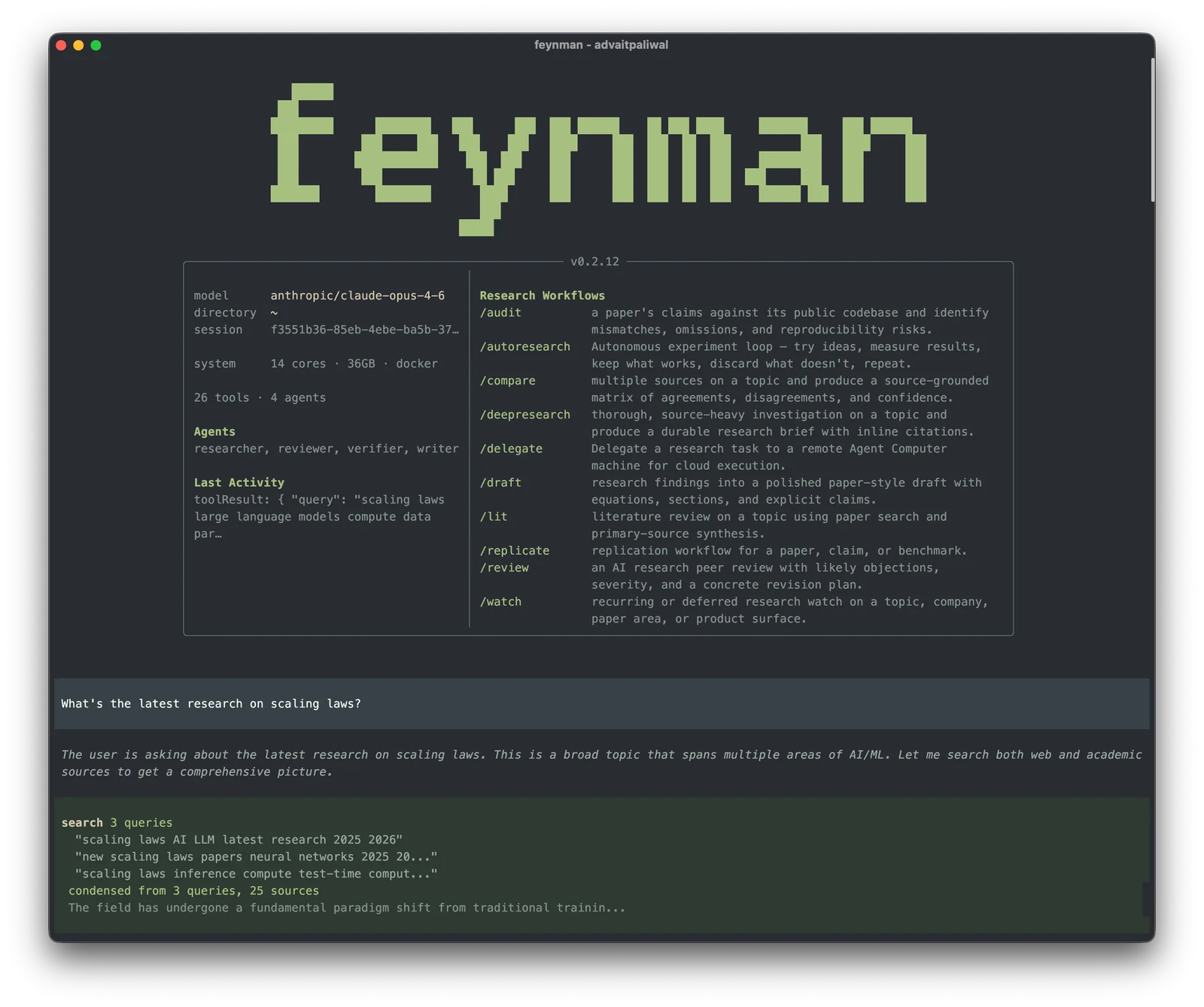
Feynman is an open-source research agent that runs on your own machine, either as a terminal CLI or as a local "science workbench" served on localhost. It searches the literature and the web, resolves papers from a DOI, arXiv ID, OpenAlex ID, PMID, PMCID or title, and returns briefs whose claims carry citations back to the source. Its PaperRank command scores candidate papers on citation evidence, methodology, reproducibility and provenance so you can decide what to read first with the reasoning shown rather than hidden. Beyond reading, it runs deep multi-agent research passes, drafts literature reviews with consensus and open questions, audits whether a paper's claims match its released code, and produces replication plans and implementable training recipes. The workbench mode adds project and session navigation, chat, notebooks, compute, chemistry sketches, spreadsheet and LaTeX previews, and artifact versioning with execution logs and verification checks. It installs as a standalone bundle with a pinned Node runtime or via npm, works with hosted providers and with local models through LM Studio, Ollama, vLLM or a LiteLLM proxy, and can be installed as a skills-only bundle into Claude, Codex or OpenCode projects.
Screenshots
Key Features
Use Cases



Frequently asked questions about Feynman
What is Feynman?
Open-source AI research agent that reads papers, ranks literature, drafts research and plans experiments from the terminal or a local workbench.
How does Feynman work?
Feynman works by combining Cited Research Briefs: Asking a research question returns a synthesized brief where each claim is tied to the paper or web source it came from, rather than an unsourced summary., PaperRank Scoring: Ranks papers on a topic with transparent evidence for citations, methodology, reproducibility and provenance so reading order is a decision you can inspect., Paper Access Resolver: Resolves a single DOI, arXiv ID, OpenAlex ID, PMID, PMCID or title against OpenAlex, arXiv/alphaXiv, DOI and Europe PMC, with optional full-text fetching., Local Science Workbench: feynman serve opens a standalone app with projects, sessions, chat, notebooks, compute, artifact previews and provenance in one place., Claim Auditing and Replication: Compares a paper's stated claims against what its code actually does, and generates replication plans with compute targets and gated experiment steps. to help users with Deciding What to Read: Ranking a fresh literature pile on a topic by reproducibility and methodology instead of citation count alone., Writing a Literature Review: Producing a review that separates where the field agrees from where questions remain open, with citations attached., Verifying a Paper's Claims: Auditing whether the results a paper reports are supported by the code and data it released., Planning a Replication: Turning a published finding into a concrete replication plan with a compute target and staged experiment steps., Running Deep Research Passes: Launching a multi-agent deep dive on a topic that synthesizes findings and verifies them before reporting..
What are the main features of Feynman?
Key features include Cited Research Briefs: Asking a research question returns a synthesized brief where each claim is tied to the paper or web source it came from, rather than an unsourced summary., PaperRank Scoring: Ranks papers on a topic with transparent evidence for citations, methodology, reproducibility and provenance so reading order is a decision you can inspect., Paper Access Resolver: Resolves a single DOI, arXiv ID, OpenAlex ID, PMID, PMCID or title against OpenAlex, arXiv/alphaXiv, DOI and Europe PMC, with optional full-text fetching., Local Science Workbench: feynman serve opens a standalone app with projects, sessions, chat, notebooks, compute, artifact previews and provenance in one place., Claim Auditing and Replication: Compares a paper's stated claims against what its code actually does, and generates replication plans with compute targets and gated experiment steps..
Who is Feynman for?
Feynman is useful for anyone interested in Deciding What to Read: Ranking a fresh literature pile on a topic by reproducibility and methodology instead of citation count alone., Writing a Literature Review: Producing a review that separates where the field agrees from where questions remain open, with citations attached., Verifying a Paper's Claims: Auditing whether the results a paper reports are supported by the code and data it released., Planning a Replication: Turning a published finding into a concrete replication plan with a compute target and staged experiment steps., Running Deep Research Passes: Launching a multi-agent deep dive on a topic that synthesizes findings and verifies them before reporting..
How much does Feynman cost?
Feynman is free to use.
How do I get started with Feynman?
Visit https://feynman.is to sign up and explore Feynman.
Explore more AI Ai Agents tools
Browse all Ai Agents tools →Compare Feynman: vs Kopai · vs Switch · vs Nina by Antalpha · vs Kit