

CartAI
AIAPI for a specialized AI agent that navigates any web property and reliably completes checkouts, subscriptions, invoices, and orders.
CartAI
API for a specialized AI agent that navigates any web property and reliably completes checkouts, subscriptions, invoices, and orders.
About CartAI
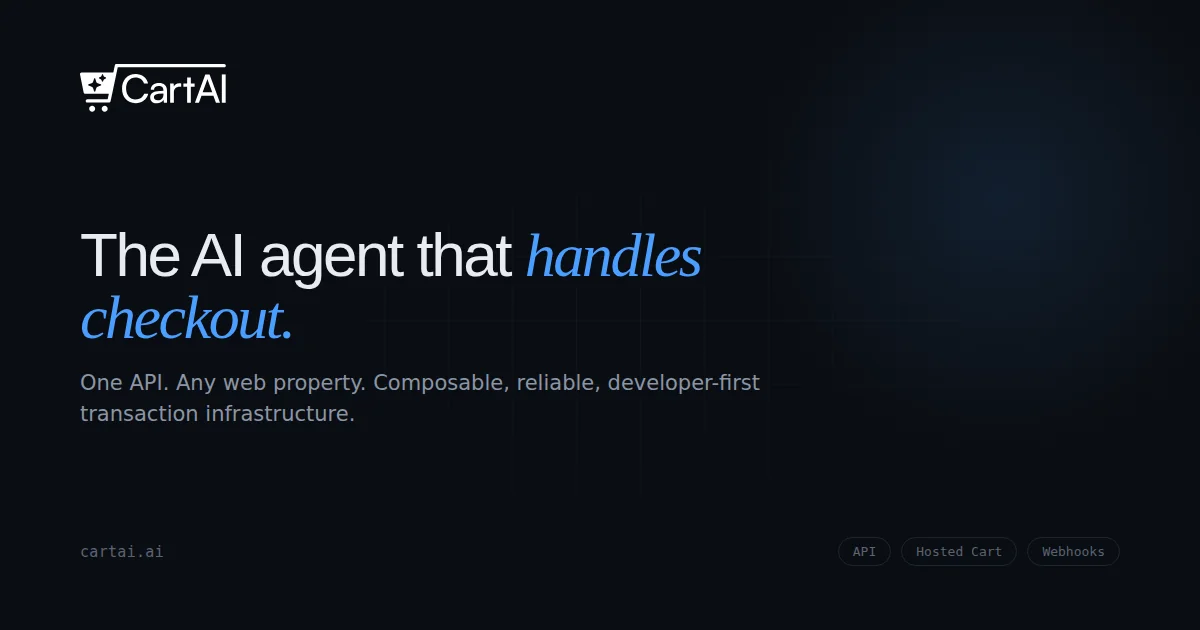
CartAI is a developer-first API that deploys a specialized AI agent to complete transactions on any web property — retail checkouts, subscription sign-ups, invoice payments, vendor portal orders, and any other flow where a purchase has to actually clear. Instead of trying to be a general browser-automation or agentic-payment platform, CartAI fuses AI-driven browser execution with a PCI-compliant payment stack into a single primitive whose only job is to land the transaction. Workflows are composable step primitives with conditional branching, are idempotent and retry-safe, and support login-gated sites, 3DS, and custom carts. Integration is a single POST to /checkout with async execution reported via webhooks (STARTED, COMPLETED, FAILED), letting teams embed transactional agents into products or enable checkout on surfaces that never had it.
Screenshots
Key Features
Use Cases



Frequently asked questions about CartAI
What is CartAI?
CartAI is an advanced API that enables a specialized AI agent to seamlessly navigate any web property, efficiently completing tasks such as checkouts, subscriptions, invoices, and orders. This innovative tool enhances user experience by automating complex processes, making online transactions smoother and faster.
Key Points
- Seamless Navigation: CartAI can navigate various web platforms effortlessly.
- Task Automation: It automates checkouts, subscriptions, and order processes.
- Enhanced User Experience: Improves efficiency and reduces cart abandonment rates.
Detailed Explanation
CartAI is designed to optimize online shopping by utilizing a specialized AI agent that mimics human behavior to complete transactions. It can handle various web properties, from e-commerce sites to service subscriptions, allowing businesses to streamline their sales processes.
For instance, when a user initiates a purchase, CartAI can fill out forms, apply discounts, and finalize payments without human intervention. This capability is invaluable for reducing cart abandonment, as it ensures a smoother checkout experience.
Businesses can implement CartAI through a simple API integration, allowing them to customize the AI's behavior to match their specific requirements, such as supporting multiple payment gateways or handling complex subscription models.
Use Cases:
- E-commerce Websites: Automate the checkout process to increase conversion rates.
- Subscription Services: Simplify user sign-ups and payment management for recurring services.
- Invoice Processing: Streamline the approval and payment process for businesses that rely on invoicing.
Best Practices / Tips
- Test Integration: Always test CartAI with a variety of products and services to ensure compatibility and efficiency.
- Monitor Performance: Regularly review analytics to gauge the effectiveness of CartAI in reducing abandonment rates.
- User Feedback: Collect user feedback to continuously improve the AI's navigation and transaction handling.
- Stay Updated: Keep abreast of updates in the CartAI API to leverage new features and improvements.
Additional Resources
How does CartAI work?
CartAI integrates various technologies to streamline online transactions by utilizing composable workflows, a PCI-compliant payment stack, and an asynchronous API with webhooks, enabling seamless payment processing and order management across diverse platforms without compromising security or user experience.
Key Points
- Composable Transaction Workflows: Customizable steps for transactions.
- PCI-Compliant Payment Stack: Secure card handling and payment execution.
- Idempotent, Retry-Safe Execution: Ensures reliable transaction processing.
Detailed Explanation
CartAI revolutionizes the online payment landscape by combining several crucial components that enhance user experience and transaction security.
-
Composable Transaction Workflows: CartAI allows businesses to assemble specific workflows tailored to their needs. Key steps can include shipping, 3DS security, login requirements, and coupon applications. This flexibility ensures that every transaction is streamlined, leading to a higher conversion rate.
-
PCI-Compliant Payment Stack: Security is paramount in online transactions. CartAI's built-in card handling ensures that sensitive information never touches the merchant's servers. This PCI compliance not only protects user data but also helps businesses avoid hefty fines associated with data breaches.
-
Idempotent, Retry-Safe Execution: CartAI's design ensures that every transaction step can survive retries without causing double charges or partial orders. This feature is crucial in real-world scenarios where connectivity issues may disrupt the transaction process. For example, if a user loses internet connection during checkout, they won't face duplicate charges when they retry.
-
Universal Web Coverage: CartAI can be integrated across various web properties, including e-commerce checkouts, custom carts, and intranet portals. This versatility makes it an ideal solution for businesses with diverse online platforms.
-
Async API with Webhooks: The CartAI API facilitates asynchronous operations, allowing businesses to initiate checkout processes without waiting for synchronous responses. A single POST request to
/checkoutreturns a taskId, while webhook events like STARTED, COMPLETED, and FAILED keep the application in sync with transaction progress.
Use Cases
- Embedded Checkout in AI Apps: Integrate CartAI into chatbots or virtual agents, allowing them to seamlessly facilitate purchases without extensive integration work.
- Automated B2B Procurement: Streamline purchasing by allowing agents to submit orders across multiple vendor portals that may have different login and purchase order processes.
- Subscription Sign-Up Automation: Automatically enroll users in third-party subscriptions when first-party APIs are unavailable, enhancing user experience and engagement.
Best Practices / Tips
- Test Composable Workflows: Regularly test and optimize your workflows to ensure they meet evolving customer needs and improve conversion rates.
- Monitor Security Compliance: Keep up with PCI compliance changes and ensure your payment stack remains secure.
- Utilize Webhooks Efficiently: Implement robust error handling and monitoring for your webhook events to maintain transaction integrity.
Additional Resources
What are the main features of CartAI?
CartAI offers powerful features including Composable Transaction Workflows, a PCI-Compliant Payment Stack, Idempotent, Retry-Safe Execution, Universal Web Coverage, and an Async API with Webhooks, ensuring secure, reliable, and efficient transactions across various platforms.
Key Points
- Composable Transaction Workflows: Customize transaction steps.
- PCI-Compliant Payment Stack: Secure card handling.
- Idempotent, Retry-Safe Execution: Prevent double-charging.
Detailed Explanation
CartAI is designed to streamline and secure payment processes in e-commerce and other online platforms. Here’s a closer look at its key features:
-
Composable Transaction Workflows: This feature allows users to design specific workflows tailored to their needs. For example, a business can easily integrate steps such as shipping, 3D Secure (3DS) verification, user login, and coupon applications into a single transaction flow, ensuring that all necessary actions occur before finalizing a payment.
-
PCI-Compliant Payment Stack: Security is paramount in online transactions. CartAI ensures that sensitive card data never touches your servers, minimizing the risk of data breaches. This compliance with PCI standards means businesses can confidently process payments without worrying about security vulnerabilities.
-
Idempotent, Retry-Safe Execution: One of the most critical aspects of online transactions is handling errors and retries. CartAI's architecture is designed to prevent double-charging customers or creating partial orders. If a transaction fails, the system can retry steps safely, ensuring that the customer experience remains seamless.
-
Universal Web Coverage: CartAI's versatility allows it to integrate with any web property. Whether it’s an e-commerce checkout, a custom cart, or a vendor portal, businesses can implement CartAI to enhance their transaction processes.
-
Async API with Webhooks: The asynchronous API design allows for efficient processing. When a checkout request is initiated, a unique taskId is returned. Businesses can then rely on webhook notifications for updates on transaction status, such as STARTED, COMPLETED, or FAILED, allowing for real-time synchronization of application states.
Best Practices / Tips
- Customize Workflows: Take advantage of Composable Transaction Workflows to tailor your checkout process for maximum efficiency and user experience.
- Regular Security Audits: Ensure compliance with PCI standards through regular security checks and updates to your payment processing systems.
- Monitor Webhook Events: Implement robust logging and monitoring for webhook events to quickly address any failures or issues in transaction processing.
Additional Resources
Who is CartAI for?
CartAI is designed for businesses and individuals seeking to streamline online purchasing and procurement processes. Its functionalities cater to embedded checkout in AI applications, automated B2B procurement, subscription management, price-triggered buying, and agent-driven bill payments, making it a versatile tool for various purchasing needs.
Key Points
- Embedded Checkout in AI Apps: Enables seamless purchasing directly from chat or agent interfaces.
- Automated B2B Procurement: Facilitates order submissions and invoice payments across multiple vendor portals.
- Subscription Sign-Up Automation: Automates user enrollment in third-party subscriptions.
Detailed Explanation
CartAI provides a robust solution for various purchasing scenarios:
-
Embedded Checkout in AI Apps: This feature allows AI chatbots or virtual agents to recommend products and enable users to purchase them without the need for complex site-specific integrations. For instance, a customer interacting with a shopping assistant can directly buy a recommended item, enhancing user experience and conversion rates.
-
Automated B2B Procurement: Businesses often face challenges managing multiple vendor portals with different login credentials and purchase order (PO) processes. CartAI automates this by allowing agents to submit orders and pay invoices seamlessly across various platforms, reducing manual effort and potential errors. This is particularly useful for large organizations that handle numerous suppliers.
-
Subscription Sign-Up Automation: For businesses looking to integrate third-party subscription services, CartAI can automate the enrollment process, especially when first-party APIs are unavailable. This functionality can save time and improve customer retention by simplifying the sign-up experience.
-
Retail Price-Trigger Buying: With this feature, users can set target prices for products. CartAI automatically executes purchases when a product hits the desired price or restocks on supported retail sites, ensuring users never miss a deal.
-
Agent-Driven Bill Pay: For recurring invoices that require manual navigation on vendor portals, CartAI allows agents to automate the payment process. This reduces the administrative burden and ensures timely payments.
Best Practices / Tips
- Identify Your Use Case: Determine which features of CartAI best fit your business needs—whether it’s for e-commerce, B2B procurement, or subscription management.
- Integrate with Existing Systems: Ensure CartAI is compatible with your current platforms to maximize efficiency and minimize disruption.
- Monitor Performance: Regularly review purchasing patterns and automated processes to identify areas for improvement or optimization.
Additional Resources
How much does CartAI cost?
CartAI offers various pricing plans designed to fit different business needs, starting at approximately $29 per month. For the most accurate and up-to-date information, visit the official CartAI website to explore their current pricing options and any promotional offers available.
Key Points
- CartAI has multiple pricing tiers tailored for different businesses.
- Monthly subscription plans begin at around $29.
- Check the official website for the latest promotions and updates.
Detailed Explanation
CartAI is a sophisticated AI-driven tool designed to enhance e-commerce experiences through personalized recommendations and streamlined checkout processes. Its pricing structure typically includes several tiers, allowing businesses to choose a plan that best suits their size and operational requirements.
-
Basic Plan: Starting at approximately $29 per month, this plan is ideal for small businesses or startups looking to leverage AI technology without a significant financial commitment.
-
Professional Plan: For medium-sized businesses, this plan might range from $79 to $149 per month. It typically includes additional features like advanced analytics and priority customer support.
-
Enterprise Solutions: Larger organizations may require custom solutions, often priced based on specific needs and usage metrics.
CartAI frequently updates its pricing and may offer promotional discounts or free trials, so visiting their official website is crucial for the latest information. Additionally, they may provide case studies or testimonials from current users, showcasing the value and ROI that different pricing plans can deliver.
Best Practices / Tips
- Review Features: Before selecting a plan, carefully review the features included in each tier to ensure it aligns with your business goals.
- Consider Long-term Costs: Evaluate the potential long-term costs versus immediate savings when choosing a plan. Sometimes a higher-tier plan offers better value due to enhanced functionalities.
- Leverage Free Trials: Take advantage of any free trial offers to test CartAI's capabilities and see how it integrates with your existing systems before committing to a subscription.
Additional Resources
How do I get started with CartAI?
To get started with CartAI, visit https://cartai.ai/ and sign up for an account. Once registered, you can explore its features, including AI-driven analytics and personalized shopping experiences designed to enhance customer engagement and boost sales.
Key Points
- Easy Registration: Simple sign-up process to create your account.
- Feature Exploration: Access to various AI tools and functionalities.
- User Support: Guidance available throughout the setup process.
Detailed Explanation
To begin using CartAI, follow these steps:
- Visit the Website: Navigate to CartAI's official website.
- Sign Up: Click on the "Sign Up" button to create your account. You’ll need to provide basic information such as your name, email address, and password.
- Explore Features: After signing in, take some time to familiarize yourself with CartAI's dashboard. Key features include:
- AI-Driven Analytics: Understand customer behavior and preferences through data insights.
- Personalized Shopping Experiences: Use AI to tailor product recommendations for individual users.
- Set Up Integrations: If you have an existing eCommerce platform, explore how to integrate CartAI seamlessly for optimal performance.
- Utilize Tutorials: Access tutorials and documentation available in the help section to maximize the tool's capabilities.
Use Cases
- Retail Optimization: Retailers can utilize CartAI to understand which products are trending, enabling smarter inventory management.
- Customer Engagement: E-commerce businesses can enhance user experience by providing personalized product suggestions based on browsing history.
Best Practices / Tips
- Complete Your Profile: Ensure your profile is fully filled out to receive tailored recommendations from CartAI.
- Regularly Review Analytics: Check your analytics dashboard weekly to stay updated on customer trends and adapt your strategies accordingly.
- Leverage Customer Feedback: Encourage customers to provide feedback on their shopping experience to further refine the AI’s recommendations.
Additional Resources
- CartAI Documentation - Comprehensive user guides and best practices.
- Webinars and Tutorials - Join live sessions or watch recordings to learn from experts.
- Support Center - Access FAQs and customer support for assistance with any issues.
Explore more AI Ai Agents tools
Browse all Ai Agents tools →Browse by use case: Automation & Productivity
Compare CartAI: vs TryCase · vs Aside · vs Wisry · vs Cline