

Deep Agents
AIOpen SourceFreeModular LangChain agent framework enabling planning, subagents, and filesystem-backed memory for complex, long-horizon tasks.
Deep Agents
Modular LangChain agent framework enabling planning, subagents, and filesystem-backed memory for complex, long-horizon tasks.
About Deep Agents
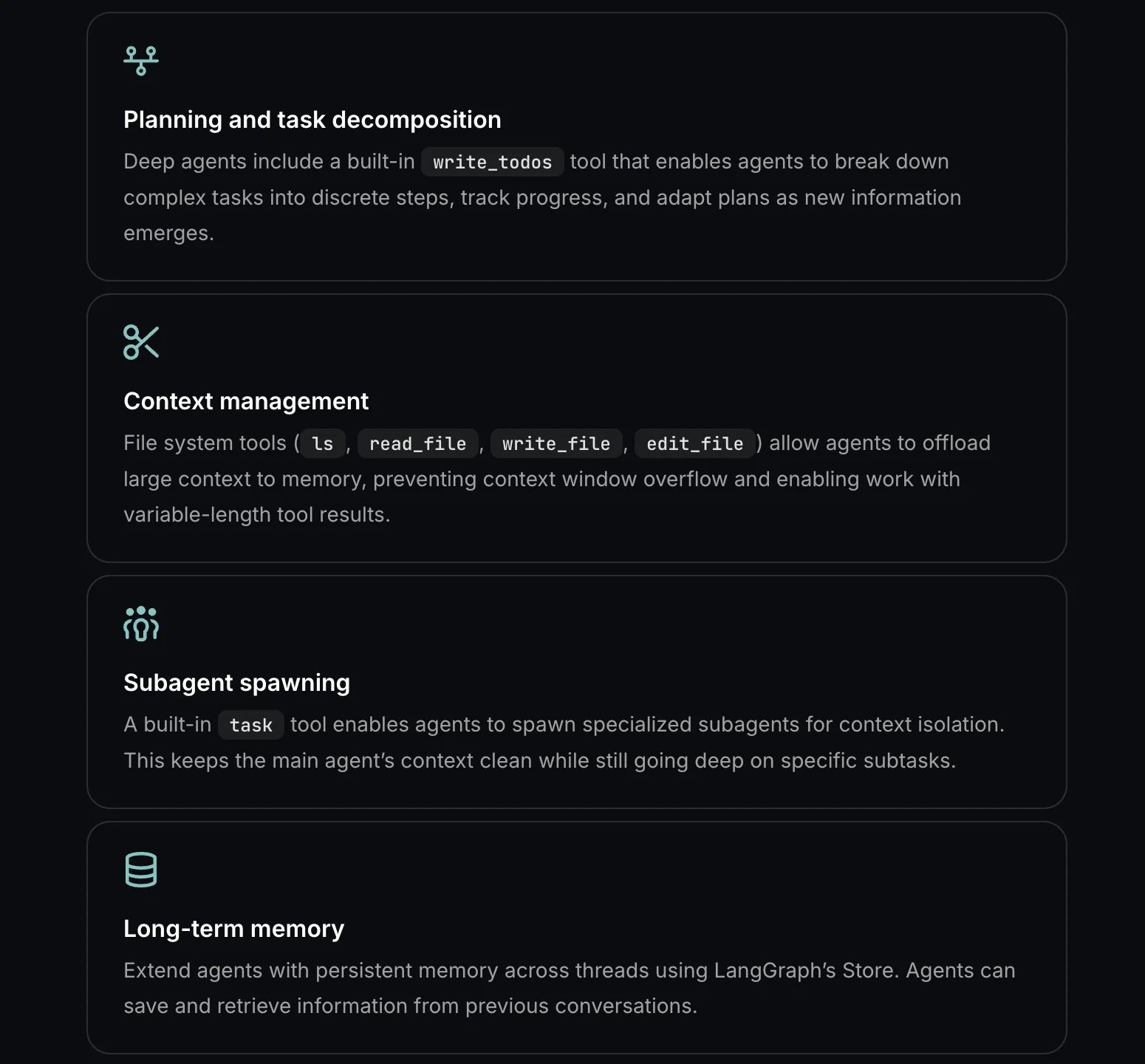
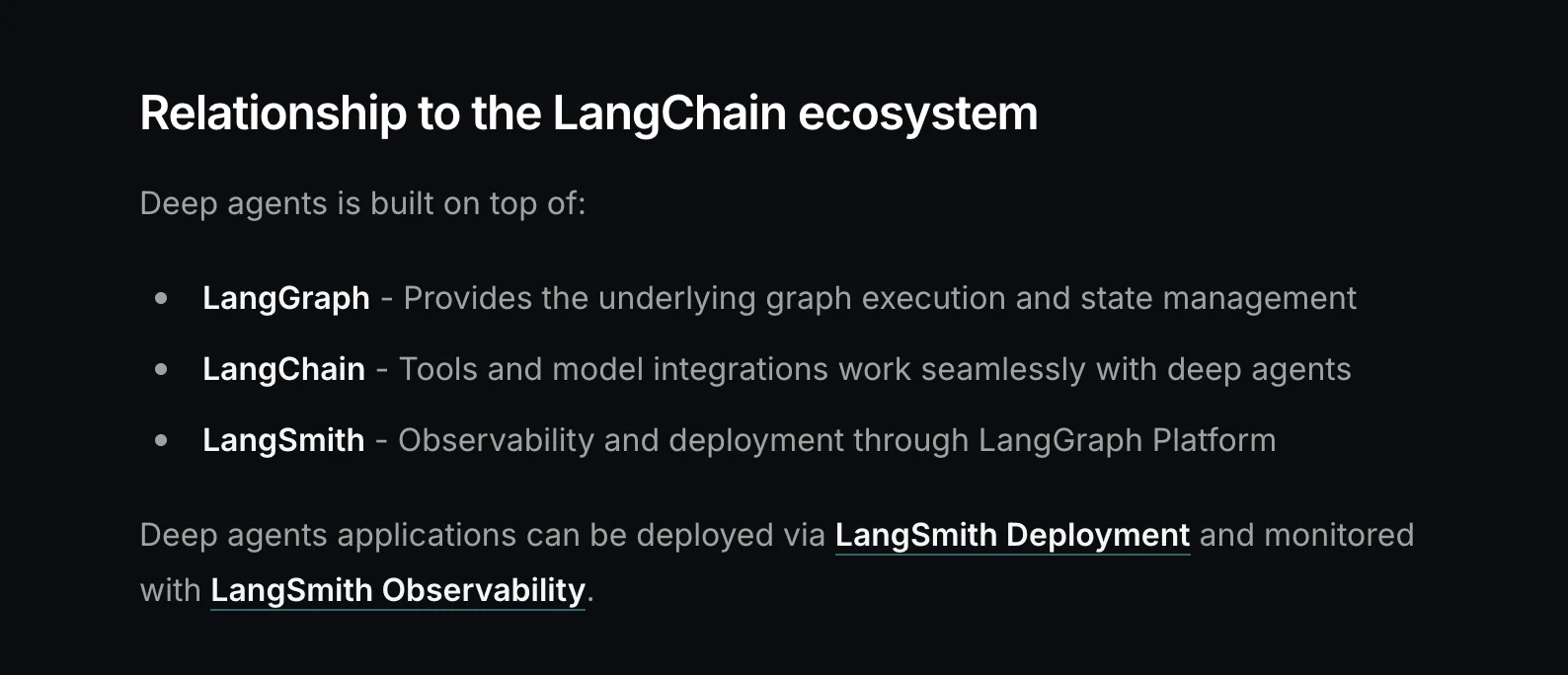
Deep Agents is a modular agent architecture in the LangChain ecosystem that combines planning, long-term filesystem-backed memory, and the ability to spawn subagents to solve complex, multi-step problems. Implemented as middleware, Deep Agents automatically attach PlanningMiddleware, FilesystemMiddleware, and SubAgentMiddleware when created via create_deep_agent, enabling structured task decomposition, persistent context storage, and delegation. The system supports human-in-the-loop workflows through LangGraph interrupts and a checkpointer/HITL middleware for tool approval, and the resulting agent is a LangGraph graph that can be interacted with via streaming, memory APIs, and studio tooling. Unique value comes from its composable middleware design which lets developers build research-grade, long-horizon agent workflows that balance automation, memory persistence, and human oversight.
Screenshots
Key Features
Use Cases



Frequently asked questions about Deep Agents
Is Deep Agents free to use?
Yes, Deep Agents is free to use as it is open-source. Users can access and self-host the source code on GitHub. However, costs may be incurred from utilizing LLM APIs and the necessary hosting infrastructure.
Key Points
- Open-source availability: Deep Agents can be accessed on GitHub.
- Self-hosting freedom: Users have the ability to host their own instances.
- Potential costs: While the software itself is free, there might be costs associated with API usage and hosting.
Detailed Explanation
Deep Agents is an innovative tool designed for building intelligent agents using AI technologies. As an open-source project, it allows developers and businesses to leverage its capabilities without any licensing fees. The source code is available on GitHub, making it accessible for anyone interested in deploying AI agents.
Self-Hosting
Self-hosting Deep Agents involves downloading the source code and setting it up on your server. This provides full control over the configuration and customization of the AI agents. To get started, users typically need a basic understanding of server management and programming to successfully deploy and maintain the application.
Associated Costs
While Deep Agents is free, users should be aware of potential expenses related to:
- LLM API Usage: If you plan to use large language models (LLMs) from providers like OpenAI or Hugging Face, be prepared for associated costs as these services typically charge based on usage.
- Hosting Infrastructure: Depending on the scale of your application, you may require robust server resources, which could incur costs through cloud providers (e.g., AWS, Google Cloud, Azure).
For example, if you deploy Deep Agents on a cloud platform, you might spend anywhere from $10 to $500 monthly, depending on your traffic and resource needs.
Best Practices / Tips
- Explore Community Resources: Engage with the community on GitHub and forums for support and to share experiences.
- Optimize API Usage: Monitor your API calls to ensure you’re not overspending on LLM usage. Implement caching strategies to minimize unnecessary requests.
- Choose the Right Hosting: Select a hosting provider that offers scalability, as this can help manage costs effectively as your application grows.
Additional Resources
This information will help you navigate the advantages and considerations of using Deep Agents effectively while optimizing for costs and resources.
What are the key features of Deep Agents?
Deep Agents features a modular middleware architecture, integrated planning tools, filesystem-backed long-term memory, subagent spawning capabilities, and human-in-the-loop approvals. These functionalities enable efficient and complex task management, enhancing automation while maintaining control over critical decisions.
Key Points
- Modular Middleware Architecture: Facilitates flexibility and scalability.
- Built-in Planning Tools: Enhances decision-making and task execution.
- Human-in-the-loop Approvals: Ensures oversight and accuracy.
Detailed Explanation
Deep Agents is designed to optimize task management through a variety of innovative features:
-
Modular Middleware Architecture: This allows developers to customize and extend the platform easily. By separating functionalities into modules, users can select only the components they need, making the system highly adaptable to different workflows and applications.
-
Built-in Planning Tools: Deep Agents includes sophisticated algorithms for planning and decision-making. These tools enable agents to evaluate various scenarios and outcomes, making it possible to strategize effectively and execute tasks with precision. For instance, an agent can analyze past performance data to predict the best course of action for future tasks.
-
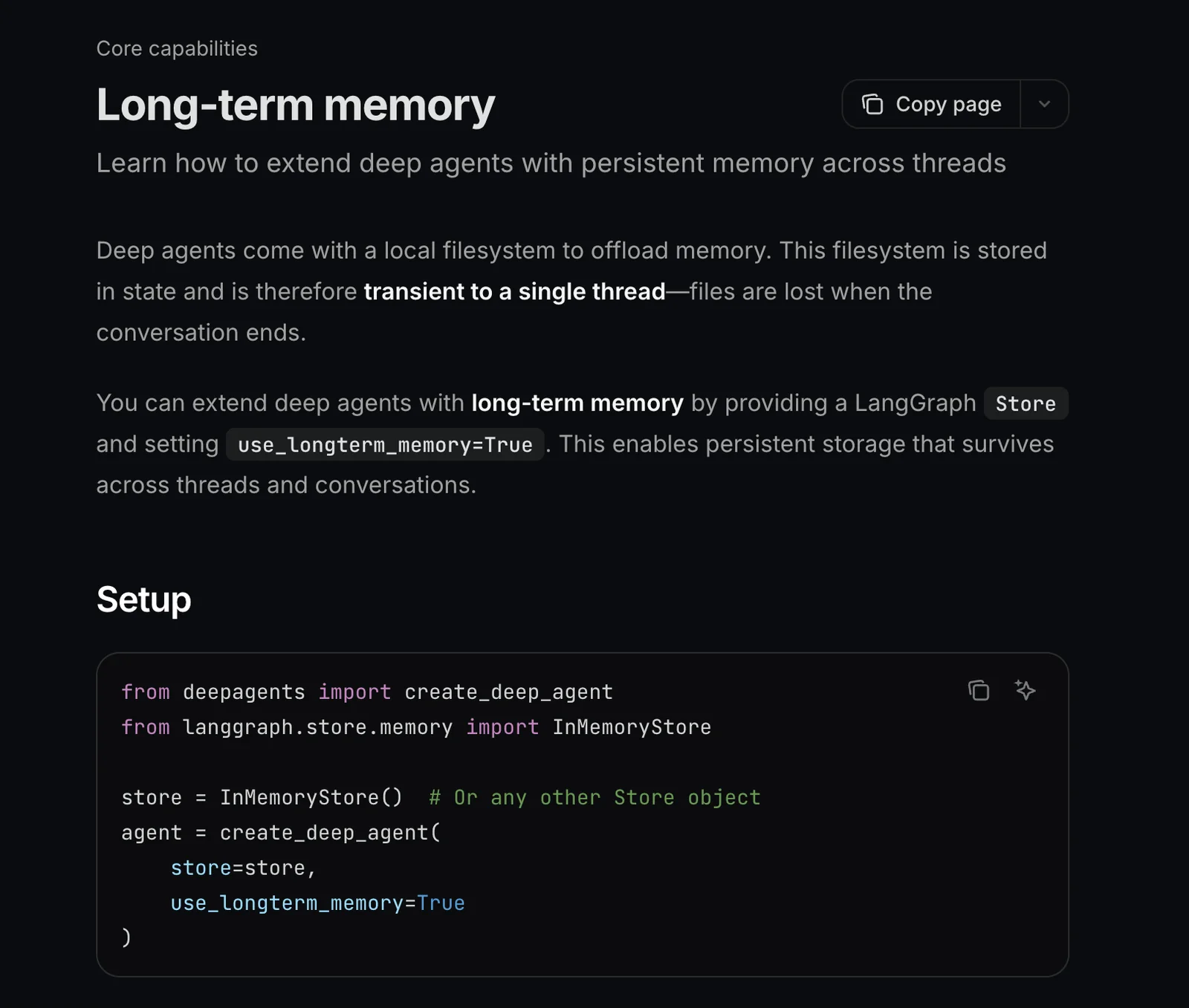
Filesystem-backed Long-term Memory: This feature allows agents to retain information over extended periods. By storing data in a structured filesystem, Deep Agents can reference historical data, improving the quality of decisions based on previous interactions and outcomes. For example, it can remember user preferences or past task results, leading to more personalized experiences.
-
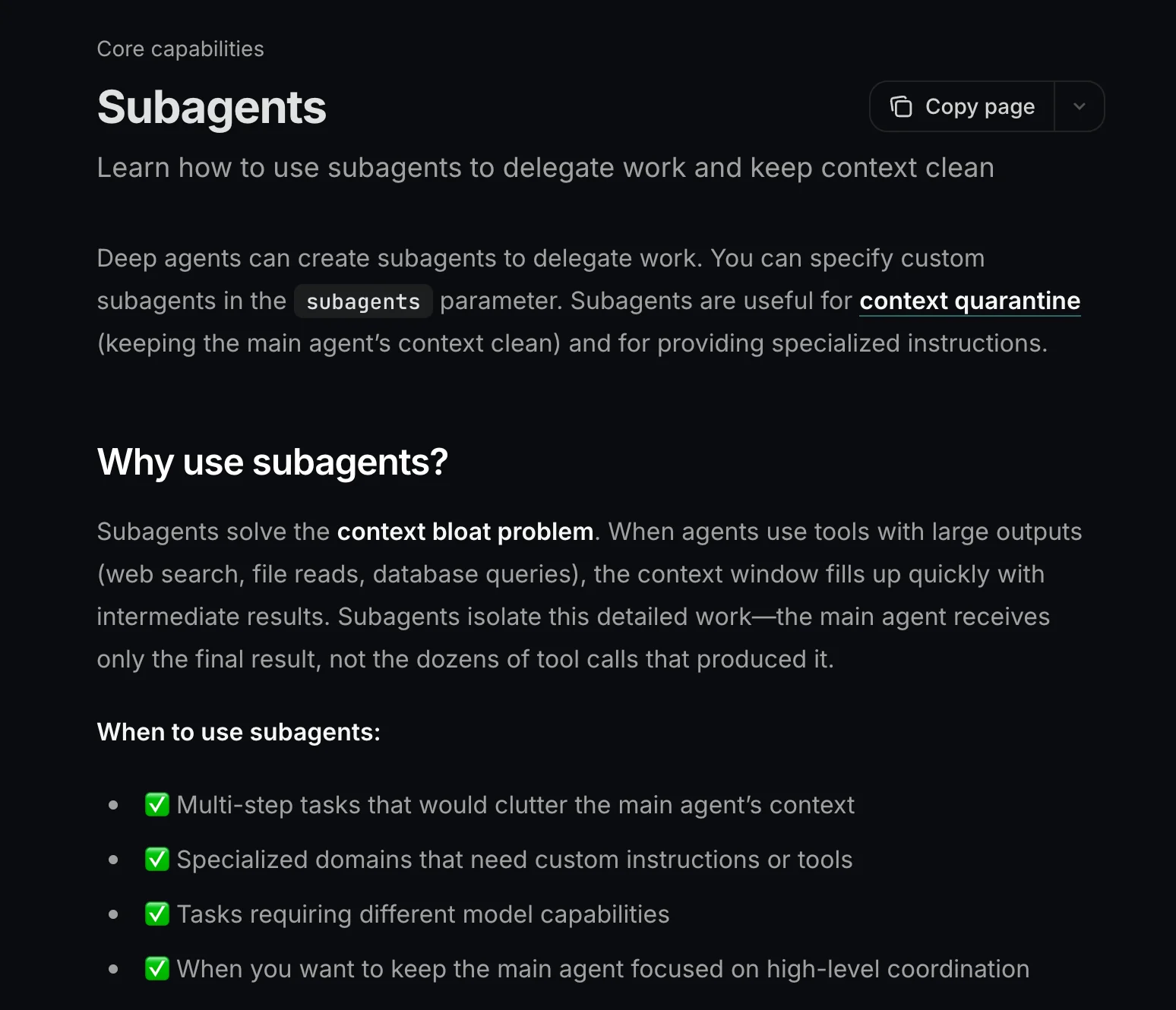
Subagent Spawning: This capability allows the main agent to create smaller, specialized agents (subagents) to handle specific tasks. This division of labor enhances efficiency, as each subagent can focus on a particular area without overwhelming the main agent. For example, a subagent could be tasked with customer support while the main agent manages project deadlines.
-
Human-in-the-loop Approvals: This feature ensures that critical decisions can be reviewed by human operators, maintaining a balance between automation and human oversight. This is particularly important in industries where accuracy is paramount, such as healthcare or finance. By integrating human approvals, Deep Agents can prevent errors and ensure compliance with regulations.
Best Practices / Tips
- Start Small: When implementing Deep Agents, begin with a single module or feature to understand its capabilities before expanding.
- Regularly Update: Keep your system updated to take advantage of new features and optimizations that can enhance performance.
- Monitor Performance: Utilize analytics tools to track the effectiveness of the agents and make data-driven adjustments to improve outcomes.
- Ensure Data Integrity: Regularly audit the information stored in long-term memory to maintain accuracy and relevance.
Additional Resources
How do I get started with Deep Agents?
To get started with Deep Agents, visit the official LangChain documentation. It offers comprehensive installation instructions, practical examples, and detailed guides to help you effectively utilize the Deep Agents framework for various AI applications.
Key Points
- Official Documentation: The primary resource for getting started.
- Installation Instructions: Step-by-step guidance for setting up.
- Practical Examples: Sample projects to illustrate usage.
Detailed Explanation
Deep Agents is a powerful framework within LangChain that enables developers to build intelligent applications using AI. To begin, follow these steps:
-
Access the Official Documentation: Navigate to the LangChain Documentation to find the specific section on Deep Agents.
-
Installation:
- Ensure you have Python 3.7 or higher installed.
- Use the following pip command to install Deep Agents:
pip install langchain[deep-agents]
-
Set Up Your Environment: After installation, create a virtual environment to manage dependencies effectively. This can be done using:
python -m venv myenv source myenv/bin/activate # For Mac/Linux myenv\Scripts\activate # For Windows -
Explore Examples: The documentation provides several examples that demonstrate how to implement Deep Agents in real-world scenarios. These examples can serve as templates for your projects.
-
Review Use Cases: Familiarize yourself with various applications of Deep Agents, such as automated customer support, data analysis, and task automation, to understand how you can leverage them in your work.
Best Practices / Tips
- Start Small: Begin with simple projects to gain familiarity with the framework before advancing to complex applications.
- Utilize the Community: Join forums and community discussions for troubleshooting and sharing insights.
- Keep Documentation Handy: Regularly refer to the documentation, as it is continuously updated with new features and best practices.
Additional Resources
By following these steps and utilizing the resources provided, you can effectively get started with Deep Agents and harness their capabilities for your AI projects.
What are the API integration options for Deep Agents?
Deep Agents offer various API integration options, allowing users to connect with different model providers and implement custom APIs. This flexibility enables users to enhance functionalities tailored to their specific infrastructure and operational requirements.
Key Points
- Multiple Model Providers: Deep Agents can integrate with various AI model providers, enhancing versatility.
- Custom API Support: Users can design and implement custom APIs for tailored solutions.
- Adaptability: The system allows for easy adaptation and extension based on unique infrastructure needs.
Detailed Explanation
Deep Agents provide robust API integration capabilities that cater to a wide array of use cases. Users can connect with established model providers like OpenAI, Google AI, and others, allowing for seamless access to advanced AI models. This integration not only broadens the functionality of Deep Agents but also enhances the overall user experience.
For instance, businesses can leverage Deep Agents to incorporate AI-driven analytics into their existing systems. By integrating APIs from various providers, users can select the best models for tasks such as natural language processing (NLP), image recognition, or predictive analytics.
Custom API support is a significant advantage of Deep Agents. Users can create APIs tailored to their business processes, enabling them to extend the capabilities of the platform. For example, a company may develop a custom API to connect Deep Agents with their CRM system, facilitating automated customer interactions or data analysis.
Example Use Cases:
- Customer Support Automation: Integrate with NLP models to create chatbots that handle customer queries automatically.
- Data Processing: Use Deep Agents with machine learning APIs to perform real-time data analytics or predictive modeling.
- E-commerce Solutions: Connect with recommendation engines to provide personalized product suggestions based on user behavior.
Best Practices / Tips
- Assess Needs: Before integrating APIs, clearly define your project requirements and choose the most suitable model providers.
- Documentation Review: Thoroughly review API documentation for each provider to ensure compatibility and optimal integration.
- Performance Monitoring: Regularly monitor the performance of your integrations to identify issues and optimize functionalities.
- Security Considerations: Implement security best practices when handling API keys and user data to protect against vulnerabilities.
Additional Resources
How does Deep Agents compare to other AI tools?
Deep Agents excels compared to other AI tools due to its modular architecture, advanced planning capabilities, and support for subagents. This unique combination allows for greater flexibility and efficiency in handling complex tasks, making it a preferred choice for developers and businesses seeking robust AI solutions.
Key Points
- Modular Design: Allows customization and scalability.
- Built-in Planning: Enhances task management and execution.
- Support for Subagents: Facilitates collaboration for complex projects.
Detailed Explanation
Deep Agents distinguishes itself in the crowded AI landscape with several key features:
-
Modular Design: Unlike traditional AI tools that operate as monolithic systems, Deep Agents employs a modular approach. This means developers can pick and choose components that best fit their project needs, leading to tailored solutions. For example, if a business requires specific functionalities for customer service, they can integrate only those modules without unnecessary bloat.
-
Built-in Planning Capabilities: Planning is crucial for executing complex tasks effectively. Deep Agents incorporates sophisticated planning algorithms that enable it to evaluate potential actions and choose the best course based on set objectives. This feature is particularly useful in scenarios such as project management, where sequential task completion is vital to success.
-
Support for Subagents: By allowing the use of subagents, Deep Agents can break down large projects into manageable segments handled by specialized agents. For instance, in a software development project, one subagent could focus on coding while another manages testing, enhancing productivity and ensuring accountability.
These features collectively empower users to tackle larger, more intricate challenges that other AI tools may struggle with.
Best Practices / Tips
- Leverage Modularity: When implementing Deep Agents, take advantage of its modularity by selecting only the components necessary for your specific use case. This helps optimize performance and resource utilization.
- Utilize Planning Features: Always incorporate the built-in planning capabilities to streamline workflows. Proper planning can significantly reduce redundancies and lead to more efficient task completion.
- Experiment with Subagents: Don't hesitate to experiment with subagent configurations. Tailoring subagents to suit various project aspects can lead to enhanced collaboration and better results.
Additional Resources
Explore more AI Ai Agents tools
Browse all Ai Agents tools →Browse by use case: Automation & Productivity
Compare Deep Agents: vs Phoenix.vu · vs Dropstone · vs Apache Maka · vs Construct Computer