

Keras
AIOpen SourceFreeHigh-level, user-friendly deep learning API for building, training, and deploying models across TensorFlow, JAX, and PyTorch.
Keras
High-level, user-friendly deep learning API for building, training, and deploying models across TensorFlow, JAX, and PyTorch.
About Keras
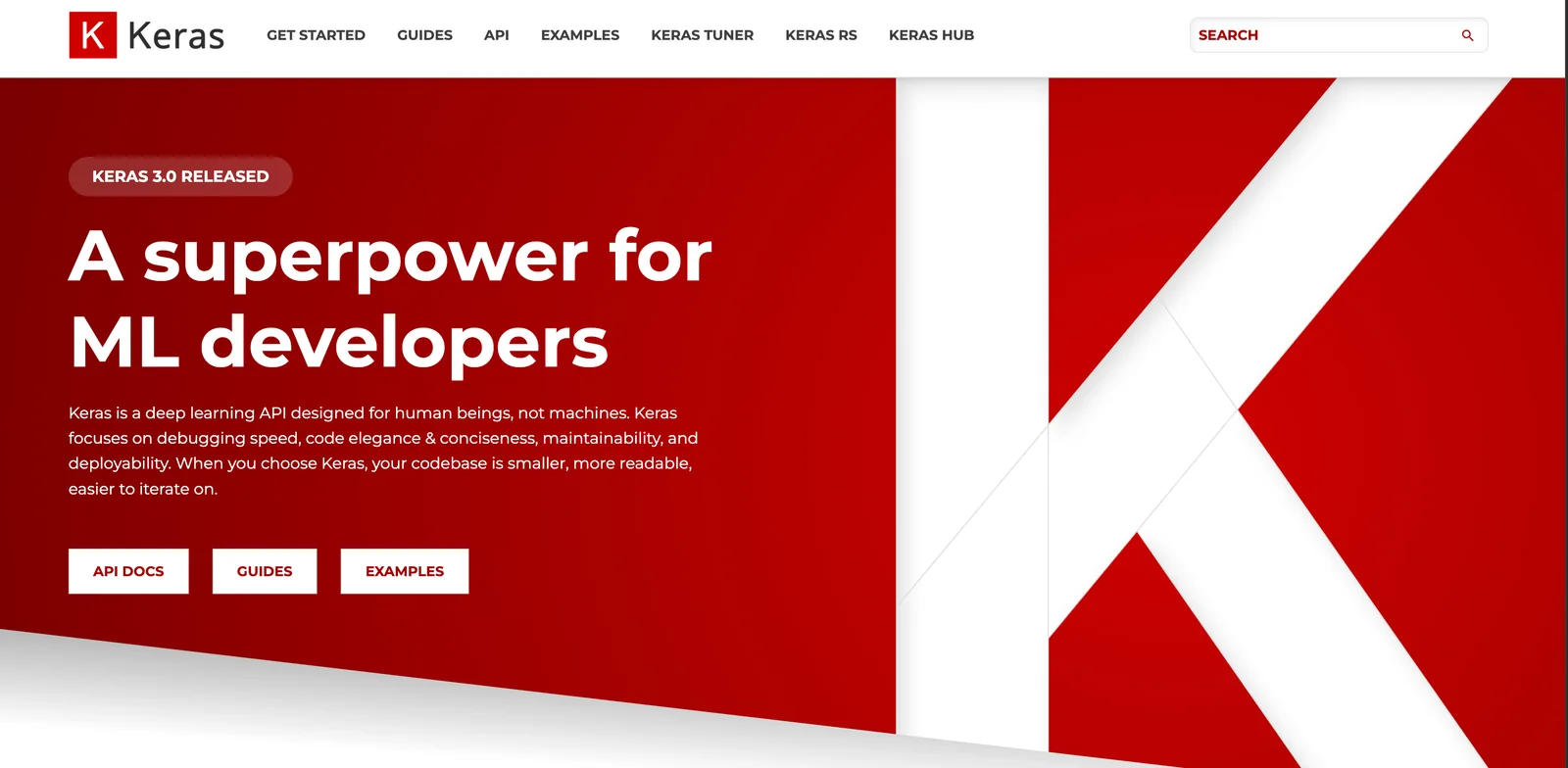
Keras is an open-source, high-level deep learning library designed for fast experimentation and easy model building. It provides a consistent, user-friendly API (Sequential, Functional, and Model subclassing) and runs on multiple backends (TensorFlow, JAX, and PyTorch) via a multi-backend core. Keras supports model serialization (.keras), a pretrained model hub (keras-hub) with canonical implementations of popular models, and first-party extensions such as KerasCV and KerasNLP. Its multi-backend design and integration with platforms like the Hugging Face Hub make it flexible for research, prototyping, and production deployments across different frameworks and hardware (including XLA/JAX acceleration).
Screenshots
Key Features
Use Cases


Frequently asked questions about Keras
Is Keras free to use?
Yes, Keras is completely free and open-source software, enabling users to download, utilize, and contribute without any cost. It operates under the Apache-2.0 license, which promotes both personal and commercial use, ensuring flexibility for developers and researchers alike.
Key Points
- Open-source License: Keras is licensed under the Apache-2.0 license, ensuring freedom to modify and distribute.
- Community Contributions: Users can contribute to the development of Keras, fostering collaborative advancements.
- Wide Adoption: Keras is widely used in academia and industry for deep learning applications.
Detailed Explanation
Keras is a high-level neural networks API written in Python, designed to enable fast experimentation. It can run on top of TensorFlow, Microsoft Cognitive Toolkit, or Theano. Since its inception, Keras has gained immense popularity due to its user-friendly interface and modularity.
Key Features of Keras:
- User-Friendly: Keras abstracts many complexities of deep learning, making it accessible for beginners.
- Modular Structure: Its modular design allows users to build and experiment with complex neural network architectures easily.
- Pre-trained Models: Keras provides a selection of pre-trained models, which can be used for transfer learning, significantly reducing development time.
Use Cases:
- Image Classification: Keras is frequently used in computer vision tasks, such as identifying objects in images.
- Natural Language Processing: It is also utilized for tasks like sentiment analysis and language translation.
- Time Series Prediction: Keras can be employed in financial forecasting and other time-dependent data analyses.
Best Practices / Tips
- Start Simple: Begin with Keras by building simple neural networks to grasp fundamental concepts before moving to more complex models.
- Utilize Documentation: Always refer to the official Keras documentation for the latest updates and best practices.
- Explore Community Resources: Engage with community forums, GitHub repositories, and tutorials to enhance your understanding and resolve issues quickly.
- Experiment with Pre-trained Models: Use Keras’s pre-trained models to save time on projects and improve initial performance.
Additional Resources
- Keras Official Documentation
- GitHub Repository for Keras
- Keras Community and Discussion Forum
- Keras Tutorials on TensorFlow
Keras stands out as a versatile tool for deep learning enthusiasts, offering a rich ecosystem to foster innovation and collaboration.
What are the key features of Keras?
Keras is a powerful deep learning library that supports multiple backends like TensorFlow, JAX, and PyTorch. It features high-level APIs for efficient model building, user-friendly design, and a curated hub of pretrained models, making it versatile for both beginners and experienced developers.
Key Points
- Multi-Backend Support: Works with TensorFlow, JAX, and PyTorch.
- High-Level APIs: Simplifies model building and experimentation.
- Pretrained Models Hub: Access a wide range of models for various tasks.
Detailed Explanation
Keras stands out due to its flexibility and ease of use, making it an ideal choice for developers of all skill levels. Here’s a deeper look at its key features:
1. Multi-Backend Support
Keras integrates seamlessly with popular deep learning frameworks like TensorFlow, JAX, and PyTorch. This multi-backend support allows users to switch between different engines without changing their Keras code. For example, developers can easily run their models on TensorFlow for production while using JAX for research.
2. High-Level APIs
Keras provides user-friendly high-level APIs that simplify the process of building neural networks. With intuitive functions for adding layers, compiling models, and training, users can quickly prototype and iterate. For instance, the Sequential model allows stacking layers in a linear fashion, while the Functional API offers flexibility for creating complex architectures.
3. Curated Hub of Pretrained Models
Keras includes a hub of pretrained models, making it easy to leverage existing work. Users can access popular models like VGG16, ResNet50, and InceptionV3 for tasks like image classification or transfer learning. This feature not only saves time but also enhances performance, as these models are trained on large datasets.
Best Practices / Tips
- Start Simple: Begin with the Sequential API for straightforward models and gradually explore the Functional API for more complex architectures.
- Utilize Pretrained Models: Leverage pretrained models for faster results and improved accuracy, particularly in image and text classification tasks.
- Experiment with Hyperparameters: Use Keras’ built-in tools, such as
Keras Tuner, to optimize your model configurations efficiently.
Additional Resources
How do I get started with Keras?
To get started with Keras, install it using pip, select a backend such as TensorFlow, JAX, or PyTorch, and explore the official Keras tutorials available on their website. These resources will guide you through the basics of building neural networks and deep learning models.
Key Points
- Install Keras via pip
- Choose a compatible backend (TensorFlow, JAX, or PyTorch)
- Utilize official tutorials for hands-on guidance
Detailed Explanation
Keras is a high-level neural networks API, designed for fast experimentation with deep learning models. Here’s a step-by-step guide to getting started:
-
Install Keras: Open your terminal or command prompt and run the following command:
pip install kerasThis command installs Keras and its dependencies.
-
Choose Your Backend: Keras can run on several backends, including:
- TensorFlow: The most commonly used backend, offering extensive support for deep learning and GPU acceleration.
- JAX: Ideal for research purposes, featuring automatic differentiation.
- PyTorch: Offers a dynamic computation graph, which is useful for certain types of neural networks.
Ensure the backend you choose is compatible with your projects. You can specify the backend in your Keras configuration file.
-
Explore Tutorials: The official Keras documentation features an array of tutorials tailored for beginners. These resources cover topics like:
- Building your first neural network
- Working with different layers
- Training and evaluation
Best Practices / Tips
- Start Simple: Begin with basic models before moving to complex architectures. For instance, create a simple feedforward neural network for the MNIST digit classification task.
- Leverage Pre-trained Models: Use models from the Keras Applications module to save time and improve performance.
- Experiment with Hyperparameters: Adjust learning rates, batch sizes, and epochs to fine-tune your model’s performance.
- Monitor Performance: Utilize tools like TensorBoard for visualizing training processes and identifying areas for improvement.
Additional Resources
By following these steps and utilizing the available resources, you'll be well on your way to mastering Keras for your deep learning projects.
How does Keras compare to TensorFlow and PyTorch?
Keras is a high-level API that significantly simplifies the model-building process compared to TensorFlow and PyTorch. It is designed for ease of use and rapid prototyping, while still providing access to lower-level functionalities for advanced users who require more control over their machine learning models.
Key Points
- Ease of Use: Keras offers a user-friendly interface, making it ideal for beginners.
- Integration with TensorFlow: Keras acts as a high-level API for TensorFlow, enhancing its functionality.
- Flexibility and Control: PyTorch provides more flexibility for researchers, while Keras balances ease of use with some level of control.
Detailed Explanation
Keras is built on top of TensorFlow, which means it takes advantage of TensorFlow’s robust capabilities while presenting a more streamlined interface. This makes Keras an excellent choice for developers and data scientists who want to quickly build and test models without getting bogged down in complex syntax.
Comparison with TensorFlow
- Keras: Focuses on simplicity and usability with a clear and concise API. It allows for rapid experimentation with built-in layers and models.
- TensorFlow: Offers extensive features for production-ready applications, including model serving and deployment options. It requires a deeper understanding of its architecture, which can be daunting for newcomers.
Comparison with PyTorch
- Keras: Provides a more straightforward approach for building neural networks, ideal for beginners or those looking to prototype quickly.
- PyTorch: Known for its dynamic computation graph, making it more flexible for complex neural network architectures and preferred in academic research.
Use Cases
Keras is particularly useful for:
- Rapid prototyping of deep learning models.
- Projects where time-to-market is critical.
- Education, as it's easier for beginners to grasp core concepts.
Best Practices / Tips
- Start Simple: When using Keras, begin with simple models and gradually incorporate more complex architectures to understand how layers and functions interact.
- Use Pre-trained Models: Leverage Keras’s built-in support for transfer learning by using pre-trained models like VGG16, ResNet, etc., for tasks like image classification.
- Stay Updated: Regularly check for updates in Keras and TensorFlow, as they frequently introduce new features and improvements.
Additional Resources
By understanding these differences, you can choose the right tool for your needs, whether you prioritize ease of use, flexibility, or advanced capabilities.
Does Keras support API integrations?
Yes, Keras supports various API integrations, including seamless loading and saving from the Hugging Face Hub. This functionality allows for efficient model sharing, versioning, and collaboration across different platforms, making it easier for developers and researchers to utilize pre-trained models in their projects.
Key Points
- Integration with Hugging Face Hub: Direct access to a vast repository of models.
- Model versioning: Keep track of changes and updates in your models effortlessly.
- Cross-platform compatibility: Share models easily across different frameworks and environments.
Detailed Explanation
Keras, a high-level neural networks API, is designed to make working with deep learning models simple and efficient. One of its standout features is its ability to integrate with various APIs, enhancing its functionality significantly.
Hugging Face Integration
With the integration of the Hugging Face Hub, developers can easily load pre-trained models directly into Keras. This is particularly useful for tasks like natural language processing, where models like BERT or GPT-3 are prevalent. To load a model from the Hugging Face Hub, you can use the following code:
from transformers import TFBertModel

model = TFBertModel.from_pretrained('bert-base-uncased')
Model Saving and Sharing
Keras also allows you to save models in formats that are compatible with various frameworks. You can save your model with:
model.save('my_model.h5')
This saved file can later be loaded into Keras or even other libraries that support the HDF5 format. This feature is invaluable for versioning your models, enabling you to track changes over time and share them with collaborators.
Cross-Platform Usage
Keras is designed to work seamlessly with TensorFlow, making it a versatile choice for developers. The ability to share models across platforms means that you can leverage the strengths of different libraries without significant overhead.
Best Practices / Tips
- Utilize Pre-trained Models: Take advantage of the vast array of pre-trained models available in the Hugging Face Hub to jump-start your projects.
- Version Control: Always save different versions of your models, especially when experimenting with hyperparameters or architectures.
- Documentation: Keep track of the modifications made to your models in a changelog for better collaboration and understanding.
Additional Resources
Explore more AI Ai Models tools
Browse all Ai Models tools →- Soup CLI
- VibeVoice
- Laguna by Poolside
- Arena AI: The Official AI Ranking & LLM Leaderboard
- PromptLayer
- PHBench
Compare Keras: vs Soup CLI · vs VibeVoice · vs Laguna by Poolside · vs Arena AI: The Official AI Ranking & LLM Leaderboard