

Sequential Thinking
AIOpen SourceFreeAn MCP server implementing a structured sequential-thinking process for dynamic, reflective problem solving and hypothesis generation.
Sequential Thinking
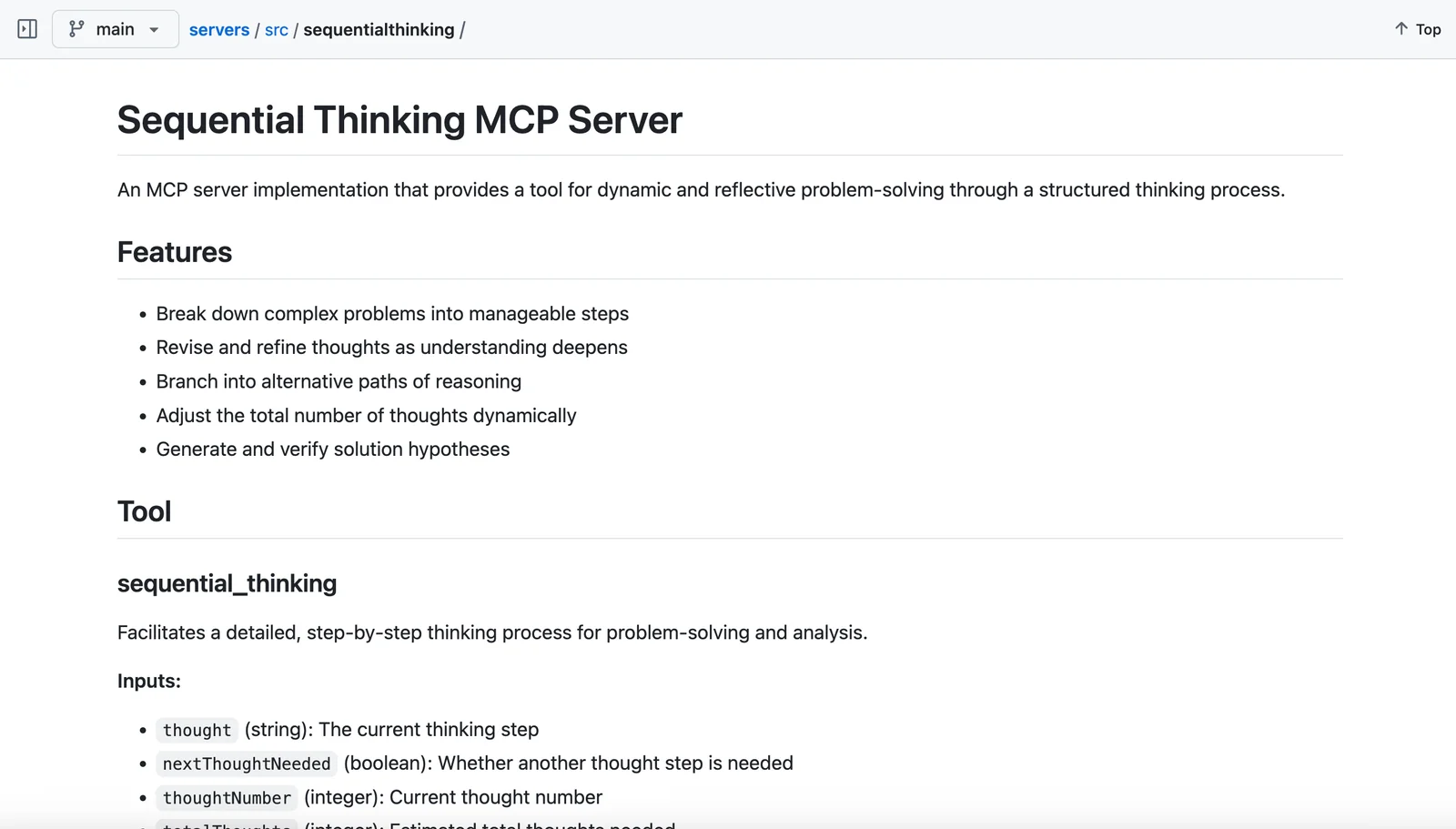
An MCP server implementing a structured sequential-thinking process for dynamic, reflective problem solving and hypothesis generation.
About Sequential Thinking
Sequential Thinking is an open-source Model Context Protocol (MCP) server that implements a structured sequential-thinking process to break down complex problems into ordered "thoughts", allow dynamic revision and branching of reasoning paths, and generate and verify solution hypotheses. It exposes the sequential-thinking tool as an MCP-compatible server so LLMs and MCP clients can orchestrate stepwise, reflective problem solving. Multiple implementations and community ports (TypeScript reference, Python ports, and high-performance Rust implementations) provide options for performance, integration, and deployment via NPM, Docker, or direct Git usage.
Screenshots
Key Features
Use Cases
MCP Server
https://github.com/modelcontextprotocol/servers/tree/main/src/sequentialthinking💡 MCP (Model Context Protocol) enables AI assistants to securely interact with local and remote resources.



Frequently asked questions about Sequential Thinking
Is Sequential Thinking free to use?
Yes, Sequential Thinking is completely free to use as it is open-source software. Users can access the source code and self-host it via NPM or Docker without incurring any charges, making it an ideal choice for developers seeking a cost-effective solution.
Key Points
- Open-Source Software: Sequential Thinking is developed and maintained by a community.
- Self-Hosting Options: Available through NPM and Docker.
- No Hidden Costs: Users can utilize all features without any fees.
Detailed Explanation
Sequential Thinking is a powerful open-source tool designed for various applications in sequential data processing and analytics. Being open-source means that anyone can contribute to its development, ensuring continuous improvement and innovation.
How to Access and Use Sequential Thinking
- Download the Source Code: You can find the source code on platforms like GitHub. Simply visit the repository, and you can clone or download the code to your local machine.
- Installation via NPM: To install Sequential Thinking using Node Package Manager (NPM), run the command:
This command will download and install the package and its dependencies.npm install sequential-thinking - Using Docker: If you prefer containerization, you can use Docker to run Sequential Thinking. Pull the image using:
This method simplifies deployment by encapsulating the application and its environment.docker pull sequential-thinking
Use Cases
- Data Science: Analysts and researchers can use Sequential Thinking for processing time-series data.
- Machine Learning: Developers can leverage the tool for building predictive models that require sequential data analysis.
- Real-time Analytics: Businesses can implement it for real-time insights into customer behavior or operational metrics.
Best Practices / Tips
- Stay Updated: Regularly check for updates or new features in the repository to enhance performance and security.
- Explore Community Support: Engage with the community through forums and discussion boards for troubleshooting and best practices.
- Test Locally: Before deploying, test your configurations locally to ensure smooth operation.
Additional Resources
- Sequential Thinking GitHub Repository - Access the source code and documentation.
- NPM Documentation - Learn more about installing packages via NPM.
- Docker Hub for Sequential Thinking - Find Docker images and usage instructions.
By leveraging these resources and following best practices, you can maximize your experience with Sequential Thinking while enjoying its free and open-source benefits.
What are the key features of Sequential Thinking?
Sequential Thinking is a cognitive approach that emphasizes structured thought decomposition, dynamic revision capabilities, branching reasoning paths, hypothesis generation, and configurable parameters. These features collectively empower users to tackle complex problems effectively and develop innovative solutions.
Key Points
- Structured Thought Decomposition: Breaks down problems into manageable components.
- Dynamic Revision: Allows users to adjust and refine their thought processes in real-time.
- Branching Reasoning Paths: Facilitates exploration of multiple solutions simultaneously.
Detailed Explanation
Sequential Thinking is a method designed to enhance problem-solving and decision-making processes. Here’s a breakdown of its key features:
-
Structured Thought Decomposition: This feature allows individuals to dissect complex issues into smaller, more digestible parts. For instance, when approaching a business problem, one can identify contributing factors like market trends, customer behavior, and financial constraints, making it easier to analyze each component.
-
Dynamic Revision: As new information becomes available, this feature enables users to revisit and modify their thought processes. For example, if initial assumptions about a project's feasibility are proven incorrect, dynamic revision allows for quick adjustments, saving time and resources.
-
Branching Reasoning Paths: Sequential Thinking encourages users to explore multiple solutions at once, rather than focusing on a single approach. This branching method is particularly useful in scientific research, where various hypotheses can be developed and tested concurrently, increasing the likelihood of discovering viable solutions.
-
Hypothesis Generation: This involves creating multiple potential solutions based on the initial analysis. For example, in a tech startup, teams can generate hypotheses about user engagement strategies, experimenting with different features or marketing tactics.
-
Configurable Parameters: Users can tailor their approach based on specific needs or constraints. For instance, a project manager may set parameters around budget, timeline, and resources, allowing the Sequential Thinking process to yield tailored insights.
Best Practices / Tips
- Start Simple: Begin with the most straightforward aspect of the problem before diving into complex components.
- Iterate Frequently: Use dynamic revision to continually assess and refine your approach as new data emerges.
- Encourage Collaboration: Use branching reasoning paths in team settings to foster diverse ideas and solutions.
- Document Your Process: Keep a record of thought processes and decisions to track the evolution of solutions and learn from past experiences.
Additional Resources
How can I get started with Sequential Thinking?
To get started with Sequential Thinking, visit the official GitHub repository to download the source code. You'll find detailed installation instructions for both NPM and Docker, enabling you to set up the framework easily on your machine or server.
Key Points
- Access the official GitHub repository for Sequential Thinking.
- Follow installation instructions for NPM or Docker.
- Explore documentation and community support for troubleshooting.
Detailed Explanation
Sequential Thinking is a powerful framework that enhances decision-making processes by breaking down complex problems into sequential steps. Here’s how to get started:
-
Download the Source Code: Begin by navigating to the Sequential Thinking GitHub repository. Here, you can clone the repository using Git or download it as a ZIP file.
-
Installation:
- Using NPM: If you have Node.js installed, open your terminal and run the command
npm install sequential-thinking. This command will install the framework and its dependencies. - Using Docker: If you prefer containerization, pull the Docker image by executing
docker pull your-docker-image. This allows you to run Sequential Thinking in a controlled environment.
- Using NPM: If you have Node.js installed, open your terminal and run the command
-
Explore Documentation: After installation, familiarize yourself with the documentation available in the repository. It provides valuable insights into functions, methods, and best practices to implement Sequential Thinking effectively.
-
Community and Support: Engage with the community through forums or chat platforms linked in the GitHub repository. This is a great way to seek help and share experiences with others.
Best Practices / Tips
- Start with Simple Problems: Begin applying Sequential Thinking to smaller, uncomplicated issues to build your confidence and understanding of the framework.
- Utilize Documentation: Regularly refer to the official documentation for updates and advanced features. It can significantly enhance your implementation skills.
- Avoid Overcomplicating: Focus on maintaining simplicity in your sequential steps. Too many variables can complicate the decision-making process and lead to confusion.
Additional Resources
Does Sequential Thinking have an API for integration?
Yes, Sequential Thinking offers an API for integration, allowing seamless connectivity with other applications through its MCP server architecture. Comprehensive documentation is available in the GitHub repository, providing guidance on API usage and implementation.
Key Points
- API Availability: Sequential Thinking provides a robust API for integration.
- MCP Server Architecture: The API leverages the MCP server architecture for enhanced performance.
- Documentation Access: Detailed API documentation can be found on GitHub.
Detailed Explanation
Sequential Thinking's API is designed to facilitate efficient integration with various applications, enhancing interoperability and functionality. The API operates on the MCP (Multi-Channel Processing) server architecture, which efficiently handles multiple requests and ensures rapid data processing.
To get started with the API, developers can access the official GitHub repository where they can find:
- Setup Instructions: Step-by-step guidance on how to integrate the API into existing systems.
- Endpoints Overview: A complete list of available endpoints, along with their functionalities.
- Sample Code: Code snippets in various programming languages to help developers understand how to interact with the API.
For example, if you want to fetch data from Sequential Thinking, you can utilize the GET request endpoint provided in the documentation. The API also supports authentication, allowing secure access to your application's data.
Best Practices / Tips
- Read the Documentation Thoroughly: Always start with the official API documentation to understand the capabilities and limitations.
- Use Version Control: When integrating the API, maintain version control to manage updates and changes effectively.
- Test Your Integration: Before going live, conduct thorough testing on a staging environment to ensure that all functionalities work as expected.
- Monitor API Usage: Keep track of API usage to avoid hitting rate limits and ensure optimal performance.
Additional Resources
- Sequential Thinking API Documentation on GitHub
- MCP Server Architecture Overview
- Community Forum for Developers
By following these guidelines and utilizing the resources provided, you can successfully integrate Sequential Thinking's API into your applications, enhancing their capabilities and performance.
How does Sequential Thinking compare to other AI problem-solving tools?
Sequential Thinking excels over many AI problem-solving tools by offering a structured, iterative approach to hypothesis generation, enabling real-time adjustments. Unlike linear models, it fosters dynamic revisions, making it more adaptable and effective for complex problem-solving scenarios.
Key Points
- Structured Approach: Sequential Thinking organizes thought processes systematically.
- Dynamic Revisions: It allows for real-time adjustments and refinements.
- Enhanced Adaptability: This tool is more suited for complex, non-linear problems than traditional AI.
Detailed Explanation
Sequential Thinking differentiates itself through its methodical framework, which is designed to enhance critical thinking and problem resolution. Traditional AI models often follow a linear progression, leading to rigid solutions that may not adapt well to evolving information or unexpected challenges.
For instance, in scenarios like product development, Sequential Thinking allows teams to generate hypotheses about market needs, test them, and revise their strategies based on real-time feedback. This iterative process encourages innovative solutions, as it can pivot quickly when new data emerges, unlike more static models that might struggle with flexibility.
Moreover, Sequential Thinking employs techniques such as:
- Hypothesis Generation: Users can create multiple hypotheses based on initial data.
- Testing and Feedback Loops: Each hypothesis can be tested in parallel, allowing for quick adjustments.
- Cumulative Learning: Insights from earlier stages feed into subsequent rounds, leading to deeper understanding and better solutions.
Best Practices / Tips
- Stay Iterative: Always be ready to revise your hypotheses based on new information.
- Encourage Collaboration: Utilize the tool in team settings to leverage diverse inputs for hypothesis generation.
- Document Each Step: Maintain records of hypotheses, tests, and outcomes to create a valuable knowledge base for future projects.
Avoid common pitfalls like sticking rigidly to an initial hypothesis or neglecting to engage with team members in the revision process. The strength of Sequential Thinking lies in its flexibility and collaborative potential.
Additional Resources
Explore more AI Mcps tools
Browse all Mcps tools →Compare Sequential Thinking: vs OzBrain · vs QApilot MCP for Android · vs Noodle Seed · vs Chrome DevTools MCP