
scikit-learn
AIOpen SourceFreeOpen-source Python library providing a consistent API for supervised and unsupervised machine learning, model selection, and preprocessing.
scikit-learn
Open-source Python library providing a consistent API for supervised and unsupervised machine learning, model selection, and preprocessing.
About scikit-learn
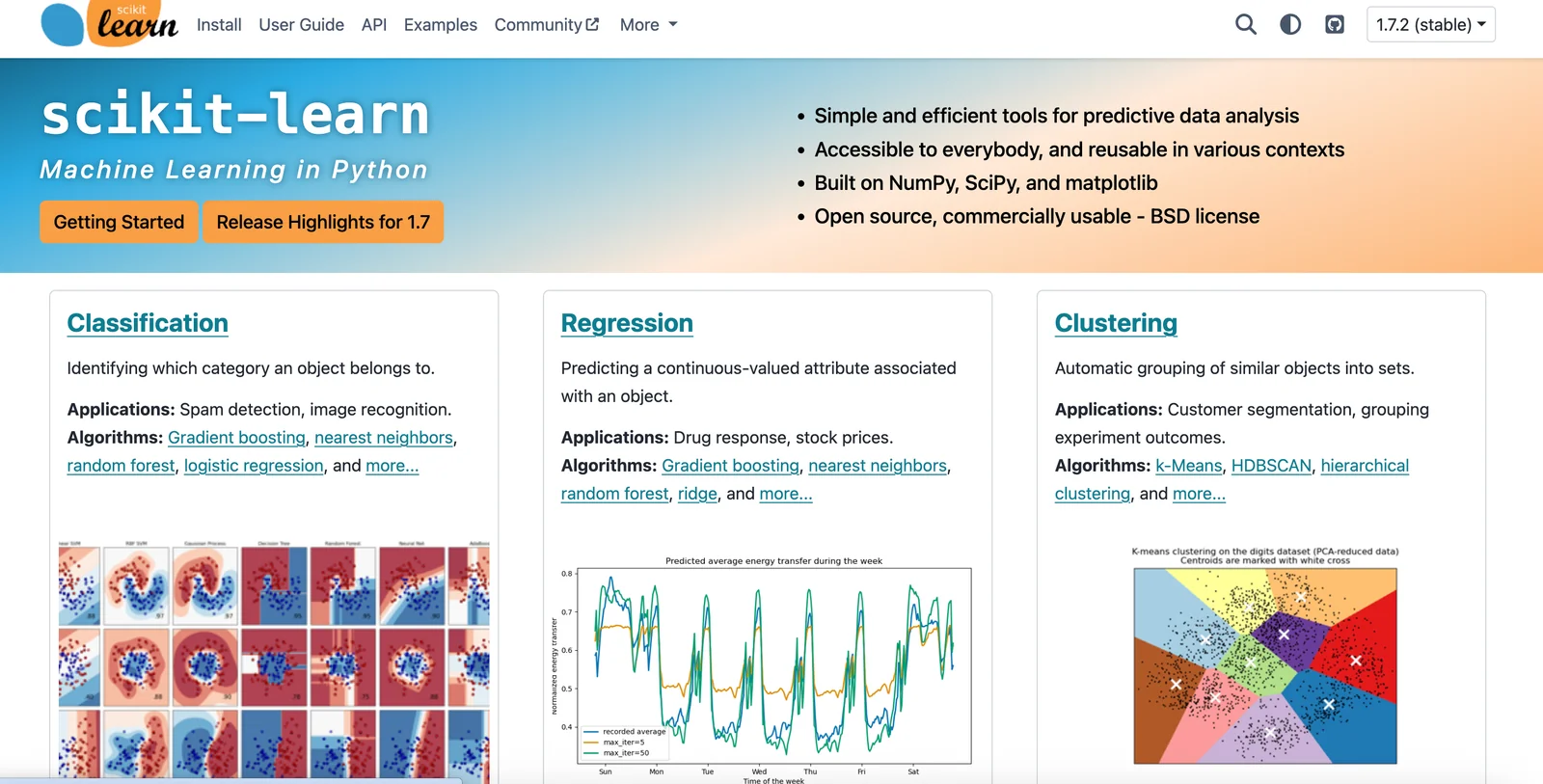
scikit-learn is an open-source Python library that implements a wide range of supervised and unsupervised machine learning algorithms and utilities. Built on top of NumPy, SciPy, and matplotlib, it provides a consistent 'estimator' API, ready-to-use implementations of classification, regression, clustering, dimensionality reduction, model selection, and preprocessing tools. scikit-learn emphasizes clean, well-documented APIs, extensive examples and tutorials, and a focus on interoperability and reproducibility (pip/conda installation, pipelines, serialization via joblib). Maintained by a global volunteer community and distributed under a permissive BSD license, it is widely used for prototyping, research, teaching, and many production workflows.
Screenshots
Key Features
Use Cases



Frequently asked questions about scikit-learn
Is scikit-learn free to use?
Yes, scikit-learn is completely free to use as it is an open-source library released under the BSD-3-Clause license. This allows users to modify, distribute, and utilize the library for both personal and commercial projects without any associated fees.
Key Points
- Open Source: Scikit-learn is an open-source library.
- BSD-3-Clause License: It is released under a permissive license.
- Commercial Use: Users can freely use it in commercial applications.
Detailed Explanation
Scikit-learn is a powerful Python library designed for machine learning and data analysis. Being an open-source project means that anyone can access its source code, contribute to its development, and use it without financial constraints. The library is released under the BSD-3-Clause license, which is a permissive license allowing users to modify, redistribute, and utilize the software freely.
For instance, if you are a data scientist looking to build predictive models, you can use scikit-learn to implement algorithms like decision trees, support vector machines, and clustering methods. The library supports numerous functionalities, including preprocessing, cross-validation, and evaluation metrics, making it ideal for both beginners and experienced users.
Use Cases
- Academic Research: Many researchers utilize scikit-learn for experiments and prototypes due to its accessibility.
- Commercial Applications: Companies can integrate scikit-learn into their products without worrying about licensing fees.
- Educational Purposes: Educators can teach data science and machine learning concepts using this library without additional costs.
Best Practices / Tips
- Keep Up-to-Date: Regularly check for updates to scikit-learn to benefit from the latest features and improvements.
- Contribute to the Community: If you find bugs or have ideas for enhancements, consider contributing to the library to help strengthen the community.
- Explore Documentation: Use the official documentation to familiarize yourself with the extensive functionality offered by scikit-learn, ensuring you maximize its potential.
Additional Resources
What are the key features of scikit-learn?
Scikit-learn is a powerful machine learning library that features a unified Estimator API, extensive algorithms for supervised and unsupervised learning, robust model selection tools, and preprocessing utilities. These features make it an ideal choice for a wide range of machine learning tasks, from data preprocessing to model evaluation.
Key Points
- Unified Estimator API: Simplifies model building and tuning.
- Wide Range of Algorithms: Includes classifiers, regressors, and clustering methods.
- Model Selection and Evaluation: Offers tools for cross-validation and hyperparameter tuning.
Detailed Explanation
Scikit-learn is designed to meet the needs of both beginners and experienced data scientists. Here are its key features:
Unified Estimator API
The Estimator API provides a consistent interface for all models. This means that you can easily fit, predict, and score models using the same methods. For example, both regression and classification tasks can be approached using fit() and predict() methods, making it user-friendly and efficient.
Extensive Algorithms
Scikit-learn includes a variety of algorithms for different tasks:
- Supervised Learning: Algorithms like Linear Regression, Decision Trees, and Support Vector Machines help in predicting outcomes based on labeled data.
- Unsupervised Learning: Methods such as K-Means and Hierarchical Clustering assist in discovering patterns in unlabeled data.
- Ensemble Methods: Techniques like Random Forest and Gradient Boosting combine multiple models to improve accuracy.
Robust Model Selection Tools
Choosing the right model and tuning its parameters is crucial for performance. Scikit-learn provides:
- Cross-Validation: Tools like
cross_val_scoreallow for a better evaluation of model performance by splitting data into multiple training and testing sets. - Grid Search and Random Search: These methods automate hyperparameter tuning, enabling users to find the best model settings efficiently.
Powerful Preprocessing Utilities
Data preprocessing is essential in machine learning. Scikit-learn offers:
- Data Scaling: Functions like
StandardScalerandMinMaxScalerhelp normalize data. - Feature Selection: Techniques such as Recursive Feature Elimination (RFE) assist in selecting the most relevant features for model training.
Best Practices / Tips
- Start Simple: Begin with a basic model before moving to complex algorithms.
- Use Pipelines: Implement
Pipelineto streamline preprocessing and model training, reducing the chance of data leakage. - Experiment with Hyperparameters: Use Grid Search or Random Search to fine-tune your model for better accuracy.
Additional Resources
How do I get started with scikit-learn?
To get started with scikit-learn, you need to install it using pip or conda. After installation, explore the official documentation, which offers tutorials and examples to help you through your initial machine learning project. This foundation will help you effectively leverage scikit-learn's capabilities.
Key Points
- Installation: Use pip or conda to install scikit-learn.
- Documentation: Official resources provide essential tutorials and examples.
- Community Support: Engage with forums and communities for troubleshooting and advanced learning.
Detailed Explanation
-
Installation: To install scikit-learn, you can use the following commands:
- With pip:
pip install scikit-learn - With conda:
conda install scikit-learn
This will also install any necessary dependencies like NumPy and SciPy.
- With pip:
-
Getting Acquainted with Documentation: The official scikit-learn documentation is a treasure trove of information. It features:
- User Guide: Comprehensive guides on different algorithms and functionalities.
- Tutorials: Step-by-step tutorials that can help you build your first machine learning model, such as classification or regression tasks.
- Examples: Real-world examples that show how to implement various machine learning techniques.
-
Hands-On Practice: Start with simple datasets, such as the Iris dataset or the Boston Housing dataset. These are included in the scikit-learn library and are excellent for practicing basic machine learning concepts.
Best Practices / Tips
- Start Small: Begin with simple models and gradually explore more complex algorithms like Random Forests or Support Vector Machines.
- Data Preprocessing: Invest time in understanding data preprocessing techniques such as normalization and encoding categorical variables, as they significantly affect model performance.
- Join the Community: Engage with platforms like Stack Overflow or the scikit-learn mailing list to seek help or share insights.
Additional Resources
- Scikit-learn Official Documentation
- Scikit-learn GitHub Repository
- Coursera Machine Learning Course (includes practical projects using scikit-learn)
What API integrations does scikit-learn support?
Scikit-learn supports API integrations with popular libraries such as NumPy, SciPy, and pandas, facilitating efficient data manipulation and model training in Python environments, including Jupyter notebooks. Additionally, it can work with tools like Matplotlib for visualization and Dask for parallel computing.
Key Points
- Integration with NumPy, SciPy, and pandas: Essential for data handling.
- Compatibility with visualization libraries: Works with Matplotlib and Seaborn.
- Support for parallel processing: Can utilize Dask for large datasets.
Detailed Explanation
Scikit-learn is designed to work seamlessly with other Python libraries, making it a versatile tool for machine learning. Here’s a breakdown of its key integrations:
-
NumPy: As the foundation for numerical operations in Python, NumPy provides support for multi-dimensional arrays. Scikit-learn heavily relies on NumPy for handling data structures, ensuring that data manipulation is both efficient and effective. For instance, input data for models is often organized in NumPy arrays.
-
SciPy: Scikit-learn utilizes SciPy for scientific computing. This library offers numerous functions for optimization, integration, interpolation, and statistics, which enhance the performance of algorithms implemented in scikit-learn. For example, you might use SciPy's optimization routines to fine-tune model parameters.
-
pandas: This library is invaluable for data manipulation and analysis. Scikit-learn can directly accept pandas DataFrames, simplifying data preprocessing tasks such as handling missing values and encoding categorical variables. For example, you can easily split your dataset into training and testing sets using pandas’ robust data manipulation tools.
-
Visualization with Matplotlib and Seaborn: To visualize the results of machine learning models, scikit-learn can integrate with Matplotlib and Seaborn. This allows users to create informative plots, such as confusion matrices or ROC curves, which help in understanding model performance.
-
Parallel Processing with Dask: For handling large datasets that do not fit into memory, scikit-learn can integrate with Dask. This library enables scalable analytics by distributing computations across multiple cores or even clusters, making it ideal for big data applications.
Best Practices / Tips
- Utilize pandas for preprocessing: Always convert your datasets into pandas DataFrames for easier manipulation before feeding them into scikit-learn.
- Leverage cross-validation: Use scikit-learn’s built-in cross-validation tools to optimize model performance and avoid overfitting.
- Visualize model performance: After training your model, visualize the results using Matplotlib or Seaborn to gain insights into its effectiveness.
- Experiment with parallel processing: If working with large datasets, consider using Dask to speed up training times.
Additional Resources
How does scikit-learn compare to TensorFlow?
Scikit-learn specializes in traditional machine learning algorithms and is user-friendly for beginners, making it ideal for simpler tasks. In contrast, TensorFlow is a powerful deep learning framework designed for complex neural network applications, making it suitable for advanced projects like image recognition and natural language processing.
Key Points
- Algorithm Focus: Scikit-learn is for traditional machine learning; TensorFlow is for deep learning.
- Ease of Use: Scikit-learn is beginner-friendly; TensorFlow has a steeper learning curve.
- Application Suitability: Scikit-learn is best for simpler tasks, while TensorFlow excels in complex projects.
Detailed Explanation
Scikit-learn is a Python library that provides simple and efficient tools for data mining and data analysis, built on NumPy, SciPy, and Matplotlib. It offers a range of supervised and unsupervised learning algorithms, such as linear regression, decision trees, and clustering methods. This makes it an excellent choice for beginners or for projects requiring quick prototyping and straightforward implementations.
For example, if you're working on a small dataset to predict house prices using linear regression, Scikit-learn's intuitive API allows you to quickly train and evaluate your model with minimal code. On the other hand, TensorFlow is designed to handle larger datasets and more complex architectures, such as convolutional and recurrent neural networks. It is highly scalable and can run on multiple CPUs and GPUs, making it ideal for deep learning tasks.
TensorFlow uses a more complex programming model, requiring a deeper understanding of machine learning concepts. It provides flexibility and control over the model architecture, enabling researchers and developers to implement cutting-edge algorithms. For instance, if you're developing a neural network for image classification, TensorFlow's capabilities allow you to customize your layers and loss functions extensively.
Best Practices / Tips
- Choose the Right Tool: Use Scikit-learn for traditional machine learning tasks and TensorFlow for deep learning projects.
- Start Simple: Beginners should begin with Scikit-learn to build foundational skills before transitioning to TensorFlow.
- Leverage Documentation: Both libraries have extensive documentation; refer to it often to understand functions and classes.
- Experiment with Datasets: Use datasets from platforms like Kaggle to practice and compare results between the two frameworks.
Additional Resources
Explore more AI Ai Models tools
Browse all Ai Models tools →Compare scikit-learn: vs Mouse-1 · vs Milliseconds.ai · vs SWE-2 · vs Desert Ant Labs