
ngrok AI Gateway
AIUnified LLM gateway that routes any SDK to public providers, custom endpoints, and self-hosted models behind one URL and one key.
ngrok AI Gateway
Unified LLM gateway that routes any SDK to public providers, custom endpoints, and self-hosted models behind one URL and one key.
About ngrok AI Gateway
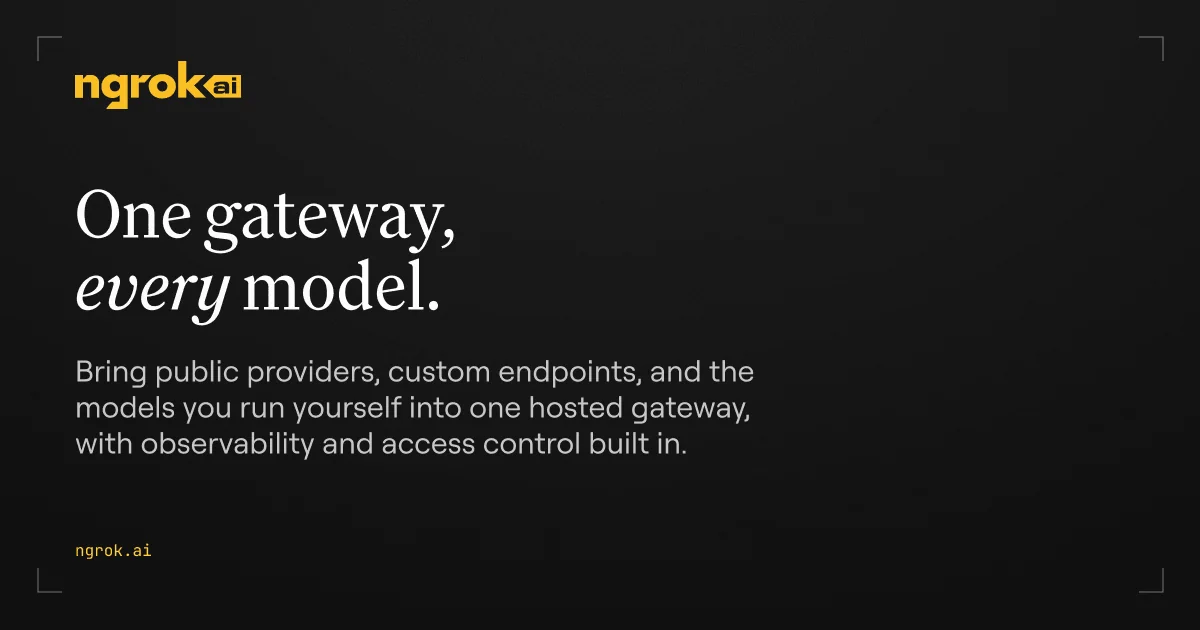
ngrok AI Gateway is a hosted LLM gateway that puts public providers, custom endpoints, and self-hosted local models behind a single URL and key. Developers point any OpenAI-compatible SDK — OpenAI, Anthropic, or the Vercel AI SDK — at gateway.ngrok.ai, and route requests to a self-hosted model with fallback to public providers in one call. Access control, observability, and cost tracking are built in, and local models are reached over private connectivity without exposing public IPs or opening inbound ports. Teams can bring the API keys they are already paying for so they pay providers directly at their current rates while managing every key in one place. It is built on ngrok's networking primitives, giving AI infrastructure the same secure ingress and traffic management ngrok is known for.
Screenshots
Key Features
Use Cases


Frequently asked questions about ngrok AI Gateway
What is ngrok AI Gateway?
Ngrok AI Gateway is a powerful unified gateway that seamlessly routes any SDK to a variety of public providers, custom endpoints, and self-hosted AI models, all accessible through a single URL and authentication key. This simplifies integration and enhances accessibility for developers and organizations.
Key Points
- Unified Access: Connects to multiple AI models and endpoints with one URL.
- Versatile Routing: Supports public providers, custom endpoints, and self-hosted solutions.
- Simplified Authentication: Operates with a single key for streamlined access.
Detailed Explanation
Ngrok AI Gateway serves as an efficient tool for developers looking to leverage multiple AI models without the complexity of managing separate URLs or authentication processes. By consolidating access, it promotes ease of use and allows for more straightforward integration into various applications.
How It Works
- Setup: After creating an account on Ngrok, you can configure your AI models and endpoints.
- Routing: The gateway automatically routes requests to the appropriate model based on the SDK being used.
- Authentication: Use one API key to manage access to all your endpoints, ensuring secure and efficient communication.
Use Cases
- Development: Ideal for developers working with multiple AI APIs during the testing phase.
- Production: Businesses can deploy applications that require diverse AI functionalities without the overhead of maintaining multiple endpoints.
- Integration: Facilitates easy integration with existing systems, improving workflow efficiency.
Best Practices / Tips
- Optimize Your SDK: Ensure that the SDK you are using is compatible and optimized for integration with the Ngrok AI Gateway.
- Monitor Usage: Regularly check your usage statistics through the Ngrok dashboard to avoid hitting your rate limits.
- Security Measures: Always keep your API key secure; consider using environment variables for sensitive information.
Additional Resources
How does ngrok AI Gateway work?
ngrok AI Gateway simplifies access to AI models by providing a unified endpoint for multiple AI providers, enabling seamless integration with existing applications. It supports fallback mechanisms, local model access, and allows users to manage their API keys efficiently, streamlining AI engineering and cost management.
Key Points
- Unified Gateway: One URL and key for diverse AI providers.
- Drop-in SDKs: Easy integration with existing AI SDKs.
- Model Fallback: Automatic switching to backup models.
Detailed Explanation
The ngrok AI Gateway functions as a centralized access point for various AI services, including public LLM (Large Language Model) providers, custom endpoints, and self-hosted models. Here’s how it works in detail:
-
Unified Gateway: Users can route requests through a single URL and API key, eliminating the need for multiple integrations with different providers. This approach drastically reduces development time and complexity.
-
Drop-in SDKs: By simply changing the base URL to
gateway.ngrok.ai, existing codebases that utilize OpenAI, Anthropic, or Vercel AI SDKs can continue to function without any further alterations. This allows teams to adopt the gateway seamlessly. -
Model Fallback: Users can specify a primary model alongside fallback options within a single API call. This ensures that if the primary provider experiences issues—like throttling or downtime—the gateway automatically routes requests to backup models, enhancing reliability.
-
Local LLM Access: The gateway allows organizations to utilize self-hosted models securely without exposing them to the public internet. This is particularly useful for businesses that prioritize data privacy and security.
-
Bring Your Own Keys: Users can integrate their existing API keys from various providers into the gateway. This feature allows businesses to maintain their current pricing plans and auditing processes while streamlining access to different models.
-
Use Cases:
- Enterprise Use: Companies can enforce access controls, determining which teams can use specific models, thus maintaining governance over AI resources.
- Startup Solutions: Startups can consolidate multiple AI keys behind a single gateway, simplifying cost tracking and management.
- ML Team Collaboration: Machine learning teams can expose local LLM clusters to application teams without needing to open firewall ports, improving collaboration and security.
Best Practices / Tips
- Centralize Management: Use the unified gateway to manage all your AI API keys for better oversight and reduced complexity.
- Test Fallback Mechanisms: Regularly test your model fallback configurations to ensure they activate correctly during outages.
- Monitor Usage: Keep track of API usage and costs through the gateway to optimize spending effectively.
Additional Resources
What are the main features of ngrok AI Gateway?
Ngrok AI Gateway offers a unified access point for public LLM providers, custom endpoints, and self-hosted models. Key features include a drop-in SDK for seamless integration, model fallback capabilities, local LLM access without public IPs, and the ability to use your existing provider keys for cost efficiency.
Key Points
- Unified Gateway: One URL and key for all model providers.
- Drop-in SDKs: Easy integration with existing code.
- Model Fallback: Enhanced reliability with backup models.
Detailed Explanation
Ngrok AI Gateway is designed to streamline how developers interact with various Large Language Models (LLMs). Here’s a breakdown of its key features:
-
Unified Gateway: With Ngrok AI Gateway, developers can connect to multiple AI providers through a single URL and API key. This simplifies the process of managing connections to different LLMs, such as OpenAI, Anthropic, or self-hosted solutions. You can focus on building your application without worrying about multiple endpoints.
-
Drop-in SDKs: Ngrok facilitates a smooth transition by allowing developers to swap the
baseURLtogateway.ngrok.ai. This means that existing code using OpenAI, Anthropic, or Vercel AI SDKs will continue to function without modification. This feature significantly reduces the time and effort required for implementation. -
Model Fallback: The gateway allows developers to specify a primary model and define fallback options in a single API call. This means if the primary model experiences issues or throttling, requests will automatically reroute to designated backup models, ensuring uninterrupted service.
-
Local LLM Access: For organizations using self-hosted models, Ngrok AI Gateway provides a secure way to connect without needing public IPs or open inbound ports. This enhances security while maintaining accessibility for development and testing purposes.
-
Bring Your Own Keys: You can continue using the API keys from providers you already pay for, routing through Ngrok at your current rates. This flexibility allows for seamless integration into existing workflows without incurring unexpected costs.
Best Practices / Tips
- Testing: Always test your integration in a development environment before deploying to production to catch any potential issues.
- Monitor Usage: Utilize Ngrok’s dashboard to monitor API usage and performance metrics for better optimization.
- Documentation: Regularly check the official Ngrok documentation for updates and best practices to ensure you’re leveraging the platform effectively.
Additional Resources
Who is ngrok AI Gateway for?
ngrok AI Gateway is designed for AI engineers, platform teams, startups, enterprises, and ML teams. It simplifies integrations by standardizing API access, allowing centralized traffic control, auditing, and secure exposure of machine learning models without the need for complex network configurations.
Key Points
- AI Engineers: Standardizes API access across multiple AI providers.
- Platform Teams: Routes production traffic with automatic failover.
- Enterprises: Implements central access controls for model governance.
Detailed Explanation
The ngrok AI Gateway serves as a unified access point for various AI models and services, making it invaluable for different organizational roles:
-
AI Engineering Teams: By standardizing on a single base URL, development teams can eliminate the need for per-provider integrations. This saves time and resources, allowing engineers to focus on building features rather than managing multiple API connections.
-
Platform Teams: These teams can route production traffic to self-hosted AI models while ensuring reliability through automatic fallbacks to public providers. For instance, if an in-house model fails, traffic seamlessly reroutes to a provider like OpenAI, minimizing downtime.
-
Startups: By consolidating access to OpenAI, Anthropic, and custom keys behind a single gateway, startups can simplify auditing and track costs effectively. This consolidation helps in managing budgets and optimizing the use of AI resources.
-
Enterprises: They can enforce governance by defining which teams and services have access to specific AI models through central access controls. This ensures compliance and security across the organization.
-
ML Teams: They can expose a local LLM (Large Language Model) cluster to application teams without the need for opening inbound network ports, thereby enhancing security while facilitating access to advanced AI capabilities.
Best Practices / Tips
- Centralize Access: Use ngrok AI Gateway to streamline API keys and access for all teams, minimizing the risk of key leaks and simplifying management.
- Monitor Traffic: Regularly audit traffic routes and usage statistics. This helps optimize costs and ensure that services are running smoothly.
- Implement Security Measures: Always use secure protocols and access controls to protect sensitive data and services exposed through the gateway.
Additional Resources
How much does ngrok AI Gateway cost?
ngrok AI Gateway offers a free tier, allowing users to access basic features at no cost. For those needing advanced capabilities, paid plans start at $8 per month, unlocking additional functionalities like custom domains, increased connection limits, and enhanced security options.
Key Points
- Free Tier: Access basic features without any cost.
- Paid Plans: Starting at $8 per month for advanced functionalities.
- Features: Custom domains, increased connection limits, and enhanced security.
Detailed Explanation
ngrok AI Gateway provides a versatile platform for developers to expose local servers to the internet in a secure manner. The free tier is ideal for testing and small projects, allowing users to create temporary tunnels without any financial commitment. This is a great starting point for developers looking to familiarize themselves with the service.
For more demanding applications, paid plans begin at $8 per month. These plans are perfect for businesses or developers who require a more robust solution. With paid subscriptions, users gain access to features such as:
- Custom Domains: Personalize your URLs for branding and easier access.
- Increased Connection Limits: Handle more simultaneous connections, which is essential for high-traffic applications.
- Enhanced Security Features: Benefit from additional layers of security, including IP whitelisting and authentication options.
ngrok's pricing structure is straightforward, making it easy for users to scale their usage based on needs.
Best Practices / Tips
- Start with the Free Tier: Experiment with the free version to understand basic functionalities before upgrading.
- Evaluate Your Needs: Analyze your project requirements and user load to choose the right plan.
- Monitor Usage: Keep track of your connection limits to avoid interruptions, especially as you scale.
- Utilize Security Features: Always enable security features on paid plans to protect your applications from unauthorized access.
Additional Resources
This comprehensive information ensures you make informed decisions about using ngrok AI Gateway according to your project's unique requirements.
How do I get started with ngrok AI Gateway?
To get started with ngrok AI Gateway, visit ngrok.ai to sign up for an account. Once registered, you can explore its features, including secure tunneling and API integration, to easily expose local applications to the public internet for testing and development.
Key Points
- Simple Sign-Up Process: Easily create an account on ngrok.ai.
- Explore Features: Discover features like secure tunneling and API integrations.
- Documentation Available: Access extensive documentation to guide your setup.
Detailed Explanation
Ngrok AI Gateway provides developers with a seamless way to expose local services to the internet securely. Here’s how to get started:
-
Sign Up: Go to ngrok.ai and click on the "Sign Up" button. Fill in your details to create an account. The process is quick and user-friendly.
-
Download ngrok: After signing up, download the ngrok client suitable for your operating system (Windows, macOS, or Linux).
-
Install ngrok: Follow the installation instructions specific to your OS. Generally, it involves unzipping the downloaded file and placing the ngrok executable in a directory included in your system’s PATH.
-
Authenticate Your Account: Retrieve your authentication token from the ngrok dashboard and run the command
ngrok authtoken <your_token>in your terminal. This step is crucial for accessing paid features and securing your tunnels. -
Start Tunneling: Use the command
ngrok http 80(or replace80with your desired port number) to expose a local server. You will receive a public URL that can be used to access your local application from anywhere.
Use Cases
- Development and Testing: Quickly share your local applications with teammates or clients without deploying them to a live server.
- Webhook Testing: Test webhooks from third-party services by providing them the public URL generated by ngrok.
- Remote Access: Enable remote access to local applications securely, useful for developers working from various locations.
Best Practices / Tips
- Use ngrok’s Dashboard: Monitor active tunnels and view traffic logs for better debugging.
- Set Up Custom Domains: If you have a paid plan, configure custom domains for a more professional appearance.
- Be Mindful of Security: Use ngrok securely by limiting access to specific IP addresses or using authentication options to protect your endpoints.
Additional Resources
- Ngrok Documentation: Comprehensive guide covering installation, commands, and advanced features.
- Ngrok GitHub Repository: Source code and community discussions for developers.
- Ngrok Blog: Insights and updates on new features and use cases.
Explore more AI Ai Services tools
Browse all Ai Services tools →Compare ngrok AI Gateway: vs ZeroClick · vs jurniti · vs Cadenya · vs OpenObserve