

Groq
AIHigh-performance inference platform delivering fast, low-cost model inference via the Groq LPU and developer tooling.
Groq
High-performance inference platform delivering fast, low-cost model inference via the Groq LPU and developer tooling.
About Groq
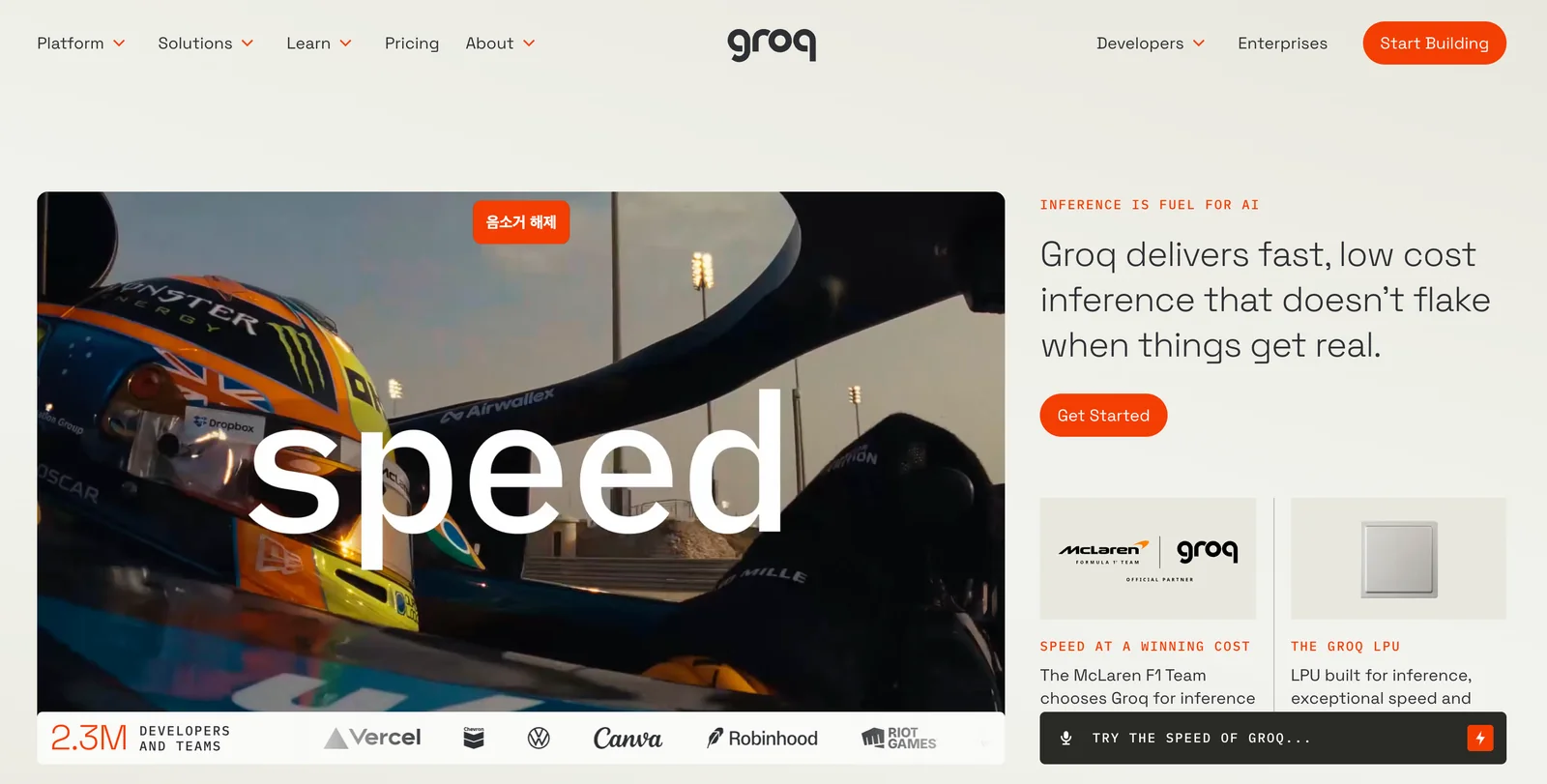
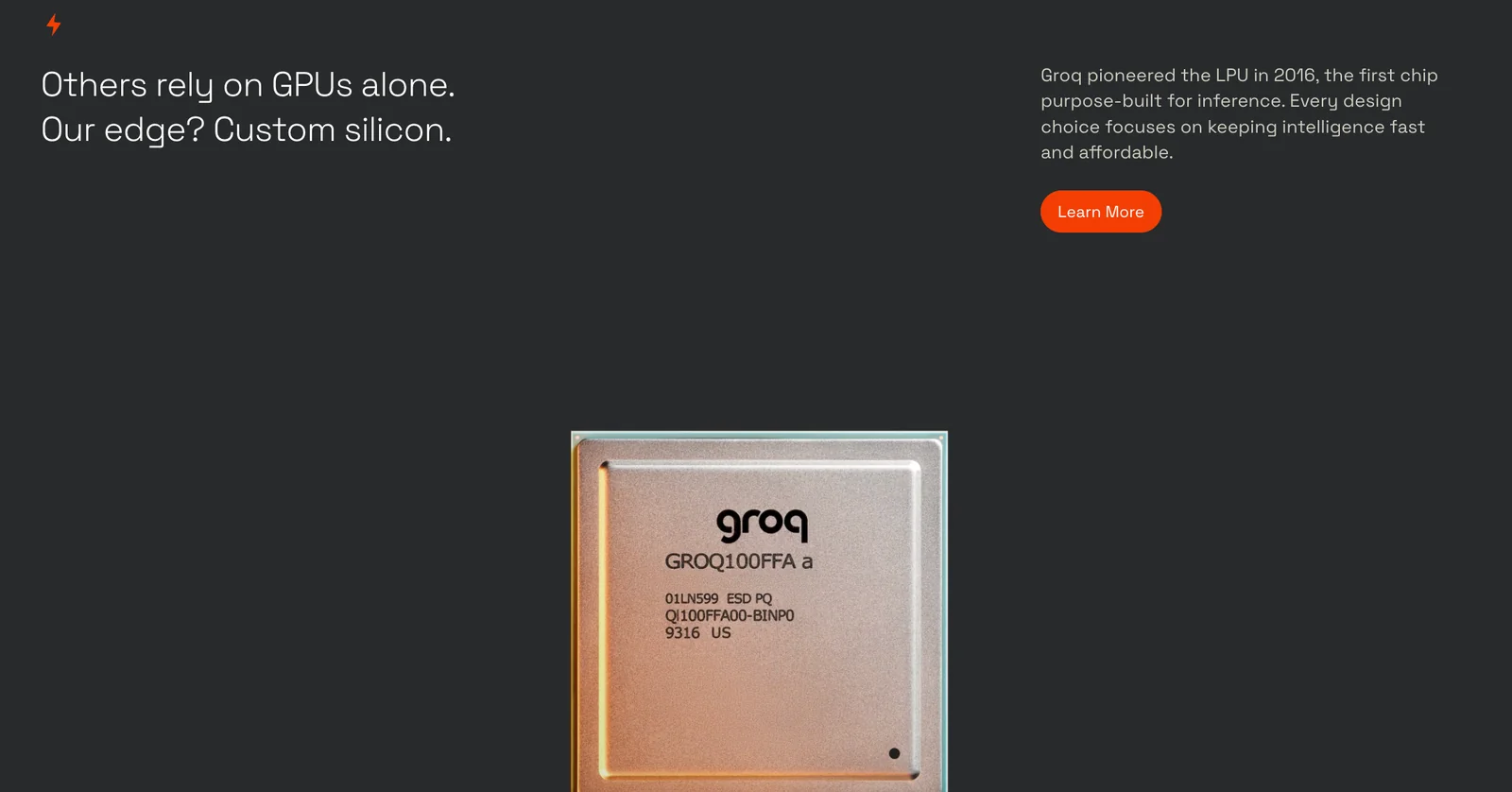
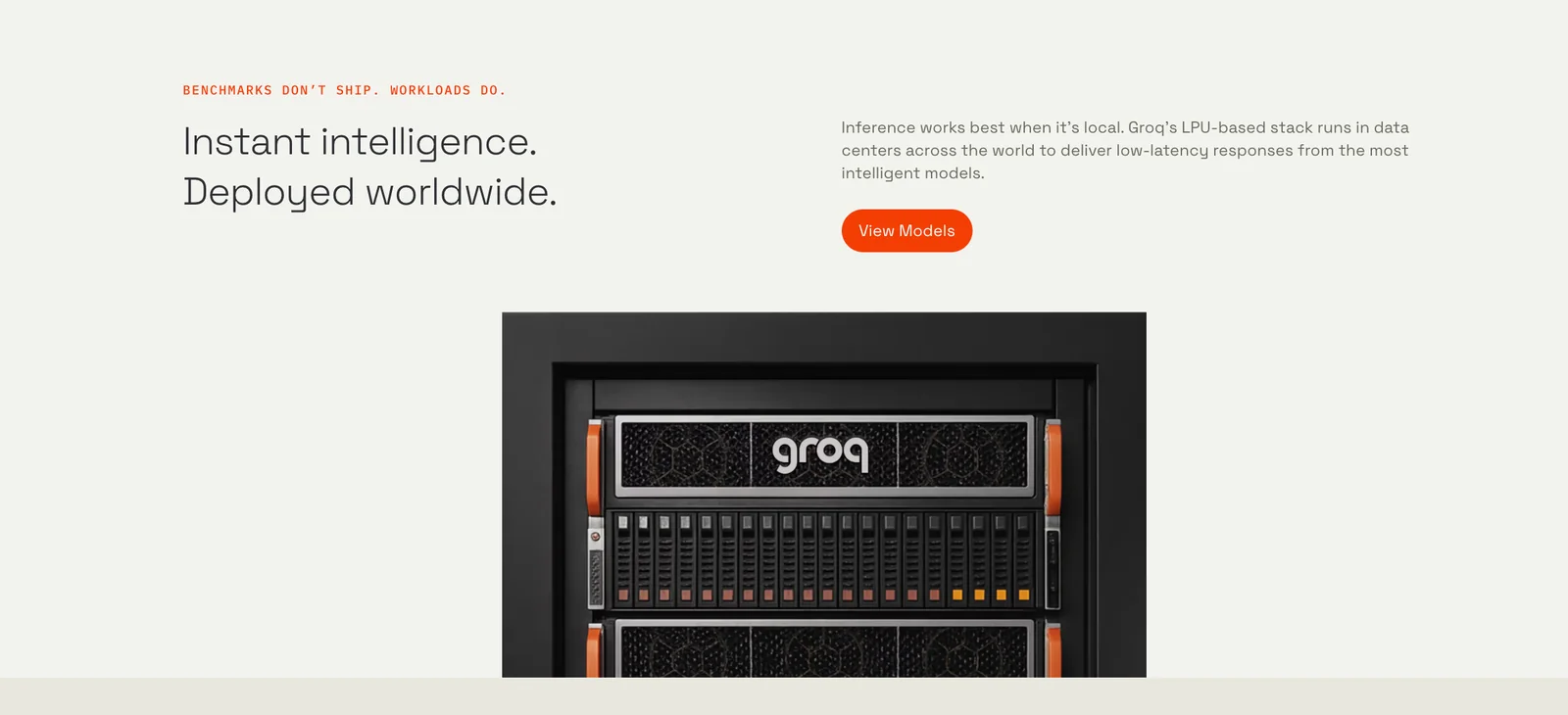
Groq provides a hardware-software platform centered on the Groq Language Processing Unit (LPU) that delivers low-latency, cost-efficient inference for machine learning workloads. The company supplies a complete stack including the GroqFlow compiler and toolchain to convert ML and linear-algebra workloads into Groq programs, SDKs (including an official Python client), REST APIs, and integrations (e.g., Gradio) for rapid application deployment. Groq's offering targets production inference, high-performance computing, and multi-modal model hosting by combining specialized hardware (GroqChip/LPU) with developer-facing tooling to optimize throughput, determinism, and operational cost.
Screenshots
Key Features
Use Cases



Frequently asked questions about Groq
What are the pricing options for Groq?
Groq offers several pricing options: a Free tier at $0 per month with limited usage, a Developer pay-as-you-go model based on token usage, and custom Enterprise plans that include dedicated support and tailored capacity. For specific pricing details, it’s best to visit Groq's official website.
Key Points
- Free Tier: Cost-effective option for limited usage.
- Pay-as-You-Go: Flexible pricing based on actual token usage.
- Enterprise Plans: Customizable solutions for larger organizations.
Detailed Explanation
Groq provides a variety of pricing options designed to meet different user needs:
-
Free Tier:
- Cost: $0 per month.
- Usage: Ideal for individuals or small projects, this tier allows users to explore Groq's features without financial commitment. It typically includes basic functionalities and limited processing capabilities which can be great for testing or learning purposes.
-
Developer Pay-As-You-Go Model:
- Pricing Structure: Users pay based on the number of tokens consumed. This model is particularly beneficial for developers and businesses that require flexibility, allowing them to scale their usage according to project demands.
- Example: If you anticipate fluctuating workloads, this option lets you only pay for what you use, avoiding fixed monthly costs.
-
Custom Enterprise Plans:
- Tailored Solutions: Designed for larger organizations, these plans offer more extensive features, higher capacity, and personalized support.
- Support: Enterprises receive dedicated customer service, ensuring they have the necessary resources to maximize their Groq experience.
- Capacity: Custom plans can be designed to meet specific operational needs, making them suitable for high-demand applications.
Best Practices / Tips
- Evaluate Your Needs: Before choosing a plan, assess your project requirements, expected usage, and budget. This will help you select the most cost-effective option.
- Test the Free Tier: Utilize the free tier to get familiar with Groq’s interface and capabilities before committing to a paid plan.
- Monitor Usage: If using the pay-as-you-go model, keep track of your token consumption to avoid unexpected charges.
- Contact Sales for Enterprise Plans: If considering an enterprise plan, reach out to Groq's sales team to discuss your specific requirements and receive a tailored quote.
Additional Resources
By understanding Groq's pricing options and selecting the right plan, users can effectively leverage the platform's capabilities while managing costs.
How does Groq's low-latency inference work?
Groq's low-latency inference operates through its advanced Groq LPU hardware, which is specifically engineered to minimize response times in machine learning workloads. This technology enables rapid, cost-effective model execution, making it particularly well-suited for applications that require real-time data processing.
Key Points
- Specialized Hardware: Groq LPU optimizes machine learning processes.
- Reduced Response Times: Achieves lower latency for faster inference.
- Real-Time Application Suitability: Ideal for industries needing instant decision-making.
Detailed Explanation
Groq's low-latency inference is predicated on its unique architecture, the Groq LPU (Tensor Processing Unit). This hardware leverages a dataflow architecture that allows for parallel processing of operations, significantly boosting throughput and minimizing delays compared to traditional CPUs and GPUs.
How It Works:
-
Dataflow Architecture: Unlike conventional architectures that process data in a sequential manner, Groq’s dataflow model enables simultaneous execution of multiple operations. This results in optimized usage of computational resources.
-
Memory Efficiency: The Groq LPU is designed with high-bandwidth memory access, reducing the time spent on data retrieval. This allows for quick access to the necessary datasets, further decreasing latency.
-
Scalability: Groq's architecture supports scaling without proportional increases in latency. As workloads increase, the system can maintain low response times, essential for applications like autonomous vehicles or real-time video analytics.
Use Cases:
- Autonomous Vehicles: Processes sensor data and makes driving decisions in real-time.
- Financial Trading: Executes trades based on market fluctuations almost instantaneously.
- Healthcare: Analyzes patient data for immediate diagnostics and treatment recommendations.
Best Practices / Tips
- Optimize Model Complexity: To leverage Groq’s capabilities, ensure your models are optimized for performance without sacrificing accuracy.
- Benchmark Performance: Regularly measure inference times against industry standards to ensure your applications benefit from low latency.
- Stay Updated: Follow Groq’s updates and firmware improvements to take advantage of enhanced features and optimizations.
Additional Resources
How do I get started using Groq?
To get started with Groq, visit their website and create a free account to obtain a developer API key. Utilize the provided SDKs and documentation to begin testing and developing applications on Groq's advanced inference platform, which supports AI workloads efficiently.
Key Points
- Create a Free Account: Sign up on Groq's website.
- Obtain API Key: Essential for accessing Groq's services.
- Explore SDKs and Documentation: Key resources for development.
Detailed Explanation
To leverage Groq's powerful inference platform, follow these steps:
-
Create an Account: Go to the Groq website and click on the "Sign Up" button. Fill out the required information, including your email address and password. Confirm your email to activate your account.
-
Obtain Your API Key: After logging in, navigate to the API section in your account dashboard. Here, you will find your unique developer API key. This key is crucial as it authenticates your applications when making requests to Groq's services.
-
Access SDKs and Documentation: Groq offers a variety of Software Development Kits (SDKs) tailored for different programming languages. Visit the documentation page to download the SDKs and explore detailed guides. These resources will help you integrate Groq's capabilities into your applications effectively.
-
Start Testing: Once you have your API key and SDK, you can begin developing. Use the sample projects provided in the documentation to familiarize yourself with the platform's features and functionalities.
-
Build Your Application: With Groq’s powerful tools, you can design applications that require high-performance AI inference. Make sure to utilize the best practices outlined in the documentation for optimal performance.
Best Practices / Tips
- Understand Groq’s Architecture: Familiarize yourself with Groq’s unique architecture to optimize your applications effectively.
- Utilize Sample Code: Start with sample code and tutorials available in the documentation to accelerate your learning.
- Stay Updated: Regularly check Groq's blog and release notes for updates on new features and improvements.
- Test Early and Often: Regularly test your application during development to catch issues early.
Additional Resources
- Groq Documentation
- API Reference Guide
- Groq Blog for updates and use cases.
Can I integrate Groq with my existing applications?
Yes, you can integrate Groq with your existing applications using its REST API and SDKs for popular programming languages such as Python, PHP, and Go. This flexibility allows developers to seamlessly incorporate Groq's advanced inference capabilities into their applications or data processing workflows.
Key Points
- REST API Availability: Access Groq's functionalities through its comprehensive REST API.
- SDK Support: Utilize SDKs for languages like Python, PHP, and Go for easy integration.
- Enhanced Inference Capabilities: Leverage Groq's powerful inference features to improve application performance.
Detailed Explanation
Integrating Groq into your applications can significantly enhance their data processing and inference capabilities. The process begins with accessing the Groq REST API, which allows developers to send requests and receive responses using standard HTTP methods. This API is well-documented, providing endpoints for various operations, making it easy to implement.
For developers preferring to work with specific programming languages, Groq offers Software Development Kits (SDKs) for Python, PHP, and Go. These SDKs simplify the integration process by providing pre-built functions that handle common tasks, such as authentication and data formatting. For example, using the Python SDK, you can quickly set up a connection to the Groq engine and send data for inference with just a few lines of code.
Use Case Example: A data science team may want to integrate Groq for real-time data analysis. By employing the REST API, they can push data from their existing databases to Groq for inference and receive results that can be directly visualized in their dashboards, enhancing decision-making processes.
Best Practices / Tips
- Start with Documentation: Always begin with Groq’s official documentation to understand the API and SDK functionalities thoroughly.
- Use Environment Variables: Store sensitive information such as API keys in environment variables for security.
- Error Handling: Implement robust error handling in your integration to manage API response issues effectively.
- Optimize Data Flow: Ensure that data sent to Groq is well-structured to minimize processing time and improve inference speed.
Additional Resources
How does Groq compare to other AI inference platforms?
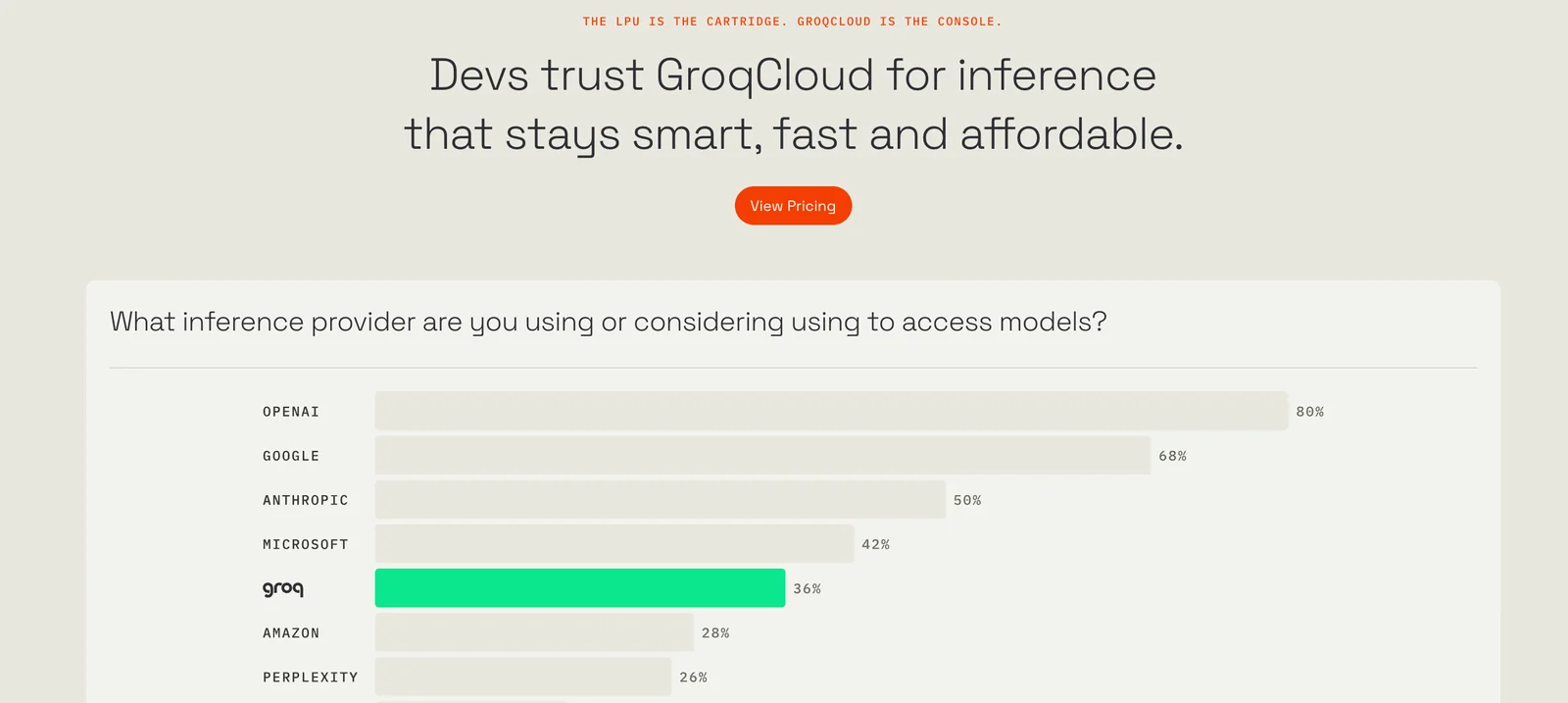
Groq distinguishes itself from other AI inference platforms through its specialized LPU (Logic Processing Unit) hardware, which delivers significantly lower latency and higher throughput. This makes Groq exceptionally suited for production-level large language model (LLM) serving and demanding high-performance computing tasks.
Key Points
- Specialized LPU Hardware: Groq's architecture is designed specifically for AI tasks.
- Superior Performance Metrics: Offers lower latency and higher throughput compared to general-purpose processors.
- Ideal for Specific Use Cases: Particularly beneficial for production LLM serving and complex computations.
Detailed Explanation
Groq's unique selling proposition lies in its specialized LPU architecture, which is engineered to optimize AI inference tasks. Traditional general-purpose processors, while versatile, often struggle with the demands of AI workloads. Groq's LPUs are purpose-built to handle parallel processing, enabling them to execute multiple operations simultaneously without compromising speed.
For example, in a use case involving large language models, Groq can significantly reduce response times, allowing for real-time applications in chatbots or virtual assistants. This capability is crucial in scenarios where milliseconds can impact user experience or system performance, such as financial trading algorithms or autonomous vehicle processing.
Additionally, Groq's platform supports high-throughput data processing, making it suitable for applications that require handling vast amounts of data quickly. Industries like healthcare, finance, and e-commerce can leverage Groq's technology to enhance their data analytics and decision-making processes.
Best Practices / Tips
- Evaluate Your Needs: Before choosing an AI inference platform, assess your specific application requirements, such as latency and throughput demands.
- Consider Scalability: Groq’s architecture allows for easy scaling, making it a future-proof choice for growing AI needs.
- Test Performance: Run benchmarks comparing Groq to other platforms for your specific use case to identify which offers the best performance metrics.
Additional Resources
Explore more AI Ai Models tools
Browse all Ai Models tools →Compare Groq: vs SWE-2 · vs Desert Ant Labs · vs Hy4 preview · vs Soup CLI