
deepseek
AIOpen SourceFreeOpen-source family of large language and multimodal models (DeepSeek-V3, R1, VL, Coder) focused on efficient MoE scaling and RL-driven reasoning.
deepseek
Open-source family of large language and multimodal models (DeepSeek-V3, R1, VL, Coder) focused on efficient MoE scaling and RL-driven reasoning.
About deepseek
DeepSeek is a research-driven suite of open-source large models and multimodal systems that includes language models (DeepSeek-V3), reasoning-focused models (DeepSeek-R1 series), code-specialized models (DeepSeek-Coder-V2) and vision-language models (DeepSeek-VL). Architecturally it leverages Mixture-of-Experts (MoE) designs and Multi-head Latent Attention (MLA) to reduce inference cost while scaling to hundreds of billions of parameters. Training includes massive pretraining (reported 14.8T tokens for V3), supervised fine-tuning and reinforcement learning stages; DeepSeek-R1 explores large-scale RL (including an RL-only variant, R1-Zero) to drive emergent chain-of-thought and self-reflection behaviors. Unique values are: open-source releases of high-performance MoE models, RL-first reasoning research, long-context and code-focused variants, and multimodal capabilities for diagrams, formulas and web pages.
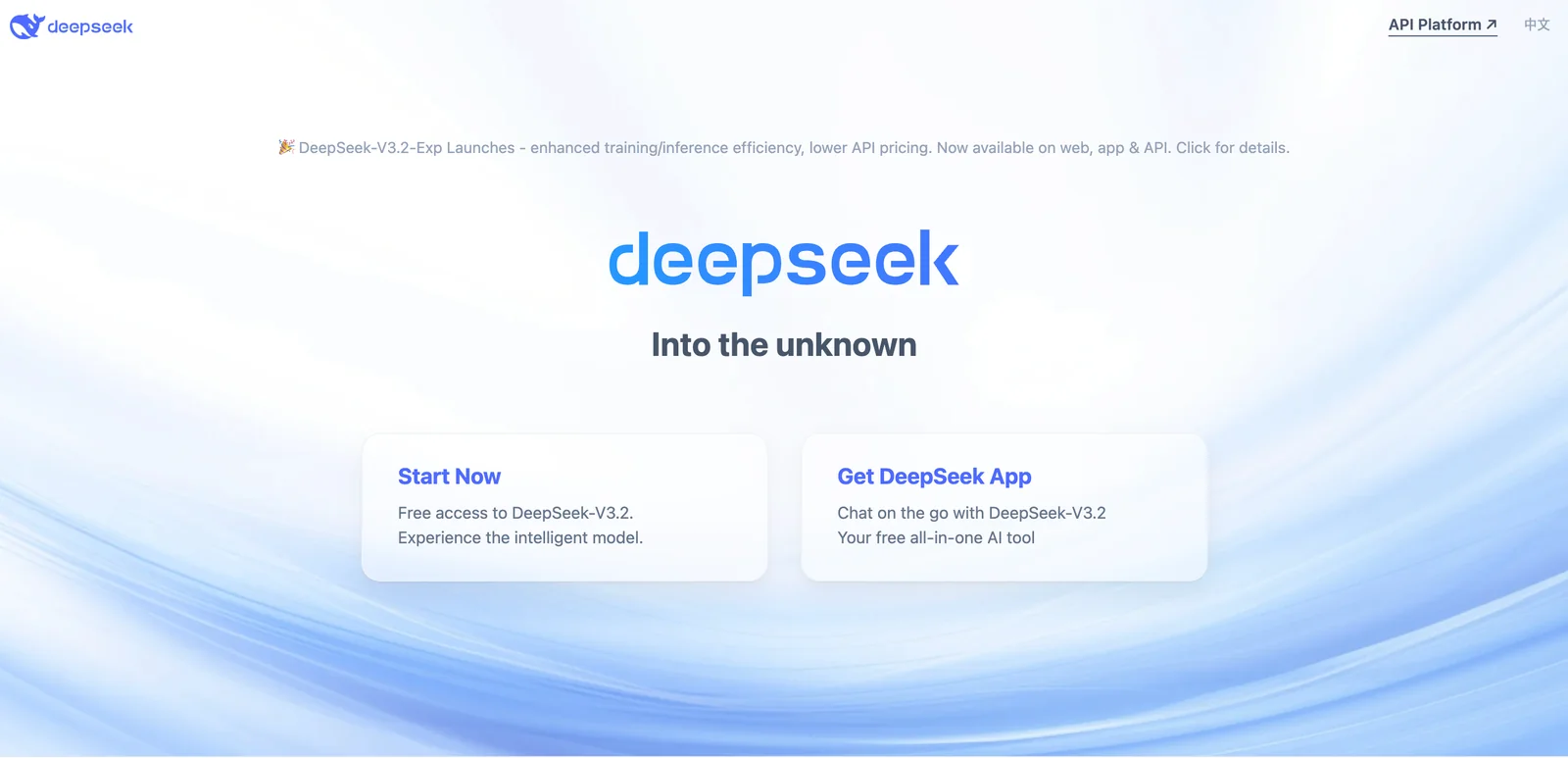
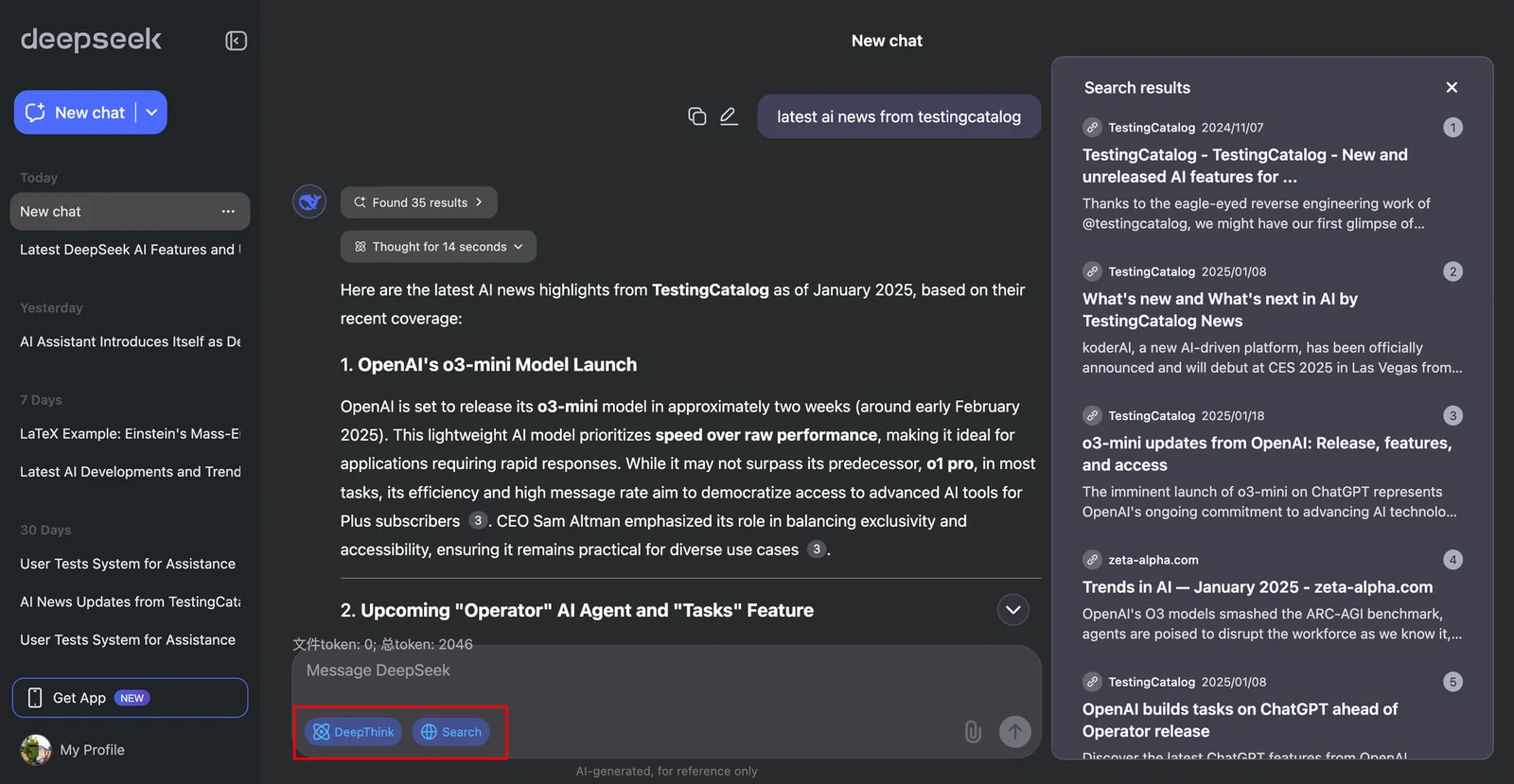
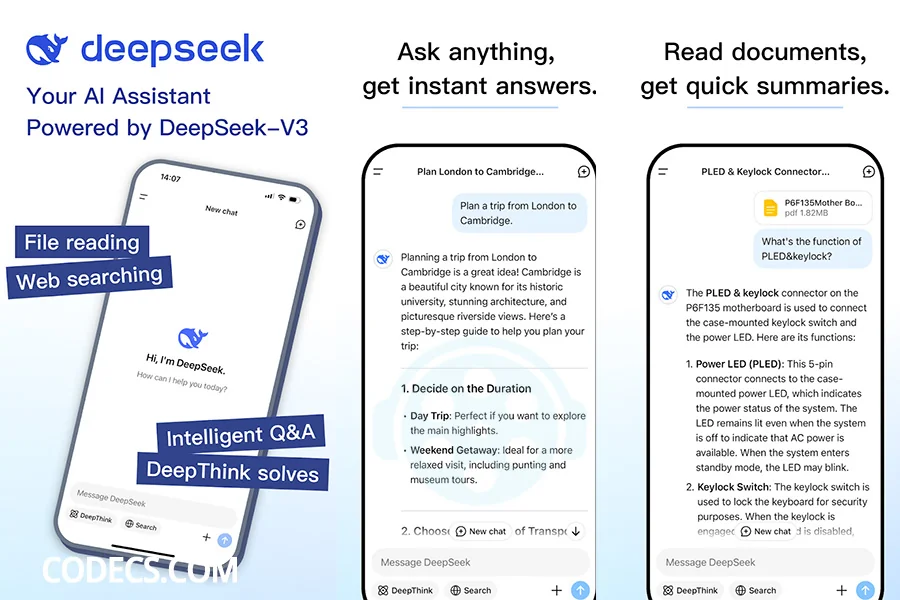
Screenshots
Key Features
Use Cases



Frequently asked questions about deepseek
What are the pricing options for DeepSeek?
DeepSeek provides flexible pricing options, including a free tier that allows users to send a limited number of daily messages. For developers, the pay-as-you-go API pricing starts at $0.27 per million input tokens, making it a cost-effective solution for various needs. Visit their website for further details.
Key Points
- Free Tier: Access to a limited number of messages daily.
- API Pricing: Pay-as-you-go model starting at $0.27 per million tokens.
- Usage Flexibility: Tailored for both casual users and developers.
Detailed Explanation
DeepSeek's pricing model is designed to accommodate a wide range of users, from casual individuals to enterprises needing robust AI solutions.
-
Free Tier: The free tier is perfect for users wanting to explore DeepSeek's capabilities without financial commitment. It typically allows a limited number of messages per day, which is ideal for personal use or trial purposes. This tier enables users to understand the platform's functionalities before deciding to upgrade.
-
Pay-as-You-Go API Pricing: For developers and businesses, DeepSeek offers a pay-as-you-go API model, starting at $0.27 per million input tokens. This pricing structure is beneficial for scaling applications as costs directly correlate with usage. For example, if a business processes 5 million tokens in a month, the cost would be approximately $1.35, providing an affordable solution for various applications such as chatbots, data analysis, and more.
-
Usage Flexibility: This pricing structure allows users to only pay for what they use, making it ideal for projects with fluctuating demands. Additionally, there are options for bulk token purchases, which can result in further savings for businesses with higher volume needs.
Best Practices / Tips
- Utilize the Free Tier: Start with the free tier to test DeepSeek's features and determine your needs before committing financially.
- Monitor Token Usage: Keep track of token usage to avoid unexpected costs. DeepSeek offers tools to help you analyze your usage patterns.
- Consider Bulk Purchases: If your application requires high token volumes, investigate bulk purchase options to reduce costs.
Additional Resources
How can I start using DeepSeek models?
To start using DeepSeek models, visit the official DeepSeek website to access the chat interface for free. You can also download model checkpoints from GitHub or Hugging Face for integration and fine-tuning, allowing for customized applications of the models.
Key Points
- Free Chat Interface: Access DeepSeek's features without any cost.
- Model Checkpoints: Download from GitHub or Hugging Face for integration.
- Fine-Tuning Options: Customize models to suit specific needs.
Detailed Explanation
DeepSeek models offer a robust platform for natural language processing and machine learning tasks. To begin using these models, follow these steps:
-
Visit the Official Website: Head to DeepSeek's official site and create an account if necessary. Here, you can engage with the chat interface, which provides interactive features for immediate use.
-
Access the Chat Interface: The chat interface allows users to explore the capabilities of DeepSeek models in real-time. This is an excellent way to understand their functionality without any initial investment.
-
Download Model Checkpoints: For those looking to implement DeepSeek models in their applications, access the model checkpoints on platforms like GitHub or Hugging Face. These repositories host various versions of the models, enabling developers to select the one that best fits their needs.
-
Fine-Tuning: Once downloaded, you can fine-tune the models to cater to your specific dataset or application. This process involves adjusting the model parameters to improve performance on particular tasks.
Best Practices / Tips
- Start Simple: Initially, use the chat interface to familiarize yourself with the model capabilities.
- Explore Documentation: Read the official documentation for detailed instructions on model integration and fine-tuning techniques.
- Test with Sample Data: Before deploying in a production environment, test the models using sample datasets to gauge performance and make necessary adjustments.
- Stay Updated: Follow DeepSeek's updates on GitHub and their website for new features, model versions, and best practices.
Additional Resources
What are the key features of DeepSeek models?
DeepSeek models are advanced AI systems that leverage Mixture-of-Experts architecture for enhanced scalability, support multimodal understanding, and provide sophisticated reasoning capabilities. Key features include extensive pretraining, open-source availability, and adaptability across diverse applications, making them ideal for various industries.
Key Points
- Mixture-of-Experts Architecture: Allows for efficient scaling and specialization.
- Multimodal Understanding: Supports processing and interpretation of multiple data types.
- Advanced Reasoning Capabilities: Facilitates complex decision-making and inference.
Detailed Explanation
DeepSeek models represent a significant advancement in artificial intelligence, primarily due to their Mixture-of-Experts architecture. This design enables the model to efficiently allocate resources, activating only the necessary components for specific tasks, which enhances processing speed and reduces computational costs. For example, when analyzing images and text together, only relevant experts are engaged, optimizing performance.
The multimodal understanding capability is another standout feature. DeepSeek models can interpret and generate content across various data types, such as text, images, audio, and video. This versatility allows businesses to implement these models in applications like customer support chatbots, content generation, and even in creative fields such as art and music production.
Moreover, DeepSeek models provide advanced reasoning capabilities. This means they can perform complex tasks that require logical deduction, such as predicting user behavior based on historical data or solving intricate mathematical problems. These features make them particularly useful in sectors like finance for risk assessment and in healthcare for diagnostic support.
Best Practices / Tips
- Utilize Pretrained Models: Take advantage of the extensive pretraining of DeepSeek models for faster deployment in your applications.
- Fine-Tuning: Customize the models on your specific datasets to enhance accuracy and relevance.
- Monitor Performance: Regularly test and evaluate the model's outputs to ensure it aligns with your business goals.
Additional Resources
How does DeepSeek's API pricing compare to competitors?
DeepSeek's API pricing is competitive, beginning at $0.27 per million input tokens for cache misses. This pricing structure offers a cost-effective alternative for large-scale text generation and reasoning tasks when compared to other models, making it a strong choice for businesses seeking efficiency and value.
Key Points
- Competitive Pricing: Starts at $0.27 per million tokens.
- Cost-Effective Solution: Ideal for large-scale operations.
- Performance Comparison: Outperforms many competitors in specific use cases.
Detailed Explanation
DeepSeek's API pricing is designed to cater to both small and large enterprises by offering a transparent and scalable model. Starting at $0.27 per million input tokens for cache misses, this price point is notably lower than many competitors, which often charge between $0.50 to $1.00 for similar services.
For instance, if a business processes 10 million tokens, using DeepSeek would cost approximately $2.70, while competitors could charge upwards of $5.00 or more. This significant cost difference can lead to substantial savings, especially for companies that rely on extensive text generation or data processing.
In terms of performance, DeepSeek not only provides cost savings but also delivers robust capabilities in generating coherent and contextually relevant text. Its efficiency makes it suitable for applications such as chatbots, content creation, and data analysis, where high performance and reliability are critical.
Best Practices / Tips
- Assess Your Needs: Evaluate your token usage patterns to determine if DeepSeek's pricing model aligns with your budget and operational requirements.
- Monitor Token Consumption: Keep track of your input tokens to optimize your costs effectively. Implement caching mechanisms to reduce cache misses and lower expenses.
- Experiment with Use Cases: Test DeepSeek across various applications to identify the most beneficial scenarios, maximizing both performance and budget efficiency.
Additional Resources
What are the technical requirements for integrating DeepSeek?
Integrating DeepSeek requires a basic understanding of API usage. You can choose to self-host the models under the MIT license or utilize their cloud API, which operates on a token-based billing system. For comprehensive guidance, refer to their official documentation.
Key Points
- API Knowledge: Basic familiarity with APIs is essential for integration.
- Hosting Options: Choose between self-hosting or using the cloud API.
- Billing Structure: Understand the token-based billing for cloud services.
Detailed Explanation
Integrating DeepSeek can be straightforward if you follow the right steps. Here’s what you need to know:
-
API Knowledge: A solid understanding of how APIs function is crucial. Familiarize yourself with RESTful API principles, as DeepSeek utilizes these for its integration.
-
Hosting Options:
- Self-Hosting: If you opt for self-hosting, ensure your server meets the necessary specifications. DeepSeek models can be run locally on your infrastructure under the MIT license, allowing for greater control and customization.
- Cloud API: For those who prefer not to manage their own servers, DeepSeek provides a cloud API option. This is ideal for businesses looking for scalability and ease of maintenance.
-
Billing Structure: Utilizing the cloud API involves a token-based billing system. Understand the pricing tiers, as costs may vary based on usage. For instance, you may need to purchase tokens that correspond to the number of API calls or data processed.
-
Documentation: DeepSeek’s documentation is a vital resource. It outlines all technical requirements, including installation guides, example API requests, and troubleshooting tips. Make sure to review the latest version for updates.
Best Practices / Tips
- Test Environment: Set up a testing environment before full integration to avoid disruptions in your production system.
- Monitor Usage: Keep track of your API usage to manage costs effectively, especially if using the cloud service.
- Stay Updated: Regularly check for updates to the API and model capabilities, as new features can enhance performance and efficiency.
Additional Resources
Explore more AI Ai Models tools
Browse all Ai Models tools →Browse by use case: Code Generation
Compare deepseek: vs Mouse-1 · vs Milliseconds.ai · vs SWE-2 · vs Desert Ant Labs