

Context.dev
AIA single REST API that turns any URL into LLM-ready markdown, crawls whole sites, and returns brand, logo, and structured company data.
Context.dev
A single REST API that turns any URL into LLM-ready markdown, crawls whole sites, and returns brand, logo, and structured company data.
About Context.dev
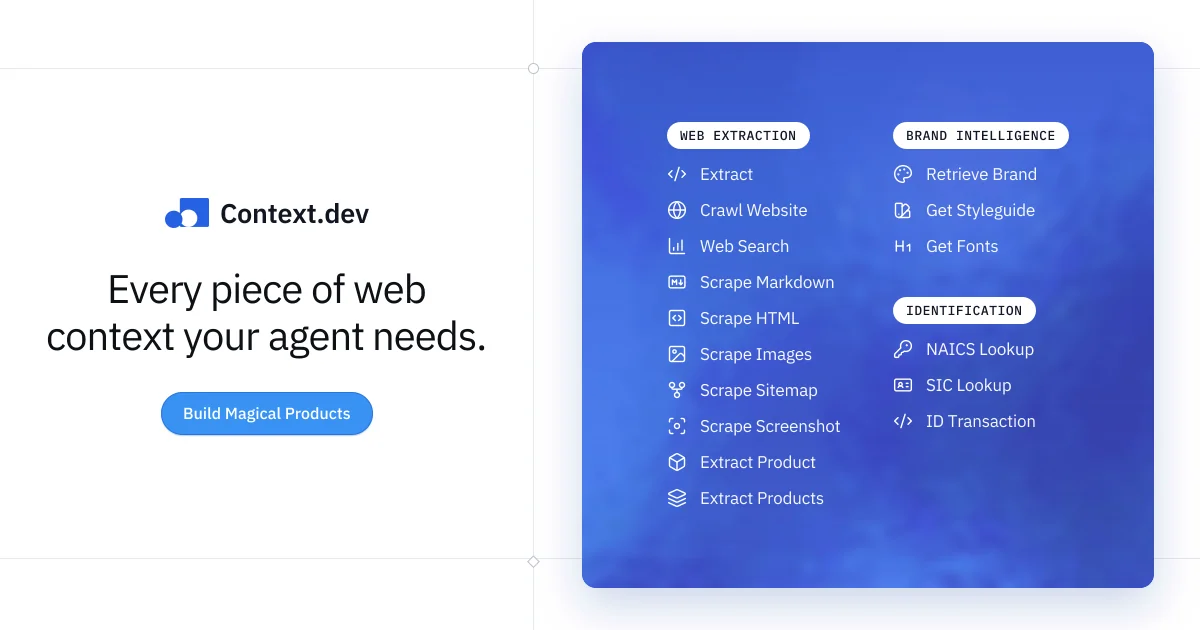
Context.dev is a web-context API that gives AI agents and LLM products live access to the web through one REST interface. It scrapes any URL into LLM-ready markdown or HTML, crawls entire sites, pulls sitemaps, screenshots, and images, and extracts structured data into a JSON schema you define. Beyond scraping, it returns brand intelligence — logos, colors, fonts, styleguides, descriptions, socials, and addresses — plus company news, people enrichment, and NAICS/SIC classification, so teams can replace several vendors with one platform. A newer /answers endpoint researches a question across the web and returns the result in the JSON shape the caller specifies, in a single call. Usage is metered in credits where a page scrape costs one credit with JS rendering, anti-bot bypass, and premium proxies included, and the service ships official SDKs for TypeScript, Python, Ruby, Go, and PHP plus an MCP server and CLI.
Screenshots
Key Features
Use Cases



Frequently asked questions about Context.dev
What is Context.dev?
A single REST API that turns any URL into LLM-ready markdown, crawls whole sites, and returns brand, logo, and structured company data.
How does Context.dev work?
Context.dev works by combining Web Scraping API: Converts any URL into markdown, HTML, raw bytes, sitemaps, screenshots, or images, with JS rendering, anti-bot bypass, and premium proxies included at one credit per page., Site Crawling: Crawls an entire domain page by page so teams can build knowledge bases or ground RAG pipelines in fresh content instead of a model's training cutoff., Schema-Based Extraction: The Extract endpoint crawls a site and returns structured data shaped to a JSON Schema you supply, removing hand-written parsers., Answers Endpoint: Takes a research task plus the JSON shape you want back, researches the web, and returns a structured answer in one API call, with a cheaper fast mode., Brand Intelligence: Retrieves logos, colors, fonts, styleguides, descriptions, socials, and addresses for a domain, powering programmatic theming and automated brand kits. to help users with Grounding AI Agents: Give an LLM agent live web access so answers reflect the current web rather than the model's training cutoff., RAG Knowledge Bases: Crawl documentation sites, academic journals, or PDFs at scale to build and refresh a retrieval corpus., Support Chatbot Ingestion: Turn a customer's whole website into the knowledge base behind an AI support bot, as SiteGPT does after migrating from a competing scraper., Automated Brand Kits and Theming: Pull a company's logo, colors, and fonts from its domain to theme an app or generate on-brand assets programmatically., Onboarding Autofill: Enrich a new signup's company profile from their email domain so onboarding forms prefill instead of asking users to type..
What are the main features of Context.dev?
Key features include Web Scraping API: Converts any URL into markdown, HTML, raw bytes, sitemaps, screenshots, or images, with JS rendering, anti-bot bypass, and premium proxies included at one credit per page., Site Crawling: Crawls an entire domain page by page so teams can build knowledge bases or ground RAG pipelines in fresh content instead of a model's training cutoff., Schema-Based Extraction: The Extract endpoint crawls a site and returns structured data shaped to a JSON Schema you supply, removing hand-written parsers., Answers Endpoint: Takes a research task plus the JSON shape you want back, researches the web, and returns a structured answer in one API call, with a cheaper fast mode., Brand Intelligence: Retrieves logos, colors, fonts, styleguides, descriptions, socials, and addresses for a domain, powering programmatic theming and automated brand kits..
Who is Context.dev for?
Context.dev is useful for anyone interested in Grounding AI Agents: Give an LLM agent live web access so answers reflect the current web rather than the model's training cutoff., RAG Knowledge Bases: Crawl documentation sites, academic journals, or PDFs at scale to build and refresh a retrieval corpus., Support Chatbot Ingestion: Turn a customer's whole website into the knowledge base behind an AI support bot, as SiteGPT does after migrating from a competing scraper., Automated Brand Kits and Theming: Pull a company's logo, colors, and fonts from its domain to theme an app or generate on-brand assets programmatically., Onboarding Autofill: Enrich a new signup's company profile from their email domain so onboarding forms prefill instead of asking users to type..
How much does Context.dev cost?
Context.dev offers a free tier with paid plans for advanced features.
How do I get started with Context.dev?
Visit https://www.context.dev/ to sign up and explore Context.dev.
Explore more AI Ai Services tools
Browse all Ai Services tools →Compare Context.dev: vs ZeroClick · vs jurniti · vs Cadenya · vs OpenObserve